
What's in this market read
- The headline range: what closing costs actually run
- Closing costs are not your down payment
- The three buckets: lender, third-party, prepaids
- Lender fees, line by line
- Third-party fees, line by line
- Prepaids and escrow, line by line
- Where closing costs go: the three-bucket split
- Closing costs by home price
- How much are closing costs on a $300k house
- Reading your Loan Estimate
- Negotiable versus fixed costs
- Seller concessions: getting the seller to pay
- No-closing-cost mortgages and the rate tradeoff
- How to lower your closing costs
- Cash to close: the full number
- Regional variation: why the same house costs more to close elsewhere
- The worked example: one $400,000 purchase, itemized
- Common closing-cost mistakes
- A closing-cost checklist
- The bottom line
Short answer: Closing costs for a buyer typically run an illustrative 2 to 5 percent of the home price, roughly $6,000 to $15,000 on a $300,000 home and $10,000 to $25,000 on a $500,000 one. They fall into three buckets, lender fees, third-party fees, and prepaids plus escrow, itemized on your Loan Estimate, and are due at closing on top of the down payment. Seller concessions and shopping title are the biggest levers.
Closing costs for a buyer typically run an illustrative 2 to 5 percent of the home price, so what closing costs buyers pay on a $300,000 home is roughly $6,000 to $15,000, itemized across lender fees, third-party services, and prepaid taxes and insurance, all due at closing on top of the down payment rather than folded into it.
Ask a first-time buyer what they are saving for and almost all of them name the down payment. Ask what closing costs are and you often get a pause, then a guess. That gap is where the final week of a purchase goes wrong: the down payment is the number everyone plans for, and closing costs are the several thousand dollars that arrive alongside it, itemized across a page of fees most buyers have never seen before the day they are asked to pay them.
This market read takes the buyer’s closing costs apart line by line: the headline range and what it works out to on real home prices, the three buckets every fee falls into, how to read the Loan Estimate that discloses them, which costs you can negotiate and which are fixed, and the levers, from seller concessions to shopping title, that lower the total. It sits alongside our down payment market read, which handles the equity side of the cash you need, and the affordability market read, which sets the price your budget supports. The affordability calculator sizes that price, and the companion below itemizes the closing costs that stack on top.
Key takeaways
- Buyer closing costs commonly run an illustrative 2 to 5 percent of the purchase price, roughly $6,000 to $15,000 on a $300,000 home and $10,000 to $25,000 on a $500,000 one.
- Closing costs are separate money from the down payment. Both come due at closing, and budgeting for only one causes the classic final-week scramble.
- Every cost falls into three buckets: lender fees, third-party fees, and prepaids plus escrow. The Loan Estimate groups them so you can read each one.
- Some costs are negotiable or shoppable, others are fixed. Seller concessions, comparing Loan Estimates, and shopping title are the biggest levers.
- Cash to close is the real number: down payment plus closing costs plus reserves, minus credits. That total, not closing costs alone, is what you bring.
The headline range: what closing costs actually run
The number worth memorizing is a range, not a figure: for buyers, closing costs commonly land somewhere around an illustrative 2 to 5 percent of the purchase price. That percentage is calculated on the price of the home, not the size of your loan, which matters because it means the bill barely shrinks when you make a larger down payment. Put 5 percent down or 20 percent down on the same house and most of your closing costs look nearly identical, since they are fees on the transaction rather than on the borrowed amount.
Translate the range into dollars and it stops being abstract. On an illustrative $300,000 home, 2 to 5 percent is roughly $6,000 to $15,000. On a $500,000 home it is roughly $10,000 to $25,000. The spread inside each range is wide because the components behave differently: lender and third-party fees are relatively predictable, while prepaid escrows and, above all, local transfer taxes swing the total hard depending on where and when you close. The honest use of the 2 to 5 percent rule is as a planning placeholder for your savings target, not a quote. The quote comes later, on a document called the Loan Estimate, which this market read reaches shortly.
Closing costs are not your down payment
The single most expensive misunderstanding in a first purchase is treating closing costs and the down payment as the same pile of money. They are not, and the lender needs both, in cash, on the same day. Our closing cost vs down payment comparison takes that exact split apart bucket by bucket, and it is the read to open if the two numbers still blur together. The down payment is your equity: the share of the price you pay so the lender finances only the remainder. Closing costs are the toll on the transaction itself, owed whether you put down 3 percent or 30. Confuse them and you arrive at closing having saved for one number while owing two.
Make the separation concrete with an illustrative case. A buyer purchasing a $400,000 home with 10 percent down owes $40,000 for the down payment. On top of that sits an illustrative 3 percent in closing costs, another $12,000, entirely separate money. The cash this buyer actually needs is $52,000 before reserves, not the $40,000 the down payment alone suggested. Our down payment market read makes the same point from the equity side, warning against draining the emergency fund to reach a rounder down payment. From the closing-cost side the warning is simpler: whatever you have earmarked for the down payment, a meaningful sum stacks on top, and it is not optional. The affordability calculator prices the home; the closing costs are the surcharge on buying it.

The three buckets: lender, third-party, prepaids
The page of fees looks chaotic on first read, but every line belongs to one of three buckets, and once you sort them the whole thing becomes legible. The first bucket is lender fees: charges the lender collects for making the loan, including origination, any discount points you choose to buy, underwriting, and processing. These are the costs most within your influence, because you choose the lender and can compare offers.
The second bucket is third-party fees: payments for outside services the lender requires but does not itself provide. The appraisal, the title search and title insurance, a survey where custom demands one, pest or other inspections, and the recording charges local government levies all sit here. Some of these you may shop for, others are set by parties you do not choose. The third bucket is prepaids and escrow, which are not fees at all but future costs collected early: a year of homeowners insurance paid upfront, several months of property tax set aside in an escrow account, and the interest that accrues between your closing day and your first mortgage payment. Sorting each line into lender, third-party, or prepaid is the single most useful habit for reading a closing statement, because it tells you instantly whether a cost is one you can influence, one you must simply accept, or one that is your own future money moving early.
Lender fees, line by line
Lender fees are where the closing bill responds to your choices, so they reward attention. The origination charge is the lender’s fee for creating and funding the loan, sometimes a flat amount and sometimes expressed as a percentage of the loan. Underwriting and processing fees cover the work of verifying your finances and assembling the file; some lenders itemize them, others roll them into a single origination line. The naming varies, which is exactly why comparing lenders on the bottom-line total matters more than arguing over any one label.
Discount points deserve their own note because they are optional and often misunderstood. A point is a fee equal to 1 percent of the loan amount, paid at closing to buy a lower interest rate for the life of the loan. Buying points raises your closing costs today in exchange for a smaller payment every month, which is a bet on how long you keep the loan: hold it long enough and the monthly savings repay the upfront cost, sell or refinance sooner and you paid for a discount you never fully used. Points are neither good nor bad in the abstract; they are a trade whose value depends on your horizon, much like the no-closing-cost structure this market read covers later. On your Loan Estimate, lender fees cluster near the top, and because you selected the lender, they are the first place to look for savings when you compare offers.
Third-party fees, line by line
Third-party fees pay for services the lender insists on but outsources, and they are a mix of the shoppable and the fixed. The appraisal is an independent estimate of the home’s value, ordered to confirm the price supports the loan, and it is commonly a few hundred dollars. Title search and title insurance protect against defects in the property’s ownership history, an unexpected lien or a flawed prior transfer, and the insurance is often one of the larger third-party lines. A survey, which maps the property’s boundaries, is customary in some regions and skipped in others.
The recording and government charges belong here too: the fees local offices collect to record the deed and mortgage in public records, plus any transfer taxes, which this market read treats separately because they vary so wildly by location. A home inspection, while technically optional and paid outside closing in many cases, is money a prudent buyer spends in the same season and belongs in the mental budget. The important distinction inside this bucket is that title-related services can often be shopped, meaning you are allowed to choose the provider and prices genuinely differ, while charges like the appraisal fee and government recording costs are effectively set. Knowing which is which tells you where effort pays off, a theme the section on lowering costs develops.
Prepaids and escrow, line by line
The third bucket confuses buyers most because the money here is not a fee at all; it is your own future expenses, collected early. Prepaid homeowners insurance is the clearest example: lenders typically require you to pay the first full year of coverage at or before closing, so a recurring bill simply arrives all at once on day one. Prepaid interest covers the stub of interest that accrues between your closing date and the start of your first regular payment, which is why closing near the end of the month reduces this line, a small timing lever worth knowing.
Escrow reserves are the other major piece. Lenders commonly collect several months of property tax and insurance upfront to seed an escrow account, the cushion from which they later pay those bills on your behalf. This is not an extra cost so much as prepositioned money: you would owe the property tax regardless, and the escrow simply requires a few months of it in advance. Because taxes and insurance premiums vary enormously by location and property, this bucket is the least predictable of the three and a major reason the 2 to 5 percent range is so wide. It is also the least worth resenting, since unlike a lender fee, escrow is your money going toward your own obligations. Recognizing that distinction keeps buyers from feeling nickel-and-dimed by what is really just their own tax bill arriving early.
Where closing costs go: the three-bucket split
Seeing the three buckets as proportions of the whole makes the closing bill intuitive rather than intimidating. The exact split shifts with your loan, your location, and the season you close in, but an illustrative division shows how the money tends to distribute across a typical purchase.
Where a buyer's closing costs go
Illustrative split of total closing costs across the three buckets.
Prepaids and escrow, your own future insurance and taxes collected early, often form the largest slice. The lender fees, the ones most within your control, are only a portion of the total, which is why shopping helps but cannot erase the bill.
The chart carries a useful lesson. Because prepaids and escrow, the bucket you cannot negotiate away because it is your own tax and insurance, so often forms the largest slice, the popular advice to aggressively haggle down lender fees, while sound, addresses only part of the picture. The lender bucket is where negotiation lives, but it is a minority of the whole. That is why the most powerful levers, as later sections argue, are seller concessions and comparing whole Loan Estimates rather than fighting over any single fee.
Closing costs by home price
Since the range is a percentage of price, the dollar figure climbs with the home, and laying several price points side by side makes the scaling clear. The bars below apply an illustrative 3 percent, a mid-range assumption, to four home prices.
Illustrative closing costs by home price
At an illustrative 3 percent of purchase price. Your real figure depends on loan, location, and timing.
At an illustrative 3 percent, closing costs scale straight with price: double the home and you roughly double the closing bill. Shift the rate to 2 or 5 percent and every bar moves proportionally.
The straight-line scaling is the point. Closing costs do not enjoy an economy of scale the way some think; a more expensive home carries proportionally more transfer tax, more title insurance, and larger prepaid escrows, so the percentage holds even as the dollars grow. This is also why the same percentage feels heavier at higher prices: 3 percent of an $800,000 home is $24,000, a sum that rivals a full down payment tier on a cheaper house. Feed your own price into the companion beside this article, or into the affordability calculator, and the dollar figure resolves for your situation.
How much are closing costs on a $300k house
The $300,000 home is the price buyers ask about most, so it is worth working the number in full. Apply the illustrative 2 to 5 percent range and closing costs on a $300k house land somewhere around $6,000 to $15,000, with a mid-range 3 percent assumption putting the planning figure near $9,000. That is money owed on top of the down payment, which at an illustrative 10 percent would be another $30,000, so the combined cash the buyer actually assembles sits closer to $39,000 before reserves rather than the $30,000 the down payment alone implied.
Sorted into the three buckets, an illustrative $9,000 on a $300k purchase might carry roughly $2,700 in lender fees, around $2,700 in third-party services like the appraisal and title insurance, and the largest slice, near $3,600, in prepaids and escrow: a year of homeowners insurance, several months of property tax, and the interest to the first payment. Move up to a $500,000 home and the same 3 percent becomes an illustrative $15,000, since closing costs scale straight with price rather than shrinking at higher tiers. Neither figure is a quote. Transfer taxes and local property-tax rates can push the real total well above or below these placeholders, which is why the Loan Estimate, not this arithmetic, sets your actual number.
Reading your Loan Estimate
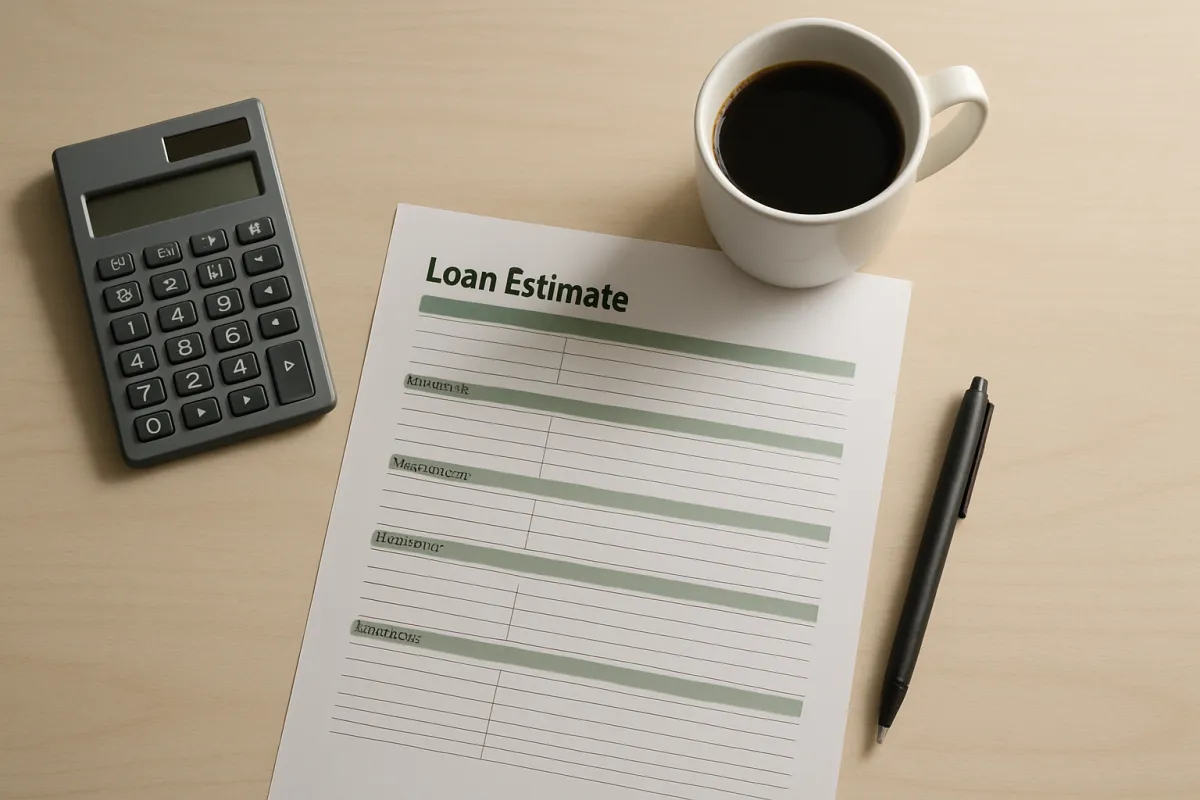
The document that turns the 2 to 5 percent guess into a real number is the Loan Estimate, a standardized form the lender must provide shortly after you apply. Its value lies in the standardization: because every lender uses the same layout, you can place two estimates beside each other and compare them line for line, which is precisely what the form was designed to enable. The estimate lays out your loan terms, the projected monthly payment, and, crucially, an itemized page of the closing costs sorted into the buckets this market read has described.
Read it in a specific order. First find the total closing costs and the separate cash-to-close figure, since those are the headline numbers. Then scan the lender fees, the bucket you can shop, and note the origination charge and any points. Next check the services you are allowed to shop for, often flagged as such, because that is where comparison between providers pays off. Finally review the prepaids and escrow, remembering that this bucket is largely your own future money and less a matter for negotiation. When you receive a second estimate from another lender, the comparison is not about which has the lowest single fee but which delivers the lowest honest total for a comparable rate. Later, just before closing, a second document called the Closing Disclosure restates the final numbers, and comparing it against the estimate is a standard, prudent check.
Negotiable versus fixed costs
Not every line on the estimate bends, and knowing which do saves effort for where it matters. The negotiable and shoppable costs cluster in the first two buckets. Lender fees, including origination and sometimes processing or underwriting charges, can vary between lenders and are fair game for comparison and, occasionally, direct negotiation. Among third-party costs, the services you are permitted to shop, title insurance and various settlement services chief among them, can differ meaningfully in price for identical coverage, so choosing the provider is a real lever.
The fixed costs are the ones set by parties you do not choose or by law. Government recording fees and transfer taxes are effectively non-negotiable; the rate is what the jurisdiction says it is. The appraisal fee is largely set, since the lender orders an independent appraisal and you pay the going rate. Prepaids and escrow are fixed in the sense that they reflect your actual taxes and insurance, which no negotiation changes, though timing your closing shifts the prepaid interest slightly. The practical takeaway is to spend your negotiating energy on the lender bucket and the shoppable third-party services, and to treat the fixed costs as a known quantity you plan around rather than fight.
Seller concessions: getting the seller to pay
One of the most effective ways to shrink the cash you bring is to have someone else cover part of the closing costs, and often that someone is the seller. A seller concession, also called a seller credit or seller-paid closing costs, is an agreement written into the purchase contract in which the seller contributes a sum toward your closing costs. It does not lower the price on paper, but it lowers the cash you need at the table, which for a stretched buyer can matter more than a small price reduction.
The concession comes with rules worth knowing. Loan programs cap how much a seller may contribute, and the cap commonly depends on your loan type and how much you put down, illustratively ranging from a few percent of the price for low-down-payment loans up to a larger share for buyers putting more down. A concession can only offset genuine closing costs, not the down payment, and it cannot exceed the costs that actually exist, so there is no pocketing the difference. Whether you can win a concession depends heavily on market conditions: in a buyer-friendly market where homes sit, sellers concede readily to keep a deal alive, while in a competitive market a concession request can weaken your offer. This is one more reason the market timing our other coverage tracks matters, and it is worth asking your agent to model an offer with a concession built in.

No-closing-cost mortgages and the rate tradeoff
The phrase no-closing-cost mortgage sells a fantasy the structure does not deliver: the costs do not vanish, they relocate. In this arrangement the lender agrees to cover your closing costs, and in exchange you accept a higher interest rate for the life of the loan, or the costs are folded into your loan balance so you finance them. Either way you pay less on closing day and more over time, which makes the label accurate only in the narrowest sense.
Whether the trade favors you hinges on the same variable that governs discount points: how long you keep the loan. A buyer who expects to move or refinance within a few years may genuinely come out ahead, since a slightly higher rate over a short stretch can cost less than several thousand dollars of upfront fees. A buyer who holds the loan for many years usually pays far more in accumulated extra interest than the closing costs would have been, making the upfront savings an expensive convenience. The structure is not a trick so much as a financing choice with a break-even point, and the honest move is to ask the lender to quote both the standard and the no-closing-cost versions and compare the total cost over your realistic holding period. Free, examined closely, usually turns out to be borrowed.
How to lower your closing costs
Several levers genuinely reduce the closing bill, and used together they add up. Shop the services you are allowed to choose, especially title insurance and settlement services, since prices for identical coverage can differ more than buyers expect. Compare Loan Estimates from at least two lenders, because origination charges and points vary and the form exists precisely to make that comparison easy; the lowest honest total, not the lowest single fee, is the target. Ask the seller for a concession, which in the right market can offset a large share of the costs outright.
Beyond those, question lender fees that sound like padding, since some processing or administrative charges are negotiable or waivable when a lender wants your business. Time the closing thoughtfully, because closing later in the month shrinks the prepaid interest collected upfront, a modest but free saving. Some buyers explore lender or agent credits, and some markets offer assistance programs that cover closing costs for eligible buyers, a category worth investigating locally just as our down payment market read suggests for the down payment itself. What none of these touch are the truly fixed costs, transfer taxes and government recording fees, so temper expectations: you are trimming the negotiable and shoppable portion, which is real but not the whole bill. A disciplined buyer who pulls every available lever can still meaningfully lower the total, and on a large purchase the savings justify the afternoon it takes.
Cash to close: the full number
The figure that matters on closing day is not closing costs and not the down payment but the sum of everything, called cash to close. It combines the down payment, the closing costs, and any required reserves or prepaid items, then subtracts the credits you have already earned or negotiated: the earnest money deposit you paid when your offer was accepted, any seller concession, and any lender credit. The result is the single amount you wire or bring, and it is the number to build your savings target around.
Assemble it illustratively. A buyer purchasing a $400,000 home with 10 percent down brings $40,000 for the down payment, roughly $12,000 in closing costs at an illustrative 3 percent, and should still hold a reserve afterward, so the cash position runs well past $52,000 once an emergency cushion is respected. Against that, an earnest money deposit already paid, say $5,000, is credited back into the total rather than paid twice, and a seller concession would reduce it further. This is the same stacking logic our down payment market read applies from the equity side and our affordability market read applies to the monthly budget: the down payment is the headline, but the real cash requirement is a stack. Size the whole stack from the start, use the affordability calculator to set the price it rests on, and the closing table holds no surprises.
Regional variation: why the same house costs more to close elsewhere
Two buyers purchasing identically priced homes in different states can face closing bills that differ by thousands, and the primary culprit is the transfer tax. A transfer tax is a charge that some states, counties, or cities impose when a property changes ownership, and the rate ranges from nothing at all in some places to a substantial percentage of the price in others. Because this tax is levied on the full purchase price, its effect on a mid-priced home can be larger than several lender fees combined, and it is entirely a function of geography rather than anything about the buyer or the loan.
Transfer taxes are the biggest regional swing, but not the only one. Local recording fees vary, title insurance practices and rates differ by state, and some markets involve an attorney in every closing while others do not, adding a legal fee that buyers elsewhere never see. Custom also dictates who pays which line: in some areas the seller traditionally covers a cost that in another area falls to the buyer, and these conventions are negotiable but often followed by default. The lesson is that a national average, including the 2 to 5 percent rule this market read opened with, is only a starting point. Your real closing costs depend on rules specific to your state, county, and even city, which is why the Loan Estimate from a local lender, not any published average, is the figure to trust.
The worked example: one $400,000 purchase, itemized
Numbers cohere when they are itemized on a single transaction, so put an illustrative buyer at the closing table for a $400,000 home with 10 percent down. The down payment is $40,000. On top of it, closing costs at an illustrative 3 percent total roughly $12,000, and here is how that $12,000 tends to distribute across the three buckets.
In the lender bucket, illustratively, an origination and underwriting charge might run around $3,600, assuming no discount points are purchased. The third-party bucket carries the appraisal at a few hundred dollars, title search and title insurance as the larger line, plus recording and any survey, together landing around $3,600 as well. The prepaids and escrow bucket, illustratively the largest, absorbs the remaining $4,800: a year of homeowners insurance paid upfront, several months of property tax seeded into escrow, and the prepaid interest to the first payment. The exact figures bend with location, especially through transfer taxes and property-tax rates, and the split will differ from this tidy illustration. Add it up and the buyer needs $40,000 for the down payment plus $12,000 in closing costs, $52,000 before reserves, against which a $5,000 earnest deposit already paid and any seller concession would credit back. That single itemized page is the whole subject of this market read made concrete, and it is exactly what your own Loan Estimate will lay out with real numbers.
Common closing-cost mistakes
The recurring errors, gathered from buyers who learned them the hard way.
- Budgeting the down payment but not closing costs. They are separate money, both due at closing. An illustrative 2 to 5 percent of price stacks on top of the down payment.
- Trusting a national average as a quote. The 2 to 5 percent rule is a placeholder. Transfer taxes and local rules can move the real figure well outside it.
- Ignoring the Loan Estimate comparison. The form is standardized so you can compare lenders. Taking the first estimate without a second leaves savings on the table.
- Assuming no-closing-cost means free. The costs move into a higher rate or the loan balance. Over a long hold, that usually costs more, not less.
- Overlooking seller concessions. In a buyer-friendly market, asking the seller to cover costs is one of the strongest levers, and many buyers never ask.
- Haggling only lender fees. They are a minority of the bill. The largest bucket is often prepaids and escrow, which negotiation does not touch.
- Forgetting reserves. Cash to close is not the end of what you need. An emergency cushion must survive the purchase, as our other coverage insists.
- Buying points without a horizon. Points and no-closing-cost structures both hinge on how long you keep the loan. Decide that first.
Each mistake traces back to seeing closing costs as a single vague number rather than an itemized, partly controllable stack.
A closing-cost checklist
Before you set your savings target, walk the sequence in order.
- Estimate the range. Apply an illustrative 2 to 5 percent to your target price for a planning figure, knowing the real number comes later.
- Get Loan Estimates. Collect at least two, compare them bucket by bucket, and judge on the honest total for a comparable rate, not any single fee.
- Sort the costs. Mark each line as lender, third-party, or prepaid so you know what you can shop, what you must accept, and what is your own money.
- Shop the shoppable. Compare title and settlement services, and question padded-looking lender fees.
- Ask for a concession. In the right market, build a seller credit into the offer with your agent.
- Size cash to close. Add the down payment, closing costs, and reserves, subtract your earnest deposit and any concession, and let the affordability calculator set the price beneath it all.
A buyer who completes this list has turned a vague dread of closing costs into a planned, itemized number, which is the entire upgrade this market read exists to deliver.
The bottom line
Buyer closing costs are not a mystery fee and not a hidden trap; they are an itemized, mostly predictable stack that runs an illustrative 2 to 5 percent of the purchase price and comes due alongside, not instead of, the down payment. Sorted into their three buckets, lender fees you can shop, third-party services you can partly shop, and prepaids that are really your own future taxes and insurance, the page of charges becomes readable, and the readable version is one you can plan for and partly lower.
The method this market read has run throughout is the same one that governs the down payment and the monthly budget: name the number, itemize it, and build your cash target around the whole stack rather than its headline. Compare Loan Estimates, ask the seller to help, weigh the no-closing-cost trade against your horizon, and remember that transfer taxes and local rules, not any national average, decide your real figure. Buyers who do that arithmetic stop being surprised at the closing table and start arriving with exactly the cash the transaction was always going to require.
Read this market read as a session with the numbers, not as financial, lending, tax, or real estate advice. Every fee, percentage, and dollar figure above is illustrative and rounded for clarity: closing costs, transfer taxes, escrow requirements, seller-concession caps, and loan-program rules all vary by location, lender, program, and the specifics of your purchase, and yours will differ. Transfer taxes and local settlement customs in particular swing the total in ways no national figure can capture, so treat your own Loan Estimate and Closing Disclosure as the authoritative numbers, and consult a qualified lender, real estate professional, or tax adviser before committing cash to a purchase.
Frequently asked questions
How much are closing costs for a buyer?
For buyers, closing costs commonly run an illustrative 2 to 5 percent of the purchase price, though the range can sit higher in areas with steep transfer taxes. On an illustrative $300,000 home that is roughly $6,000 to $15,000, and on a $500,000 home roughly $10,000 to $25,000. The wide spread exists because some costs scale with the loan while others, like local transfer taxes and prepaid escrows, vary enormously by location and timing. Treat any single percentage as a planning placeholder and get your real figure from a Loan Estimate.
What is the difference between closing costs and the down payment?
They are two separate piles of money that both come due at closing, which is why budgeting for one and forgetting the other causes a scramble in the final week. The down payment is your equity stake, the slice of the price you pay in cash so the lender only has to finance the rest. Closing costs are the transaction fees on top: lender charges, third-party services, and prepaid items like insurance and taxes. A buyer putting an illustrative 10 percent down on a $400,000 home owes $40,000 for the down payment and, separately, perhaps $8,000 to $20,000 in closing costs, for a combined cash need well beyond the down payment alone.
What do buyer closing costs actually include?
They fall into three buckets. Lender fees cover the cost of originating the loan: origination charges, discount points if you buy them, underwriting, and processing. Third-party fees pay outside services the lender requires: the appraisal, title search and title insurance, a survey in some areas, and various recording charges. Prepaids and escrow are not fees at all but future costs collected early: homeowners insurance paid a year ahead, several months of property tax set aside in escrow, and interest that accrues between closing day and your first payment. The Loan Estimate groups them so you can see each bucket clearly.
Can the seller pay my closing costs?
Often yes, through what are called seller concessions or seller credits, where the seller agrees to contribute toward your closing costs as part of the deal. Loan programs cap how much the seller may contribute, and the cap commonly varies with your loan type and down payment size, illustratively ranging from a few percent of the price up to a larger share for buyers putting more down. Concessions can only offset actual closing costs, not the down payment, and cannot exceed the costs that exist. In a buyer-friendly market this is one of the most effective ways to reduce the cash you bring, so it is worth asking your agent to build a concession into the offer.
What is a no-closing-cost mortgage, and is it a good deal?
A no-closing-cost mortgage does not erase the costs; it moves them. The lender covers your closing costs in exchange for a higher interest rate, or folds the costs into the loan balance, so you pay less today and more over the life of the loan. Whether that trade favors you depends almost entirely on how long you keep the loan. A buyer who expects to sell or refinance within a few years may come out ahead paying the higher rate briefly, while a buyer who holds the loan for many years usually pays far more in added interest than the upfront costs would have been. Run both versions before assuming free is cheap.
How can I lower my closing costs?
Start by shopping the services you are allowed to choose, since title insurance and some settlement services can vary meaningfully between providers for identical coverage. Compare Loan Estimates from more than one lender, because origination charges and points differ and the documents are standardized specifically so you can lay them side by side. Ask the seller for a concession, negotiate or question junk-sounding lender fees, and time your closing thoughtfully, since closing later in the month reduces the prepaid interest collected upfront. None of these erase the fixed costs like transfer taxes, but together they can trim a real amount from the total.
What is cash to close, and how is it different from closing costs?
Cash to close is the single number you actually wire or bring on closing day, and it is bigger than closing costs alone. It combines your down payment, your closing costs, and any required reserves or prepaid items, minus credits such as your earnest money deposit already paid and any seller concession. Closing costs are just one component of that total. The final figure appears on your Closing Disclosure, the document you receive before closing, and it should be reviewed against the earlier Loan Estimate. Budgeting for cash to close rather than closing costs in isolation is what keeps the final week free of surprises.
Do closing costs vary by location?
Significantly, and transfer taxes are the main reason. A transfer tax is a charge some states, counties, or cities levy when property changes hands, and the rate ranges from zero in some places to a substantial percentage of the price in others, which alone can swing closing costs by thousands on the same home. Recording fees, title practices, attorney involvement, and who customarily pays which line all differ by market as well. This is why two buyers purchasing identically priced homes in different states can face very different closing bills, and why a national average is only a starting point until you know your local rules.

Hamza Hai is the editor of AbodeWave. She holds an MBA and reviews the site's articles against our editorial standards, checking that every figure is labelled for what it is, that nothing is presented as verified fact without a source the reader can check, and that the writing stays useful to a non-specialist.