
What's in this market read
- What a low appraisal actually means
- Why the lender uses the lower of price and value
- The first move: read the report before you react
- Size the gap before you argue about it
- Option 1: renegotiate the price toward the value
- Option 2: cover the appraisal gap in cash
- Option 3: split the difference with the seller
- Option 4: request a reconsideration of value
- What makes a reconsideration worth filing
- Factual errors worth flagging in the report
- Option 5: use your contingency to step back
- What your appraisal contingency actually says
- How a low value moves your LTV and your PMI
- Seller concessions and the quieter ways to close a gap
- How your loan program changes the menu
- When a second appraisal is even possible
- What happens to your earnest money deposit
- Comparing the five paths on cash, payment and risk
- A worked example: one low appraisal, four paths
- What weakens your position before the number even lands
- Questions to ask your lender and your agent this week
- Common mistakes after a low appraisal
- A checklist for the week the number lands
- The bottom line
Your appraisal came in low, the email from your loan officer has a number in it that is smaller than the price on your contract, and the first honest thing to say is that this is a solvable problem with a short menu of answers. It is not a verdict on the house, it is not an accusation that you overpaid, and it does not automatically end the deal. What it does is change the arithmetic of who pays for the part of the price the loan will no longer cover.
This market read is about the decision rather than the mechanics. If you want the mechanics, how an appraiser reaches a value, what they measure, who orders and pays for the report, our home appraisal explainer covers that ground and this page will not repeat it. What follows is the five things a buyer can actually do once the number is in front of them: renegotiate the price, cover the gap in cash, split it with the seller, ask the lender for a reconsideration of value, or use a contingency to step back. Every one of them depends on what your contract says, what your lender allows and what your state’s forms provide, so treat this as a way to prepare for the conversation with your agent and lender, not as a substitute for it. Keep the affordability calculator open alongside it, because most of these paths end up being cash questions.
Key takeaways
- A low appraisal is a financing problem, not a cancellation: most lenders size the loan against the lower of price and value, so the shortfall becomes cash somebody has to cover.
- The five buyer paths are renegotiating the price, covering the gap in cash, splitting it with the seller, requesting a reconsideration of value, and using an appraisal contingency to exit.
- Renegotiating and covering the gap often produce the same loan and the same payment; the difference between them is the cash you bring to closing.
- A reconsideration of value is an evidence exercise routed through your lender, and no lender is obliged to change the number. A second appraisal is rarely available on request.
- Whether you can exit, and what happens to your deposit, is decided by your contract and your state's form, so that answer comes from your agent and attorney rather than from any article.
What a low appraisal actually means
A low appraisal means one professional’s independent opinion of market value came in beneath the price two parties negotiated. That is all it means at the moment it lands. It is not a finding that the house is defective, which is what an inspection would tell you, and it is not proof that your price was foolish. Appraisers work from recent comparable sales, and in a fast-moving market the sales that closed two months ago can trail what buyers are paying today.
The consequence is narrow but real. Lenders generally advance a percentage of the lower of the contract price and the appraised value, so the appraisal sets a ceiling on the loan. The difference between the price and that ceiling is the appraisal gap, and it is money the mortgage will not supply. On an illustrative $450,000 contract appraised at $430,000, the gap is $20,000, or about 4.4 percent of the price.
Everything that follows is a negotiation about who absorbs that $20,000: the seller, through a price cut; you, through extra cash; both of you, through a split; the appraiser, if a reconsideration moves the value; or nobody, if the deal ends. Framing it that way early keeps the conversation practical instead of emotional.
Why the lender uses the lower of price and value
The rule that drives all of this is simple and rarely negotiable: the loan-to-value ratio is calculated against the lower of the purchase price and the appraised value. The lender is not trying to referee your negotiation. It is protecting the collateral behind the loan, and it will not treat a price as evidence of value when its own independent appraisal disagrees.
That is why a low appraisal shrinks your loan even though you and the seller are perfectly happy with the price. If you planned to put 10 percent down on a $450,000 home, you were planning on a $405,000 loan. With the value at $430,000, a loan at 90 percent of value is $387,000. The lender did not reduce your down payment percentage; it applied that percentage to a smaller base.
You will hear the phrase “the lender only lends on the appraised value,” and it is close enough to be useful. What matters practically is that arguing with your loan officer about the price is wasted effort. The person whose opinion can change the number is the appraiser, through the process described further down, and the person who can change the price is the seller. Your lender is applying a policy, and our pre-approval market read explains how that policy shapes your borrowing power from the very start.

The first move: read the report before you react
Before you call the seller’s agent, get the appraisal itself. Buyers are usually entitled to a copy of the report their loan paid for, and your loan officer can tell you how and when it will be delivered. A summary email with one number in it is not enough to make a decision on, because the number is a conclusion and the case for it sits in the pages behind it.
Read three things first. The comparable sales: which homes did the appraiser use, how far away are they, how recently did they close, and are they honestly similar to the one you are buying? The adjustments: what did the appraiser add or subtract for differences in size, condition, garage, lot or finish? And the property description: square footage, bedroom and bathroom count, basement finish, age, condition rating.
You are looking for two distinct things. One is a factual error you can document, which is the strongest basis for a reconsideration. The other is a judgment you disagree with, which is much weaker ground, because judgment is exactly what an appraiser is engaged to exercise. Sorting your objections into those two piles in the first day or two will tell you honestly whether a challenge is worth the time, or whether you should move straight to negotiating the money.
Size the gap before you argue about it
The single most useful thing you can do in the first hour is put a number on the problem and on each way out of it. Buyers frequently discover the gap is smaller than the anxiety, or that the extra cash is affordable but would empty the reserves they need after closing, which is a different and more important finding.
Work with the illustrative numbers used throughout this market read. The price is $450,000, the appraised value is $430,000, and you had planned to put 10 percent down. The gap is $20,000. At 90 percent of the $430,000 value, the loan is $387,000. Hold the price and your cash for the down payment portion becomes $450,000 minus $387,000, which is $63,000, against the $45,000 you had planned. Renegotiate to the value and the same 10 percent applies to $430,000, so you bring $43,000.
Notice the loan is $387,000 on both paths, which is the point most buyers miss and the reason the payment barely moves. Every figure here is illustrative, chosen because round numbers make the shape visible. Put your own price, value, down payment and rate into the companion at the end of this page, and use the affordability calculator to check that the resulting payment still fits the budget you started with.
Illustrative cash for the down payment portion under each path
A $450,000 price appraised at $430,000, 10 percent down. Closing costs sit on top of every bar.
The loan is $387,000 on all four paths, so the bars measure cash, not payment. Illustrative figures only; confirm your own with your lender.
The chart is worth a second look because of what it does not show. There is no bar for a lower monthly payment, since the loan is identical across the paths. A low appraisal, in this shape of deal, is a cash event first. Our cash to buy a house market read covers the rest of the money you need to have ready alongside it.
Option 1: renegotiate the price toward the value
The most common resolution is also the most direct: ask the seller to reduce the price to the appraised value, or to somewhere near it. The argument writes itself, because an independent third party the seller did not choose has put a number on their home, and any other financed buyer is likely to run into the same ceiling.
Strength here comes from the market rather than from your indignation. If the listing sat for weeks, if the seller has already committed to their next purchase, or if comparable sales genuinely support the appraiser, a reduction is a reasonable ask and often a successful one. If the seller has backup offers, a buyer willing to waive the appraisal contingency waiting behind you, or the belief that a different appraiser would see it differently, expect resistance.
Make the ask through your agent, in writing, with the appraisal’s own reasoning behind it rather than a bare demand. Give the seller a path that saves face: a reduction to the value, a reduction plus a closing cost credit, or a shorter close in exchange for the cut. And decide in advance what you will do if the answer is no, because an ask you cannot follow up is just an opinion. Our seller concessions market read covers the credit side of that trade in detail.

Option 2: cover the appraisal gap in cash
The second path keeps the price where it is and closes the gap with your own money. On the running example that means bringing $63,000 for the down payment portion instead of $45,000, an extra $18,000 against your original plan, or $20,000 more than the renegotiated path would have needed.
This is the right choice more often than buyers expect, and the wrong choice more often than sellers admit. It is right when the home is genuinely hard to replace, when you have reason to believe the value is conservative rather than accurate, when you intend to stay long enough for the market to settle the argument, and, above all, when you can pay it without stripping your reserves. It is wrong when the extra cash comes out of the money you need for closing costs, moving, immediate repairs and the emergency fund that keeps an unexpected roof from becoming a crisis.
Two practical tests. First, after the extra cash, do you still have a cushion you would be comfortable with on the day you get the keys? Second, does the smaller loan push you across a mortgage insurance or rate threshold, in either direction? Run both past your loan officer before you agree to anything, and price the whole cash picture with our buyer closing costs market read rather than the down payment alone.

Option 3: split the difference with the seller
Between “you cut the price” and “I bring more cash” sits the settlement that closes a great many deals. The seller comes down part of the way, you cover the rest, and both sides walk away having conceded something. On the running numbers, a price of $440,000 puts $10,000 on each side.
Look at what that does. The loan is still $387,000, because the lender is still working from the $430,000 value. Your cash for the down payment portion becomes $440,000 minus $387,000, or $53,000, which sits neatly between the $43,000 of a full renegotiation and the $63,000 of holding the price. Your monthly payment does not change at all.
The split has a social advantage worth naming. A seller who has publicly refused to move can usually accept a partial reduction without feeling they capitulated, and a buyer who has said they cannot fund the whole gap can usually find half of it. Deals that stall on principle often restart on a number that lets both sides claim they held their ground. Your agent will know whether the seller’s position is a bargaining stance or a genuine floor, which is one more reason the choice of agent matters, as our agent selection market read sets out.
Option 4: request a reconsideration of value
A reconsideration of value is a formal request, filed through your lender rather than sent to the appraiser directly, asking for the report to be reviewed in light of specific information. Appraiser independence rules exist to keep interested parties from leaning on the appraiser, so the lender controls the channel and the tone stays factual.
What a reconsideration is not: an appeal because the number disappoints you, a complaint about the appraiser, or a request to consider how much you want the house. Those go nowhere and can burn goodwill you may need later. What it can be is a documented case that specific, recent, genuinely comparable sales were available and not used, or that the report contains a factual error about the property.
Many lenders maintain a written process for handling these requests, including what evidence they will forward and how long it takes. Ask your loan officer what theirs is, because the answer varies by lender and by loan program, and a request that does not follow their process may simply not be considered. Be clear-eyed about the odds too: the appraiser may review the material and leave the value exactly where it was, and no lender is obliged to adopt your view. Meanwhile the clock on your contract keeps running, so run this path in parallel with a negotiation rather than instead of one.
What makes a reconsideration worth filing
The difference between a request that gets read seriously and one that gets filed away is evidence. A few characteristics separate them.
- Recent closings, not listings. An active listing shows what somebody hopes to get. A closed sale shows what somebody paid, and closed sales are the currency appraisers work in.
- Genuine proximity and similarity. A comp two streets away in the same school attendance area and the same style carries weight. One from across a major road, in a different subdivision, does not, however similar the floor plan.
- A clear reason it was missed. New closings that recorded after the appraiser pulled data, or a sale that closed off market, are believable omissions. A comp the appraiser considered and rejected in writing is not.
- Factual corrections with documentation. A survey, a permit, a floor plan or a tax record beats an assertion about square footage every time.
- A short, unemotional presentation. Two or three strong comps with addresses, closing dates, prices and one line each on why they fit. Nothing about your feelings, your rate lock or your moving date.
- Your agent’s fingerprints on it. Agents pull comparable sales for a living and know which nearby sales an out-of-area appraiser might not weight correctly.
Assemble that in a day or two if you are going to do it at all. A reconsideration filed a week before closing is a different and much worse conversation than one filed the day after the report lands.
Factual errors worth flagging in the report
Errors of fact are the strongest ground you have, because correcting them does not ask the appraiser to change an opinion, only to fix a description. They are also more common than you would guess, particularly on homes that have been altered over the years.
Check the gross living area against a survey, floor plan or listing measurement, and understand that finished basement space is usually treated differently from above-grade area rather than simply added to it. Check the bedroom and bathroom count, including whether a room the seller markets as a bedroom actually qualifies under local convention. Check the garage, the lot size, the year built and the condition rating. Check whether recent permitted work, a new roof, a replaced system, a renovated kitchen, appears anywhere in the report.
If the appraiser never entered the home, and some assignments are drive-by, desktop or hybrid products, the risk of a description error rises. Ask your lender what type of report was completed.
Present corrections as corrections. “The county record shows 2,180 square feet and the report says 1,960; the survey is attached” is a sentence a lender can act on. “The appraiser clearly did not appreciate the quality of the finishes” is not. Our home appraisal explainer describes what appraisers record on site, which is useful background for reading the description section closely.
Option 5: use your contingency to step back
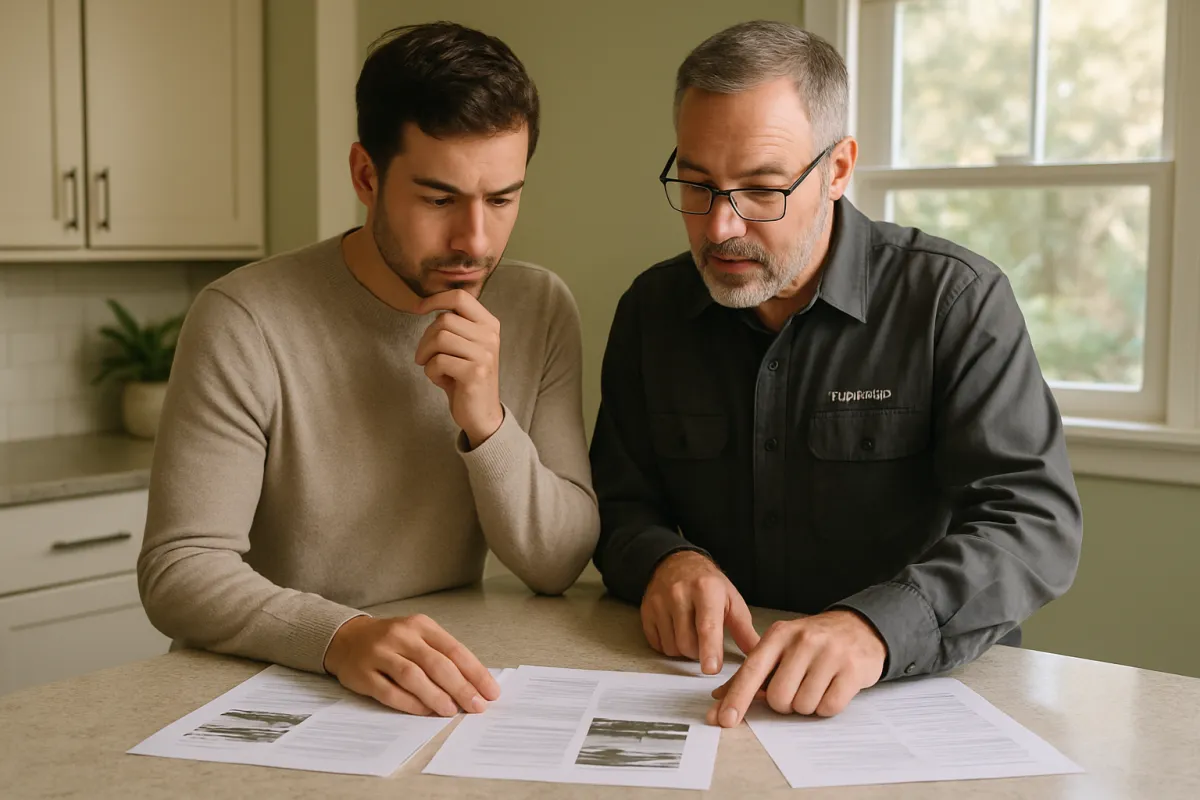
The fifth path is leaving. If your contract contains an appraisal contingency and you are inside its window, that clause is the mechanism through which a buyer can typically renegotiate or terminate when the value comes in below the price. It exists precisely for this moment.
Two cautions that matter more than anything else on this page. First, the existence and wording of an appraisal contingency is a matter of your specific contract and your state’s form, not a universal right. Some contracts have one, some have a modified version that only permits renegotiation, some have a partial gap clause, and some buyers waived it to win the deal. Second, whether stepping back returns your deposit, and what steps and signatures that involves, is decided by that contract, by the escrow instructions and by your state’s practice.
So the honest instruction is procedural rather than substantive. Get your agent to read the clause with you, identify the exact deadline and the exact notice it requires, and if the deposit is large enough to matter, involve a real estate attorney licensed where the property sits. Deadlines in these clauses are usually strict, and a right you failed to exercise on time is often no different from a right you never had. Our contingencies market read explains how the appraisal contingency sits alongside the inspection and financing clauses.
What your appraisal contingency actually says
Buyers tend to remember that they “have an appraisal contingency” without remembering what version they signed. The variations change your options materially.
A straight appraisal contingency typically conditions the purchase on the property appraising at or above a stated figure, often the contract price, and gives the buyer a defined window to act if it does not. A renegotiation-only version may require the parties to attempt an agreement before any termination right arises. A partial gap or appraisal gap coverage clause commits the buyer to cover a stated amount of any shortfall, so a $10,000 clause on a $20,000 gap leaves you exposed to half of it and protected on the rest. A full waiver removes the protection entirely.
Three details decide how these work in practice: the trigger, the deadline and the notice. The trigger is what value threshold activates the clause. The deadline is how many days after the report, or after a fixed contract date, you have to act. The notice is what you must deliver, to whom, and in what form.
Get those three answers in writing from your agent on the day the appraisal lands. And read the version you signed rather than the version you remember, because the difference between them is where deposits are lost.
How a low value moves your LTV and your PMI
Beyond the cash, a low appraisal can shift you across a threshold that has nothing to do with the gap itself. The loan-to-value ratio is measured against the lower figure, so a value below the price quietly raises your effective LTV even when your dollar down payment has not changed.
The clearest illustration is the 20 percent line on a conventional loan. Suppose you had planned to put exactly 20 percent down on the $450,000 price, or $90,000, expecting a $360,000 loan and no private mortgage insurance. With the value at $430,000, that same $360,000 loan is about 83.7 percent of value, which is above the 80 percent line. To reach 80 percent of $430,000 you would need the loan down to $344,000, which means bringing $106,000 rather than $90,000, an extra $16,000.
That is a real cost the gap arithmetic alone does not show, and it can flip the ranking of your options: renegotiating the price to the value restores the 20 percent position, while covering the gap may not. It cuts the other way too, since a smaller loan sometimes lands you in a better pricing tier. Ask your loan officer to quote both paths with mortgage insurance included, and read our PMI market read for how that premium is sized.
Illustrative sources of the $450,000 price if you hold the price and cover the gap
Loan sized at 90 percent of the $430,000 appraised value. Shares sum to 100.
The 4 percent slice is the whole argument. Illustrative figures; your own split depends on your price, value, down payment and program.
The stack makes the proportions honest. A gap that dominates a week of your life is a small slice of the purchase, which is an argument both for not panicking and for not overpaying to end the discomfort.
Seller concessions and the quieter ways to close a gap
Price is not the only lever, and sometimes it is not the easiest one for a seller to pull. A seller who has told the neighbourhood what they are getting, or who has a second lien to clear, may resist a headline reduction while being quite willing to help in other ways.
A closing cost credit leaves the contract price intact while handing you money at the table, which can free up cash you then redirect toward the gap. A rate buydown paid by the seller lowers your payment rather than your price. Agreeing to leave appliances, pay for a repair the inspection found, or cover a home warranty all shift real dollars without touching the number on the contract.
Two limits keep this honest. Loan programs cap how much a seller can contribute toward the buyer’s costs, and those caps vary by program and by your down payment, so your lender has to confirm what your file can accept before you agree. And concessions do not reduce the appraisal gap directly, because the loan is still sized against the value; they only make the cash easier to find. Our seller concessions market read covers how the caps and the mechanics work.
How your loan program changes the menu
The five options are not equally available on every loan, and the program you chose before any of this happened quietly shapes what you can do now.
On a conventional loan, the lender sizes the loan against the lower of price and value and the contingency in your contract governs your exit. On government-backed programs, additional program-level protections and procedures may apply, and the appraisal itself can carry conditions about the property’s condition that a conventional appraisal would not. Government-backed appraisals also tend to stay attached to the property for a period, which matters if the deal falls apart and the seller relists.
Rather than assert program rules that change, treat this as a set of questions for your loan officer: does my program have its own remedy when the value comes in short, does the appraisal stay with the property if we terminate, what does my program allow in seller contributions, and does the smaller loan change my mortgage insurance or funding fee position? Get the answers in writing. Our coverage of FHA loans and VA loans sets out how those programs work generally, and your lender applies the current version to your file.
When a second appraisal is even possible
This is the hope buyers reach for first and the one that most often disappoints. A second appraisal is not something a buyer can order because the first one was unwelcome. The whole architecture of appraisal ordering, with independent assignment and rules against influence, exists to prevent value shopping.
There are narrow circumstances in which a second look happens. A lender’s own review process may find the report deficient and require corrections or a new assignment. Some loan programs and investor guidelines provide for a second appraisal in defined situations. And moving the file to a different lender does produce a new appraisal, because the new lender orders its own, but that is a decision with consequences: a second appraisal fee, a restart of underwriting, a possible loss of your rate lock, pressure on your closing date, and no assurance the new number will be higher. It may be lower.
The realistic sequence is to exhaust the reconsideration process with the lender you have, negotiate in parallel, and treat a lender change as a last resort you take with your eyes open. Ask your loan officer directly what their written policy permits before you build a plan around a second opinion.
What happens to your earnest money deposit
Buyers ask this question first and it deserves a careful answer rather than a confident one. Your earnest money is held under the terms of your contract and the escrow instructions, and what happens to it when a purchase ends is determined by those documents and by the law and practice of the state where the property sits.
What can be said generally is how the pieces relate. A properly exercised contingency, within its deadline and with the notice the contract requires, is the mechanism contracts use to address a buyer’s exit. A missed deadline, a waived contingency or a termination for a reason the contract does not cover puts you in a different position. Release of funds from escrow usually needs the agreement of both parties or a defined process, so even a clear entitlement can involve paperwork and time.
What cannot be said from here is what your deposit will do, because the answer is written in your file, not in this market read. Take the contract to your agent the same day, and to a real estate attorney if the sum is material to you. Our earnest money market read explains how the deposit differs from the down payment and where it goes at closing.
Comparing the five paths on cash, payment and risk
Laid side by side, the options sort themselves by what they cost you and what they require from someone else.
| Path | Cash effect | Payment effect | Depends on |
|---|---|---|---|
| Renegotiate to value | Lowest cash, $43,000 illustrative | Unchanged, loan still $387,000 | Seller agreeing |
| Cover the gap | Highest cash, $63,000 illustrative | Unchanged, loan still $387,000 | Your reserves |
| Split the difference | Middle, $53,000 illustrative | Unchanged, loan still $387,000 | Both sides moving |
| Reconsideration of value | Could remove the gap entirely | Rises if the value and loan rise | Evidence and lender process |
| Use the contingency | Recovers nothing already spent | None, no purchase | Contract, deadline, notice |
Two patterns are worth pulling out. The first three paths produce the same loan and the same monthly payment on these numbers, so they are pure cash decisions and can be compared with a single figure. The fourth is the only one that can make the gap vanish rather than reallocate it, which is why it is worth a fast, evidence-led attempt even when the odds are modest.
The fifth is the one people rank emotionally rather than financially. Leaving costs you the appraisal fee, the inspection you paid for and the time, and it also returns you to a market where the next house may have its own problems. It is the right answer when the gap is unaffordable or the seller is immovable, and it should be a decision rather than a reflex.
A worked example: one low appraisal, four paths
Take a single deal through all of it. The contract price is $450,000, the plan was 10 percent down, or $45,000, on a 30 year loan at an illustrative 6.5 percent. The appraisal arrives at $430,000, leaving a $20,000 gap.
The lender confirms it will lend 90 percent of the $430,000 value, so the loan is $387,000 in every scenario where the purchase proceeds. At the illustrative rate that is roughly $2,446 a month in principal and interest, before taxes, insurance, any mortgage insurance and any association dues.
Path one, the seller reduces to $430,000. You bring $43,000 for the down payment portion, $2,000 less than you had planned, and your payment is about $2,446. Path two, you hold the price and cover the gap. You bring $63,000, which is $18,000 more than planned and $20,000 more than path one, and your payment is still about $2,446. Path three, you meet at $440,000. You bring $53,000 and your payment is, again, about $2,446. Path four, the agent finds two closings from the past three weeks that the report did not use, files a reconsideration through the lender, and the value is either revised or it is not. If it moves to the price, the gap disappears and the loan resizes upward, along with the payment.
Every figure here is illustrative and rounded. Put your own numbers in the companion below, and check the resulting payment against the affordability calculator.
What weakens your position before the number even lands
Some of what decides your options was settled weeks earlier, when you wrote the offer. Knowing which choices narrow the menu is useful the next time you compete for a house.
Waiving the appraisal contingency is the largest. It removes the defined exit and hands the seller certainty, which is exactly why it wins offers. Agreeing to gap coverage of a stated amount is a smaller version of the same trade, and it is measurable, which makes it easier to size against your reserves. Stretching the down payment to the last dollar leaves nothing to cover a gap with, so a buyer with no cushion has fewer paths than one who kept a reserve. A very short closing window compresses the time you would need for a reconsideration.
None of these are mistakes on their own; they are prices paid for competitiveness, and our bidding war market read covers when they are worth paying. The mistake is paying them without deciding in advance what you would do if the appraisal came in low. Write the offer with a number in mind for the gap you could absorb, and the day the report arrives becomes a decision rather than a shock. Our offer market read walks the terms where these choices are made.
Questions to ask your lender and your agent this week
The fastest route from surprise to decision is a short list of specific questions asked of the two people who can answer them.
For your loan officer: what exactly is the appraised value and when will I get the full report? What loan amount does the value support at my down payment? Does the smaller loan change my mortgage insurance, my rate tier or my program eligibility? What is your written reconsideration of value process and what evidence will you forward? Are there circumstances in which a second appraisal would be ordered on this file? How much of a seller contribution can my program accept?
For your agent: what does my appraisal contingency actually say, what is the deadline, and what notice does it require? How strong is the case that the comps used were the right ones? What is your read on the seller’s position and their alternatives? What would you ask for, and what do you expect them to accept?
And for both: what happens to my timeline if we spend a week on a reconsideration? Getting these answers in writing, in the first few days, is worth more than any amount of reading, because they turn general possibilities into your actual menu.
Common mistakes after a low appraisal
The errors cluster, and most of them come from reacting to the number instead of working the problem.
- Treating the value as a verdict on the house. It is an opinion about price formed from comparable sales, not a finding about the property’s condition. The inspection answers the condition question.
- Calling the appraiser. Independence rules route everything through the lender. Direct contact achieves nothing and can complicate the file.
- Filing a reconsideration with no evidence. Disagreement is not a case. Two strong recent comps or a documented factual error is.
- Emptying the reserves to hold the price. Closing with nothing behind you turns the first unexpected repair into a crisis. The cushion is part of the affordability question.
- Missing the contingency deadline while negotiating. Contract clocks do not pause for conversations. Diary the date the day the report arrives.
- Assuming a different lender means a better number. A new lender orders a new appraisal, with a new fee, a restarted file, and no promise the value moves your way.
- Deciding alone. Your agent, your loan officer and, where deposits or deadlines are in play, an attorney each hold a piece of the answer.
Underneath all of them sits the same habit: treating a routine financing event as a personal setback and making a rushed decision to end the discomfort.
A checklist for the week the number lands
A compact sequence keeps the week orderly.
- Get the full report, not the summary. Ask your loan officer for the document and read the comps, the adjustments and the property description.
- Write down the gap and the cash on each path. The price minus the loan the value supports, on the hold, split and renegotiate versions.
- Find the contingency, the deadline and the notice. Have your agent confirm all three in writing and put the date in your calendar.
- Sort your objections into facts and opinions. Facts may support a reconsideration; opinions almost never do.
- Ask the lender the mortgage insurance question. Confirm whether the smaller loan moves you across a threshold in either direction.
- Make the ask through your agent. A written, evidence-backed request to the seller, with a fallback you have already decided on.
- Test the cash against the rest of your money. Closing costs, moving, immediate repairs and reserves, not the down payment alone. The affordability calculator and our closing costs market read are the two checks worth running.
- Decide, then act inside the deadline. A decision made on day nine of a ten day window is worth more than a better one made on day eleven.
Buyers who work this list tend to reach a resolution in days rather than weeks, and to reach it with their reserves intact.
The bottom line
When the appraisal came in low, one thing changed: the loan is now sized against the appraised value rather than the price, and the difference is cash the mortgage will not supply. The five ways through are asking the seller to reduce the price, covering the gap yourself, splitting it, asking your lender for a reconsideration of value backed by real evidence, or using an appraisal contingency to step back if your contract gives you one and the deadline has not passed.
The arithmetic is friendlier than the feeling. On the illustrative $450,000 purchase appraised at $430,000, the loan is $387,000 on every path that closes, so renegotiating, splitting and covering the gap differ by cash alone, from $43,000 to $63,000 for the down payment portion, with the payment near $2,446 throughout. What genuinely varies is your mortgage insurance position, your reserves after closing and the seller’s willingness to move.
What no article can tell you is whether your contract lets you exit, what happens to your deposit, whether your lender will forward a reconsideration, or whether a second appraisal is available on your file. Those answers live with your agent, your loan officer and, where the money or the deadlines are serious, a real estate attorney in your state. Size your own version in the companion below, check the payment against the affordability calculator, and read the home appraisal explainer if you want the mechanics behind the number. Then make the call inside your deadline, with your reserves in view.
Treat this market read as general, plain-language background for a conversation with your own professionals, not as legal, financial, mortgage, tax or appraisal advice. Every price, value, gap, loan amount, rate, payment and percentage above was chosen to illustrate the arithmetic and is not a quote, a market figure or a prediction. Contingency rights, notice requirements, deadlines, deposit handling, reconsideration of value procedures, second appraisal availability, seller contribution limits and mortgage insurance rules all differ by contract, lender, loan program and state form, and they change over time. Read the documents you actually signed, ask your lender for its own written policies, and confirm anything affecting your money, your deposit or your contract with your real estate agent, your loan officer or a licensed attorney in your state before you act.
Frequently asked questions
What does it mean when the appraisal came in low?
It means the appraiser's opinion of the home's market value landed below the price you and the seller agreed to. That matters because most lenders size the loan against the lower of the contract price and the appraised value, so the shortfall, usually called the appraisal gap, is money the lender will not finance. On an illustrative $450,000 price appraised at $430,000, the gap is $20,000. Nothing about a low appraisal cancels your contract by itself, and nothing about it forces the seller to move. It changes one thing: how much of the price the loan can cover, and therefore how much cash somebody has to find. Who finds that cash is the negotiation that follows, and your agent and lender are the two people who should shape it.
What are my options if the appraisal comes in low?
Buyers generally look at five paths, and which ones are actually open to you depends on your contract, your lender and your state's forms. You can ask the seller to lower the price toward the appraised value; you can hold the price and cover the gap in cash on top of your down payment; you can split the difference so both sides absorb part of it; you can ask your lender about a reconsideration of value, which is an evidence-based request to review the report; or you can use an appraisal contingency, if your contract has one and its deadline has not passed, to step back from the purchase. Most deals end up as some blend of the first three. None of the five is automatic, so read your own contract with your agent before you pick.
Can I get a second appraisal if the first one comes in low?
Not on request, as a rule. Lenders order appraisals through an independent process precisely so the parties cannot shop for a better number, and most will not commission a second report simply because a buyer or seller dislikes the first. A second appraisal is more likely to be discussed when the lender's own review finds a material problem with the report, when the loan program or investor rules provide for one, or when the file moves to a different lender, which starts a fresh appraisal at a fresh cost with no promise of a different result. Switching lenders also restarts underwriting and can put your closing date at risk. Ask your loan officer what their written policy allows before you assume a second look is available.
Will the seller lower the price after a low appraisal?
Sometimes, and their willingness usually depends on how replaceable you are. A seller with several backup offers and a hot market behind them has little reason to cut, because they may believe the next buyer will pay the same price and appraise better. A seller who has already bought their next home, whose listing has sat, or who knows the low value is likely to repeat with any financed buyer, has real reason to move. The appraisal is useful leverage because it is an independent opinion rather than your own argument about price. Your agent is the right person to judge the seller's position and to make the ask. There is no rule that obliges a seller to reduce the price, so treat a reduction as something you negotiate.
What is a reconsideration of value and does it work?
A reconsideration of value is a formal request, submitted through the lender, asking the appraiser to review the report in light of specific information. It is an evidence exercise, not an appeal on the grounds that you dislike the number. The requests with any real chance supply recent, genuinely comparable sales the appraiser appears not to have used, or point to factual errors such as a wrong square footage, a missed bedroom, an omitted finished basement or unrecorded permitted work. Appraiser independence rules exist to keep pressure off the appraiser, so the tone stays factual and the lender controls the channel. Many lenders maintain a written process for this; ask yours what theirs is. The value may not change at all, and no lender is obliged to adopt your view.
Do I lose my earnest money if I walk away after a low appraisal?
That depends entirely on your contract, and it is the wrong question to answer from a web page. Many purchase contracts include an appraisal contingency that gives the buyer a defined right to renegotiate or terminate within a stated window if the value comes in below the price, and where that contingency applies and the deadline has been met, the deposit is typically addressed by the contract's own terms. Where the contingency was waived, has expired, or was written differently on your state's form, the answer can be very different. Release of an earnest money deposit also usually involves the seller, the escrow holder and sometimes a written agreement between the parties. Ask your agent and, if the amount matters to you, a real estate attorney in your state before you give notice.
Does a low appraisal change my monthly payment?
Often less than buyers expect, because the loan is usually sized as a percentage of the lower figure either way. On an illustrative $450,000 price appraised at $430,000 with 10 percent down, a loan at 90 percent of the $430,000 value is $387,000 whether the seller reduces the price to the value or you hold the price and cover the gap in cash. The payment is the same on both paths; what differs is the cash you bring to closing. Where the payment does move is when the smaller loan changes your mortgage insurance position, your rate tier or your loan program. So the honest framing is that a low appraisal is mostly a cash problem, sometimes a mortgage insurance problem, and only occasionally a payment problem.
Should I waive the appraisal contingency to win the house?
Waiving can make an offer more competitive, and it also removes the protection that gives you a defined way out if the value lands short. The decision is a cash question before it is a strategy question: if you waive, you are telling the seller you can close at the agreed price even if the appraisal disagrees, so you need to know what size gap you could actually cover and still afford your closing costs and reserves. Some buyers cap the exposure with a partial gap clause rather than a full waiver, agreeing to cover a stated amount. Because the wording of these clauses controls what happens later, and it varies by state form and by brokerage, have your agent and, where appropriate, an attorney review the exact language before you sign.

Hamza Hai is the editor of AbodeWave. She holds an MBA and reviews the site's articles against our editorial standards, checking that every figure is labelled for what it is, that nothing is presented as verified fact without a source the reader can check, and that the writing stays useful to a non-specialist.