
What's in this market read
- What a real estate contingency actually is
- The three parts of every contingency
- The inspection or due diligence contingency
- The financing contingency
- The appraisal contingency
- When the appraisal comes in under the contract price
- The title contingency
- The sale of existing home contingency
- The insurance and survey contingencies
- Contingencies for condos, HOAs and new construction
- How contract deadlines are counted
- Why a missed deadline can silently waive your protection
- The notice and cure process
- How earnest money is released or forfeited
- Waiving a contingency is a transfer of risk
- What each waiver actually puts at stake
- Softer alternatives to a full waiver
- What each waiver could cost in dollars
- Where your cash sits when a contingency fails
- The worked example from offer to closing
- Common mistakes buyers make with contingencies
- Questions to ask before you sign
- Your contingency checklist
- The bottom line
Two buyers can write the same price on the same house and end up in completely different positions, and the difference is almost never the number. It is the set of conditions attached to it. Contingencies are the clauses that decide whether you can walk away from a contract with your deposit intact, or whether you are committed to a house you have not inspected, at a price no appraiser will support, with a loan that has not been approved.
This market note takes contingencies apart in plain terms: what a contingency actually is, each of the major ones and the deadline that governs it, how those deadlines are counted, what happens when the appraisal lands under the contract price, how earnest money is released or fought over, and the part buyers most need before a competitive weekend, which is what a waiver genuinely costs you. It sits alongside our offer walkthrough, our inspection checklist, and our appraisal explainer. The companion beside this note reprices the deposit, the appraisal gap, and the cash at stake for your own contract.
Key takeaways
- A contingency is a condition in the contract: if it is not satisfied and you follow the contract's procedure in time, you can cancel and normally recover your earnest money.
- Every contingency has its own separate clock, and a missed deadline can waive the protection silently, with no warning from anyone.
- Waiving a contingency does not remove a risk, it transfers that risk to you. Waiving the appraisal contingency means covering the shortfall in cash.
- Contingency exits usually run through a written notice, and many are structured as a notice and cure sequence rather than a straight cancellation.
- Contract terms, default windows, and deposit dispute procedures differ by state and by the form your market uses, so your own executed contract is the only authority.
What a real estate contingency actually is
Strip away the legal phrasing and a contingency is a simple bargain. You are agreeing to buy the house, but only if a specific thing turns out to be true. If it does not turn out to be true, and you say so in the way the contract requires, before the date the contract sets, you get to leave and your deposit comes back to you.
That structure is why contingencies are worth understanding as a category rather than as a list of clauses. They are not benefits a seller hands out. They are the mechanism that converts an offer from an unconditional promise into a conditional one, and every condition you remove moves the contract closer to unconditional.
The wording that creates each condition comes from the purchase contract, and in most markets that contract is a standard form produced by a state or local association or drafted by counsel. Those forms differ meaningfully. A window that is filled in as a default in one state may not exist as a default in another, and the procedure for cancelling can differ even between neighbouring markets. Nothing in this note overrides the document you sign.
The practical consequence is that you should read the contingency section of your own contract before you sign it, with your agent, and where it is customary in your market, with a real estate attorney. That is not a formality. It is where you learn what your exits actually are.

The three parts of every contingency
Once you see the pattern, every contingency in a purchase contract reads the same way. There is a condition, a deadline, and a procedure. Miss any one of the three and the clause does not help you.
The condition is the thing that has to be satisfied: an inspection you find acceptable, a loan approval, an appraisal at or above a stated value, a title free of objections you cannot live with. Conditions vary in how objective they are. Some are close to absolute, such as whether a lender issued a denial. Others are written to give the buyer wide discretion, such as a due diligence period where the buyer may cancel for any reason or no reason at all.
The deadline is the date, and often the time of day, by which the condition must be satisfied or the buyer must act. Deadlines are the part buyers underestimate most, because they arrive while you are busy scheduling contractors and chasing documents.
The procedure is what you actually have to do. Almost always it involves delivering written notice to the seller or the seller’s agent, in a form and by a delivery method the contract specifies. A phone call to your agent is not notice. An email may or may not be, depending on what the contract says about delivery. This is the quiet trap: buyers who had a valid reason to cancel and lost the protection because they told the wrong person, in the wrong way, or a day late.
The inspection or due diligence contingency
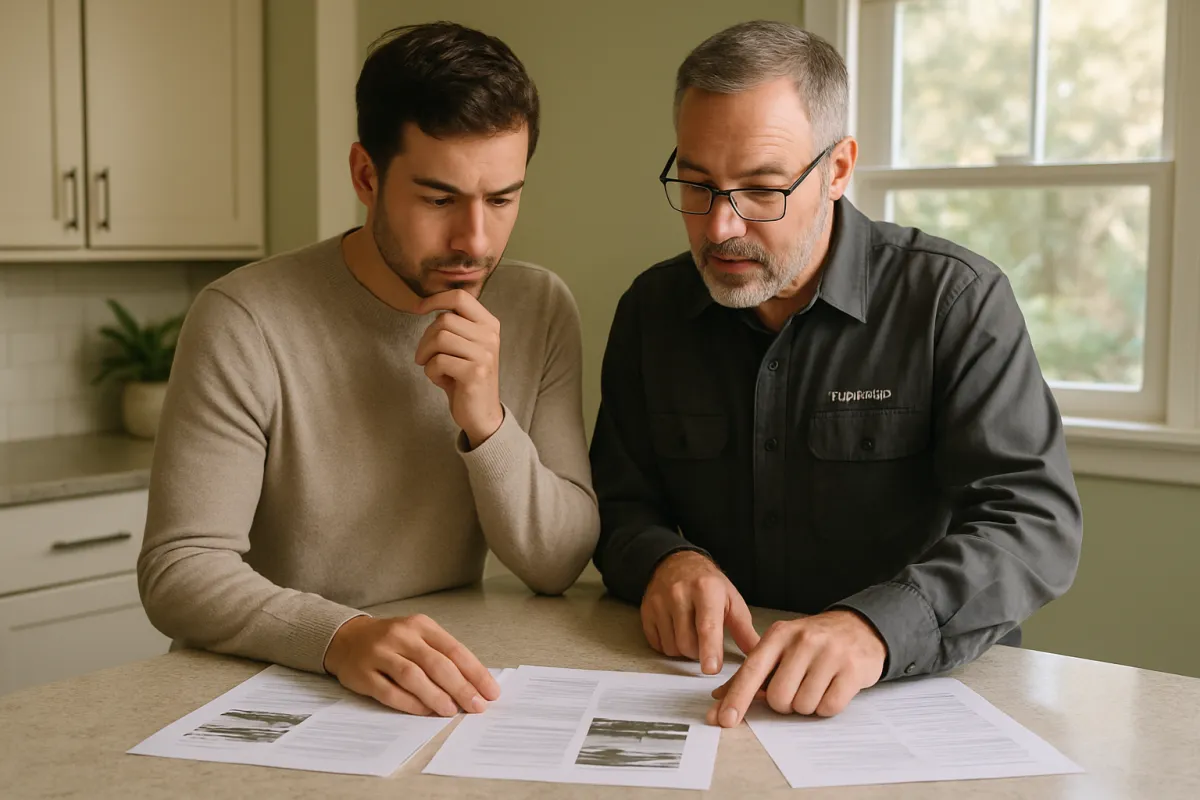
The inspection contingency gives you a window to have the property professionally examined and to decide what you want to do about what turns up. In some markets it is written narrowly as an inspection contingency tied to defects. In others it is written broadly as a due diligence period during which the buyer may cancel for essentially any reason, which is a much stronger position for a buyer.
What it protects you from is not simply a bad house. It protects you from committing before you know what you are buying. The financial exposure it covers is open ended, because you do not know in advance whether the inspection will surface a minor list or a structural problem that changes the value of the deal.
The window is typically the shortest of the major contingencies, and it is doing a lot of work in a small number of days. You have to book an inspector, attend or review the inspection, get specialist opinions where the general inspector flags something outside their scope, price the repairs, and then decide whether to accept, request repairs or a credit, or cancel. Our inspection checklist covers what a report should surface, and our step by step on booking one covers the scheduling side, which is the part that eats the window.
The outcome of an inspection contingency is more often a renegotiation than an exit. That is worth saying plainly, because buyers sometimes treat the clause as a nuclear option they hope never to use. In practice it is the leverage that turns a report full of findings into a credit at closing or a repair completed before it.
The financing contingency
The financing or loan contingency conditions the purchase on you actually obtaining the mortgage. Without it, a lender’s decision to decline your loan becomes your problem alone, and your deposit is exposed even though the failure was not something you controlled.
Financing contingencies are usually written with parameters, not just a general reference to getting a loan. The clause may specify a loan type, a maximum rate you are obligated to accept, a loan amount, or a term. Those parameters matter. A contingency that says you must accept any loan on any terms is close to no protection at all, while one that specifies terms lets you exit if the only approval you can get is materially worse than what you planned for.
The most common misunderstanding here is the difference between a pre-approval and a loan commitment. A pre-approval is a lender’s preliminary read on you as a borrower. Underwriting the actual loan involves the property as well, and the appraisal, title work, and insurance all feed into it. Deals fail at underwriting for reasons that had nothing to do with the borrower’s credit. Our pre-approval walkthrough explains what that first step does and does not establish.
The financing window tends to be the longest of the standard contingencies because it depends on a third party’s process. It is also the one most likely to need an extension, which is negotiated in writing as an amendment. Do not assume a lender’s delay automatically extends your protection. If the date is approaching and the loan is not done, the extension has to be agreed and documented before the clock runs out.
The appraisal contingency
The appraisal contingency conditions the purchase on the property appraising at or above a value, usually the contract price. It exists because your lender is not lending against the price you agreed. It is lending against the lower of the price and the appraised value, which means a low appraisal changes your loan even though the price did not change.
An appraiser is producing an opinion of value based on the property and comparable sales, not validating your negotiation. Our appraisal explainer covers how the opinion is formed and why two appraisals of the same house can differ. What matters contractually is what happens to you when the number is lower than the price.
The clause typically gives you a defined set of moves within a defined window: notify the seller of the shortfall, attempt to renegotiate the price, request a reconsideration or a second appraisal where the lender’s process allows one, or cancel and recover the deposit. Some forms require you to deliver a copy of the appraisal with your notice. Some set a tolerance, meaning you agree to absorb a shortfall up to a stated amount and only gain the right to cancel beyond it.
This is the contingency competitive buyers are most often asked to give up, and it is also the one whose waiver has the most immediate and most quantifiable cash consequence. The next section works through exactly what that consequence looks like.
When the appraisal comes in under the contract price
Take an illustrative contract at $420,000 with 10 percent down. The plan is $42,000 of down payment and a $378,000 loan. The appraisal comes back at $405,000.
The gap between price and appraised value is $15,000. That is the headline number, but it is not the number you have to find. The lender will support 90 percent of $405,000, which is $364,500, and your original loan was $378,000. The difference is $13,500, and that is the additional cash you would need to close on the same terms. In other words, because the loan was covering 90 percent of every dollar of price, only 90 percent of the gap converts into cash you must produce. Your total cash for down payment and gap becomes $55,500 instead of $42,000.
Those figures are illustrative and the arithmetic moves with your down payment percentage. At 20 percent down, 80 percent of the gap converts to cash. At 3 percent down, nearly all of it does. The general principle holds in every case: a low appraisal costs a low down payment buyer proportionally more cash than a high down payment buyer, which is the opposite of what most people assume.
From there the paths are the ones the clause names. You can pay the difference if you have it and the house is worth it to you. You can ask the seller to reduce the price, or to split the gap, which in a balanced market is a genuine conversation and in a hot one often is not. You can pursue a reconsideration through the lender if there is a defensible argument that comparable sales were missed. Or you can cancel under the contingency if you still have it and are inside the window. The companion beside this note recomputes the gap and the extra cash for your own price, down payment, and appraised value.
The title contingency
The title contingency conditions the sale on the seller being able to convey the ownership interest the contract promises. What you are buying is not only a structure. It is a legal interest in a piece of land, and that interest can be encumbered by things that are invisible on a walkthrough: unreleased liens, unpaid taxes, easements, boundary disputes, judgments against a prior owner, or gaps in the chain of ownership.
The mechanics usually run through a title search performed by a title company, attorney, or escrow holder depending on your market. The search produces a commitment or preliminary report listing what is on record and what conditions must be met before a policy will be issued. The contingency gives you a window to review that report and raise objections.
Most title issues get resolved rather than killing deals. A lien gets paid off out of the seller’s proceeds at closing. A recording error gets corrected. The contingency exists for the cases that cannot be cleared, and for giving you a defined moment to actually read what the report says instead of assuming it is routine. Our title insurance note covers the policy that sits behind this process and the difference between the lender’s policy and an owner’s policy.
Pay particular attention to easements and restrictions, which are frequently not defects at all but do change what you can do with the property. A recorded easement across the back of a lot is not something anyone will clear for you. It is something you decide you can live with, or do not.
The sale of existing home contingency
If you need to sell your current home to buy the next one, a sale of existing home contingency conditions your purchase on that sale closing. It is the most seller unfriendly contingency in common use, because it makes your contract depend on an entirely separate transaction the seller has no visibility into and no control over.
Sellers respond to that in a few standard ways. Some refuse it outright. Some accept it only if your current home is already under contract rather than merely listed. Many accept it with a kick out clause, which lets the seller keep marketing the property and, if a better offer arrives, give you a short period to either remove the contingency and proceed or release the contract.
That kick out period is the part to understand before you sign, because it can compress a decision you expected to have weeks for into a matter of days. If you are relying on this contingency, know in advance what you would do if the notice arrived tomorrow, including whether bridge financing or a temporary rental is realistic for you.
The alternative structures are worth pricing before you commit to this route. Buying first with bridge financing, selling first and renting, or lining the two closings up on the same day all have costs and risks, and all of them are more expensive than they look on paper. The honest framing is that this contingency does not eliminate the sequencing problem, it just decides who carries it.
The insurance and survey contingencies
Two smaller conditions matter more than their profile suggests, and both can appear as standalone contingencies or be folded into a broader due diligence period.
An insurance or insurability contingency conditions the purchase on your ability to obtain property insurance on acceptable terms. This has become a live issue in areas exposed to wildfire, wind, flood, or repeated water claims, and it can surface late because insurance quoting often happens after the property is under contract. A property that is difficult or very expensive to insure is a different financial proposition than the same property in an easier market, and your lender will require coverage regardless. Get quotes early rather than assuming coverage is a formality.
A survey contingency conditions the purchase on a survey that does not reveal problems: encroachments, boundary lines that do not match what the listing implied, structures built over a setback or an easement, access issues. Whether a survey is customary varies widely by region, and in some markets it is standard while in others it is rare on a resale.
Both of these share a characteristic worth naming. They are conditions about things a walkthrough cannot show you, discovered by a third party on a timeline you only partly control. That makes their deadlines the ones most likely to arrive before the information does, which is a scheduling problem more than a legal one. Order early.
Contingencies for condos, HOAs and new construction
Attached homes and association governed communities add a document review condition. You are buying into a set of rules, a budget, a reserve position, and a share of whatever the association owes or is about to spend, and the only way to evaluate that is to read the governing documents, the recent meeting minutes, and the financial statements.
The contingency gives you a defined period to review that package after you receive it, and the receipt date matters as much as the review period, because the clock usually starts when the documents are delivered rather than when the contract was signed. Our note on homeowner associations covers what those fees pay for and what to look for in a reserve position. The item to hunt for is a special assessment that has been discussed but not yet levied, which is a future cost that will not show up in the current monthly fee.
New construction is its own category. Builder contracts are frequently drafted by the builder, and the contingency structure in them can differ substantially from a resale form: different inspection rights, different appraisal handling, different deposit terms, and sometimes limits on cancellation that a resale buyer would find surprising. If you are buying new construction, having the contract reviewed before you sign is not an overreaction. It is the point at which review is still useful.
How contract deadlines are counted
Almost every dispute about whether a buyer acted in time comes down to counting. Contracts specify how days are counted, and the specification is not the same everywhere.
The variables are simple to list and easy to get wrong. Does day one start on the day the contract was fully executed, or the following day? Are the days calendar days or business days? Are weekends and holidays included? Is there a cutoff time on the final day, and whose time zone governs it? What counts as delivery for the purpose of stopping the clock: sending, or receipt? A window that sounds like a comfortable stretch can be much tighter once you resolve those questions against the actual document.
The practical method is to sit down when the contract is executed, with your agent, and write every deadline into a calendar as a specific date and time, not as a duration. Then set your own reminders several days ahead of each one, because the useful moment to discover you need an extension is not the afternoon it expires.

Why a missed deadline can silently waive your protection
Here is the part that surprises people. In many contract structures, a contingency does not stay alive until someone cancels it. It expires on its own, and in some forms the buyer’s failure to act by the deadline is treated as the buyer accepting the condition and proceeding.
Nobody has to tell you this happened. There is no notification, no confirmation, no closing of an account. The window passes and the protection is simply gone, and you find out when you try to use it.
The consequence is not just that you can no longer cancel for that reason. It is that if you then cancel anyway, you may be cancelling without a contractual basis, which is exactly the situation in which a seller has a claim on the deposit. A buyer who would have been fully protected on Tuesday can be exposed on Thursday, with nothing having changed except the date.
Some forms work the other way, requiring the buyer to affirmatively remove or waive contingencies in writing, so that silence keeps the protection alive rather than killing it. Which structure your contract uses is one of the single most important things to know about it, and it is a question your agent can answer in one sentence. Ask it early, not when a deadline is close.
The notice and cure process
Several contingencies are not built as a clean yes or no. They are built as a conversation with deadlines attached, and the shape is usually the same: the buyer delivers a written notice identifying the problem, the seller has a period to respond or to cure, and then the buyer has a further period to accept the response or to cancel.
Inspection contingencies are the clearest example. You deliver a repair request or an objection notice. The seller can agree, decline, or counter with a partial remedy or a credit. If no agreement is reached within the response window, the contract usually gives one or both parties the right to terminate.
Two features of this structure matter more than the rest. First, the notice has to be specific enough to do its job, which usually means identifying the items rather than gesturing at general dissatisfaction. Second, the response period runs off the notice, so delivering your notice on the last possible day compresses everything downstream and can leave you deciding under pressure. Sending on day six of a ten day window is a materially better position than sending on day ten.
Silence in a notice and cure sequence is rarely neutral. Depending on the form, a failure to respond can be a deemed rejection or a deemed acceptance, and those are opposite outcomes. Read which one applies before you rely on waiting.
How earnest money is released or forfeited
Earnest money sits with a neutral holder, usually an escrow company, title company, or brokerage trust account depending on the market. Our note on earnest money covers what the deposit is and how it is credited toward your cash at closing, and our escrow explainer covers the holder’s role.
The mechanism that matters here is what happens when the deal ends. The holder is not a judge. In most arrangements it cannot simply decide who was right and pay out. It needs either matching written instructions from both parties, or an outcome from whatever dispute process the contract and local practice provide.
That is why a contested deposit can sit for a long time even when one side’s position looks obviously stronger. If the seller will not sign a release, the money stays put. The available routes from there vary by state and by contract, and can include a negotiated split, mediation, arbitration, litigation, or an interpleader in which the holder deposits the funds and lets a court decide. Several of these cost more than the deposit is worth on a modest transaction, which is a fact worth knowing before the dispute rather than during it.
The practical lesson is preventative. Cancel cleanly, inside a live contingency, following the contract’s exact procedure, and the release is usually routine. Cancel outside one and you may be negotiating for your own money.

Waiving a contingency is a transfer of risk
The single most useful idea in this note is this one. When you waive a contingency to make an offer more attractive, you have not given up a formality and you have not reduced the risk in the transaction. You have moved a specific risk from the seller’s side of the table to yours, and you are now the one who pays if it materialises.
That framing changes how the decision feels. A seller comparing two offers is buying certainty, and a waived contingency is certainty they no longer have to purchase with a price reduction. It has value to them precisely because it has cost to you. The cost is not theoretical. It is the amount you would have to absorb in the scenario the contingency was written to cover.
So the question is never whether waiving helps you win. It usually does. The question is whether you can absorb the specific downside, in cash, on the timeline the contract sets, without a plan that depends on everything going right. Our bidding war note covers the competitive dynamics in more depth, including the levers that make an offer stronger without stripping out protection.
There is also a version of this decision that is simply not available to some buyers, and that is fine. If waiving the appraisal contingency would require cash you do not have, the waiver is not a bold move, it is an undertaking you cannot perform. Competing on other terms is the honest response.
What each waiver actually puts at stake
Being explicit is better than being general, so here is what each of the main waivers hands you.
Waive the inspection contingency and you own the condition of the house as it is, including whatever a competent inspector would have found and you did not. You lose the exit and you also lose the leverage, because a repair request with no ability to cancel behind it is a request. The exposure is uncapped in principle, since you are agreeing before you know.
Waive the appraisal contingency and you have agreed to bring the shortfall in cash if the value comes in low. On the illustrative $420,000 contract with 10 percent down and a $405,000 appraisal, that is about $13,500 on top of the $42,000 down payment. You cannot borrow your way out of it, because the loan is the thing that shrank.
Waive the financing contingency and your deposit is exposed if underwriting fails for any reason, including reasons attached to the property rather than to you. Depending on the contract and the jurisdiction, a seller’s remedies may not stop at the deposit, which is a question for an attorney rather than an assumption.
Waive the sale of existing home contingency and you have committed to closing regardless of whether your current home sells, which means you need a real financing plan for carrying both, not an intention to sell quickly.
Waive title, insurance, or survey conditions and you are accepting whatever the record, the insurance market, or the boundary turns out to say, on a property you have not finished investigating.
Softer alternatives to a full waiver
The choice is rarely binary, and the middle ground is where most of the useful strategy lives.
You can shorten a window instead of removing it. A five day inspection period is far more attractive to a seller than a fifteen day one, and it preserves the protection as long as you have your inspector lined up in advance. Pre booking the inspection before you write the offer is what makes a short window realistic rather than reckless.
You can cap your exposure rather than eliminate it. An appraisal gap clause in which you agree to cover a shortfall up to a stated amount, and retain the right to renegotiate or cancel beyond it, gives the seller most of the certainty they want while keeping a defined ceiling on what you can be asked to produce. Choose the cap from your reserves, not from what you think it takes to win.
You can narrow the trigger rather than remove the clause. An inspection contingency limited to major systems or to findings above a dollar threshold tells the seller you are not going to renegotiate over a loose handrail, while keeping your exit for something structural.
You can also compete on terms that cost you nothing contractual: a larger deposit, a faster response period, a closing date that suits the seller’s move, or a rent back arrangement. Those signal seriousness without transferring risk, which makes them the first place to look before you touch a contingency at all.
What each waiver could cost in dollars
Numbers make the trade concrete. The chart below prices each waiver against the same illustrative $420,000 contract with 10 percent down, a $8,400 deposit, and an appraisal at $405,000. These are not measured averages. They are worked scenarios meant to show the shape of the exposure.
Illustrative cash exposure created by each waiver
Scenario figures on a $420,000 contract with 10 percent down and an $8,400 earnest deposit. Illustrative, not survey data. Your own exposure depends on your contract and your market.
Each bar is scaled to the largest scenario at $18,000. The inspection figure is an illustrative repair total, not a typical one, and it is uncapped in principle because you are agreeing before you know. The appraisal figure is 90 percent of a $15,000 gap, since the loan was covering 90 percent of the price. The two deposit figures are the same because both waivers expose the same $8,400, though a seller's remedies may not stop at the deposit in every jurisdiction.
Two things stand out. The appraisal waiver is the only one whose cost you can calculate precisely in advance, which is why it is the easiest to make a responsible decision about: you either have the cash or you do not. The inspection waiver is the one with no ceiling, which is why it is the hardest to price and the one most worth replacing with a shortened window rather than removing.
Where your cash sits when a contingency fails
The second chart follows the money rather than the risk. On the same worked example, a low appraisal that you decide to absorb changes the composition of your cash at closing, and the appraisal gap becomes a visible slice sitting next to the down payment and the closing costs.
Cash at closing after absorbing an appraisal gap
Illustrative $420,000 contract: $42,000 down payment, $13,500 of appraisal gap cash, and closing costs at 3 percent of price, summing to 100 percent of about $68,100.
Illustrative shares of about $68,100 in total cash. The $8,400 earnest deposit sits inside the down payment slice, credited at closing rather than added on top. The closing cost share uses an illustrative 3 percent of price. Your own figures depend on your price, down payment, appraised value, and local cost structure.
The point of the split is proportion. A buyer who budgeted $42,000 of down payment and $12,600 of closing costs planned for about $54,600 and is now asked for about $68,100, roughly a quarter more, at a point in the process where there is no time to raise it. That is what a waived appraisal contingency looks like in practice, and our closing cost breakdown itemises the smallest slice. The companion reprices all three for your own contract.
The worked example from offer to closing
Follow one illustrative contract through its windows to see how the pieces connect.
The offer is accepted at $420,000. The deposit is $8,400, or 2 percent of price, and it goes to the escrow holder. The buyer keeps the inspection, financing, and appraisal contingencies, and the contract sets a ten day inspection window. Working backward, the buyer books the inspector before writing the offer, so the inspection happens on day three and the report arrives on day four. Spread across a ten day window, the $8,400 deposit works out to about $840 of protected value per day, which is a crude but useful way to feel the cost of a wasted day.
The report flags a water heater near the end of its life and evidence of past moisture in a crawlspace. The buyer gets a specialist opinion on day six and delivers a written repair request on day seven, inside the window and with three days of response period left rather than none. The seller counters with a credit rather than repairs, the buyer accepts, and the inspection contingency is satisfied.
The appraisal comes back at $405,000. The gap is $15,000, and since the loan was covering 90 percent of price, the buyer needs about $13,500 more in cash than planned. Because the appraisal contingency is alive, the buyer has real choices. They ask for a price reduction, the seller offers to split, and they settle somewhere in between, which is only possible because the alternative was a cancellation the seller wanted to avoid.
Had the buyer waived that contingency to win the house, the conversation would not have happened. There would have been $13,500 to produce and a closing date to produce it by. Same house, same price, same appraisal, completely different position, and the difference was one clause. Every figure here is illustrative and rounded to show the method.
Common mistakes buyers make with contingencies
The failures repeat, which makes them easy to design around.
Treating contingencies as boilerplate. The section of the contract that decides your exits gets less attention than the paint colour, and it is the only part that determines what happens when something goes wrong.
Booking the inspection after the offer is accepted. The window starts running immediately, and a week spent finding an available inspector is a week of a window you cannot get back.
Assuming someone will remind you. Agents and lenders track a lot, but the obligation to act inside a window is yours, and a deadline that passes quietly does not announce itself.
Waiving the appraisal contingency without counting the cash. This is the most common expensive mistake, because the waiver feels like a paperwork concession and lands as a cash call.
Confusing pre-approval with a loan commitment, and therefore treating the financing contingency as redundant. Underwriting can fail on the property.
Delivering notice informally. Telling your agent you want to cancel is not delivering notice to the seller in the manner the contract requires, and the gap between those two things has cost buyers their deposits.
Reading a contingency as protection against changing your mind. Most are conditions about specific things, not general escape hatches, and a broad due diligence period is a market specific feature rather than a universal one.
Questions to ask before you sign
A short list, asked of your agent and where customary a real estate attorney, before the contract is executed rather than after.
Which contingencies does this contract include by default, and which have to be added by rider? What is the exact expiry date and time of each one? Are days counted as calendar days or business days, and when does day one start?
Does a contingency expire automatically if I do nothing, or do I have to remove it in writing? That single answer changes how you manage every deadline in the contract.
What form of notice does the contract require, to whom, and by what delivery method? Does the clock stop on sending or on receipt?
If the appraisal comes in low, what exactly does this contract let me do, and is there a tolerance amount I have already agreed to absorb?
Who holds the earnest money, and what does this contract say happens to it if the parties disagree? What does the process cost, in this state, in practice?
If I am asked to waive something to compete, what is the smallest change that gets most of the effect: a shorter window, a capped gap, a narrowed trigger?
Your contingency checklist
Read the contingency section of the contract in full before signing, with your agent, and with an attorney where that is customary in your market.
Write every deadline into a calendar as a fixed date and time on the day the contract is executed, and set reminders several days ahead of each.
Confirm whether contingencies expire automatically or require written removal, and manage your calendar accordingly.
Book the inspection before you write the offer, or at minimum have an inspector confirmed and available.
Get insurance quotes early rather than assuming coverage is available at an ordinary price.
Read the title commitment and, for an association property, the governing documents, budget, reserves, and recent minutes, inside the review window.
Know your cash ceiling before you consider any appraisal gap exposure, and cap what you agree to at a number you can actually produce.
Deliver every notice in writing, in the form and to the party the contract specifies, and keep proof of delivery.
Prefer a shortened window, a capped gap, or a narrowed trigger over a full waiver whenever the seller will take it.
Ask, before you sign, what happens to the deposit if the parties disagree, and how that process works where you are buying.
The bottom line
Contingencies are the part of a purchase contract that decides what happens when reality disagrees with the plan. Each one names a condition, sets a clock, and specifies a procedure, and all three have to line up for the protection to work. The version that governs you is the one in your own executed contract, not a general description of how these usually work, because the defaults and the procedures genuinely differ from state to state and form to form.
The strategic half is simpler than it looks. A waiver is a purchase, and the price is whatever the protection would have covered. The appraisal waiver has a price you can compute, so compute it before you offer. The inspection waiver has no ceiling, so replace it with a shorter window instead of removing it. And whatever you agree to, know your deadlines as dates on a calendar, because the most common way buyers lose a protection they paid for in negotiation is by letting it expire while they were busy. Run your own numbers in the companion, then take the specifics to your agent.
This market note is educational reporting on how purchase contracts are structured, not legal, financial, or lending advice, and reading it does not create any professional relationship. Real estate contracts, the standard forms used in each market, default contingency windows, how days are counted, notice requirements, and the procedures for resolving a disputed earnest money deposit all vary by state and by locality, and they change over time. Nothing above states a rule that applies everywhere, and no clause described here should be assumed to exist in your contract until you have read it there. Every price, percentage, and dollar amount is illustrative and rounded to show the arithmetic, and your own deposit, appraisal gap, and cash at closing will differ. Before you sign, waive anything, or respond to a deadline, confirm what your specific contract requires with a qualified real estate agent and, where it is customary in your market, a licensed real estate attorney.
Frequently asked questions
What is a contingency in real estate?
A contingency is a condition written into the purchase contract that has to be satisfied before the sale becomes fully binding on the buyer. If the condition is not met and the buyer follows the contract's procedure within the contract's deadline, the buyer can cancel and typically recover the earnest money deposit. The most common ones cover the inspection, the loan, the appraisal, and the title, and each one has its own separate clock. The exact wording, the default windows, and the cancellation procedure come from whatever contract or standard form your market uses, so the only authoritative version is the document you actually sign.
What are the most common home buying contingencies?
Four appear in most residential purchase contracts: the inspection or due diligence contingency, the financing contingency, the appraisal contingency, and the title contingency. Depending on the property and the market you may also see a sale of existing home contingency, an insurance or insurability contingency, a survey contingency, and a document review contingency for condos or homeowner associations. New construction contracts and cash offers can look very different from the standard resale form. Ask your agent which contingencies the local form includes by default and which ones have to be added by rider or addendum.
How long do real estate contingency periods last?
There is no universal length. Contingency windows are negotiated, and many markets have a customary starting point that a standard form fills in as a default, which the parties then adjust. Inspection windows tend to be the shortest and the financing window tends to be the longest because it depends on a third party underwriting a loan. What matters far more than the customary number is that you know the exact date and time each of your windows expires and you work backward from it. Read the dates off your own executed contract and confirm them with your agent rather than assuming a standard period applies.
What happens if the appraisal comes in below the purchase price?
The lender will generally lend against the lower of the contract price or the appraised value, so a low appraisal opens a gap between what you agreed to pay and what the loan will support. On an illustrative $420,000 contract with 10 percent down, an appraisal at $405,000 creates a $15,000 gap, and because the loan was covering 90 percent of that amount you would need roughly $13,500 more in cash to close on the same terms. Your options usually include paying the difference in cash, renegotiating the price, requesting a review or a second appraisal where the lender allows one, or cancelling under an appraisal contingency if you have one. Those figures are illustrative and your own gap depends entirely on your price, down payment, and appraised value.
Should I waive contingencies to win a competitive offer?
Waiving a contingency does not make a risk disappear, it moves that risk from the seller to you, and the price of the transfer is whatever the protection would have covered. Waiving the appraisal contingency means you have agreed to cover a shortfall in cash. Waiving the inspection contingency means you own whatever the inspection would have found. Waiving the financing contingency means your deposit is exposed if the loan does not close. Buyers sometimes decide those trades are worth making, but the decision should follow an honest look at your reserves and a conversation with your agent, and in many markets a real estate attorney, not a snap decision on the day of an offer deadline.
Do I lose my earnest money if I cancel a contract?
It depends on whether you cancelled under a contingency you still had, and whether you followed the contract's procedure inside the contract's deadline. Cancel properly under a live contingency and the deposit is normally returned to you. Cancel after the window has closed, or for a reason your contract does not cover, and the seller may claim the deposit. In practice the escrow or title holder usually cannot release the money to either side without matching instructions or a formal resolution, so a contested deposit can sit for a while. Our note on earnest money explains where the deposit lives and how it is credited at closing.
What is the difference between a contingency and a concession?
A contingency is a condition that lets you exit the contract if something specific is not satisfied. A concession is something one party gives the other inside a deal that is going forward, such as a seller crediting money toward closing costs or agreeing to make a repair. Contingencies protect your ability to leave. Concessions change the economics of staying. The two interact, because a defect found during the inspection window often turns into a repair request or a credit rather than a cancellation, which is why the inspection contingency is as much a renegotiation tool as an exit.
Can a seller reject an offer just because it has contingencies?
Yes. A seller can accept, reject, or counter any offer for reasons that have nothing to do with price, and in a competitive situation a clean offer with fewer conditions can beat a higher one with more. That is exactly why contingency strategy matters. The useful response is rarely all or nothing, though. Tightening a window, capping how much of an appraisal gap you will cover, or agreeing to a shorter response period can make an offer read as more certain without stripping out the protection entirely.

Hamza Hai is the editor of AbodeWave. She holds an MBA and reviews the site's articles against our editorial standards, checking that every figure is labelled for what it is, that nothing is presented as verified fact without a source the reader can check, and that the writing stays useful to a non-specialist.