
What's in this market read
- Why buying out of state fails differently
- Before you start: what you need in place
- Step 1: Decide whether you buy before or after you move
- Step 2: Get preapproved with a lender licensed in the destination state
- Step 3: Build your local team, starting with a buyer’s agent
- Step 4: Research the market remotely before you fly
- Step 5: Make the touring trip count
- Step 6: Write the offer with the protections a remote buyer needs
- Step 7: Run inspection and due diligence at a distance
- Step 8: Close remotely and take possession
- What a remote purchase actually adds to your costs
- Where the remote premium goes
- What changes at the state line and must be checked, not assumed
- Attorney states, escrow states, and who actually runs your closing
- Property tax reassessment and the payment you did not budget for
- Insurance availability as a purchase constraint
- What a video walkthrough can and cannot show you
- Judging a neighbourhood you have never lived in
- A worked example from first search to closing day
- Common mistakes remote buyers make
- Troubleshooting the situations that come up
- The remote buying checklist
- The bottom line
A buyer purchasing three streets away can fix most mistakes with a Saturday morning. They can drive past the house at 7pm on a Friday to hear the street, walk the block twice, sit in the traffic they would sit in every day, and get a second opinion from someone who has lived there for a decade. A buyer purchasing eleven hundred miles away has none of that, and the failure modes that follow are not the same failure modes a local buyer faces. They are quieter, they show up later, and they are considerably more expensive to unwind.
This walkthrough takes the out of state purchase step by step, in the order the decisions actually arrive: whether to buy before or after you move, how lender licensing quietly constrains who can even take your application, how to build a local team that works for you rather than for the referral chain, how to research a market you cannot drive through, how to make one trip do the work of five, and how to write an offer and close a purchase from another time zone. It assumes you already understand the basic purchase mechanics covered in our first home walkthrough, and it focuses only on what changes when you are not there. The companion beside this walkthrough prices the remote specific extras for your own purchase as you read.
Key takeaways
- Renting for six to twelve months at the destination is usually the lower risk sequence. Buying before you move is defensible, but it should be a decision you made deliberately rather than a default.
- Mortgage licensing is state by state. Ask any loan officer whether they are licensed to originate in the destination state before you send a single document.
- Your buyer's agent is your eyes on the ground for the whole transaction, which makes the hiring decision worth more to a remote buyer than a local one. A referral is a starting point, not a choice.
- On the illustrative $380,000 purchase used throughout, the remote specific extras came to about $5,650, roughly 1.5 percent of the price and about a tenth of the total cash the deal required.
- Closing remotely runs through remote online notarisation, a mail away package, or a power of attorney. Your closing agent and lender decide which is available, so ask in week one, not week eight.
Why buying out of state fails differently
Local purchases fail on price and financing. Remote purchases fail on information. The buyer who overpays by twenty thousand dollars in their own city usually knew what they were doing and chose the house anyway. The buyer who overpays from another state frequently did not know that the school catchment ends at the cross street, that the highway noise carries at night in that direction, or that the tidy street they saw in photographs turns into a different kind of street four blocks on.
The second failure mode is trusting the wrong intermediary. When you cannot see anything yourself, everyone you deal with becomes a proxy for your own eyes, and the incentives of those proxies are not identical to yours. An agent introduced through a referral chain gets paid when you buy. An inspector recommended by that agent works in the same local economy. None of this makes anyone dishonest, and most of these people do good work, but a remote buyer has less ability to detect the exception.
The third is timeline. Every step that requires your physical presence becomes a scheduling problem, and scheduling problems compound. A local buyer who needs a document notarised does it at lunchtime. A remote buyer does it if the notary appointment, the courier pickup, and the closing agent’s cutoff line up on the same day. Run your price range through the affordability calculator before you start, because the cash side of a remote purchase carries extras a local purchase does not.

Before you start: what you need in place
This is a longer project than a local purchase and it works best when the prerequisites are gathered before you start rather than assembled under contract deadlines.
- Time budget. Plan on eight to sixteen weeks from first serious search to keys, with twelve as a reasonable middle. Remote adds calendar time at three points: lender licensing checks, the touring trip, and the closing logistics.
- Cash budget. Down payment, closing costs, and a separate line for the remote specific extras. On the illustrative purchase below those extras came to about $5,650, and buyers routinely forget to budget any of it.
- Documents. The standard income, asset, and identity package your lender will ask for, scanned and organised before you apply, because every day you spend hunting for a statement is a day of a remote timeline you do not get back.
- A destination shortlist. Three or four candidate neighbourhoods rather than a whole metro, because a trip spread across an entire market tells you almost nothing.
- Difficulty. Moderate. No step is technically hard. The difficulty is entirely in sequencing and in resisting the urge to compress the parts that protect you.
One prerequisite is attitude rather than paperwork. A remote purchase rewards buyers who are willing to lose a house. The cost of walking away from a deal that stopped making sense is a few hundred dollars of inspection money and some wasted time. The cost of buying the wrong house in a city you do not know, and discovering it after the movers leave, is measured in years.
Step 1: Decide whether you buy before or after you move
The first decision is sequencing, and most relocation content skips it because it assumes you have already chosen to buy. Renting at the destination for six to twelve months is usually the lower risk sequence, and it deserves to be stated plainly rather than buried.
Renting first buys you information that no amount of remote research produces. You learn the commute in real traffic rather than in a mapping estimate. You learn which neighbourhoods you actually want to be in, which is frequently not the one you shortlisted from photographs. You learn whether the job holds and whether the move suits you. You also convert an irreversible six figure decision into a reversible one for the price of a lease and one extra move.
The case for buying immediately is real. You avoid moving twice, which on the illustrative numbers here costs roughly $2,400 of temporary housing and storage plus the second move itself. You avoid a lease that constrains your timing. In a market where prices are rising you buy earlier, and you start building equity rather than paying rent.
The honest test has three parts: how confident are you about the job, how confident are you about the area, and can you see yourself in the same house in five years. Two solid yeses and one shrug is usually fine. Two shrugs means rent. Watch out for the trap of treating a relocation package deadline as if it were a housing deadline, since the two rarely have to match.
Step 2: Get preapproved with a lender licensed in the destination state
Mortgage lending is licensed state by state. That single sentence catches more relocating buyers off guard than any other structural fact in the process, because it is invisible until it blocks you. The loan officer who handled your last purchase competently may simply be unable to originate a loan secured by a property in the state you are moving to, even when the institution behind them operates in forty states.
Ask two questions before you upload a document. Are you personally licensed to originate in the destination state, and does this institution lend on properties there. Both answers must be yes. If either is no, ask to be introduced to a colleague who is licensed there rather than starting over from scratch, since your file and your relationship can often move internally.
Then get a real preapproval, not a prequalification. A preapproval means your income and asset documents have been reviewed and a credit report pulled. In a market where you are competing without being physically present, a soft prequalification letter is a weak instrument. Our pre-approval walkthrough covers what the underwriter is actually checking, and our note on broker versus bank explains why the channel you choose changes how wide the lending shelf is, which matters more when your file has a relocation shaped wrinkle in it.
Watch out for a specific version of that wrinkle: a new job in the destination state that starts after closing. Lenders treat future income differently from current income, and the treatment varies. Raise it in week one.
Step 3: Build your local team, starting with a buyer’s agent
You need three local people: a buyer’s agent, a lender who can close in that state, and an inspector. The agent is the hire that decides the transaction, because a remote buyer delegates far more to them than a local buyer ever does.
The default path is a referral from your current agent, and referrals carry a fee paid out of the receiving agent’s commission. That is normal and disclosed, and it is not the problem. The problem is that a referral chain optimises for who knows whom, not for who works your specific submarket every week. Take the referral if it is offered, then interview that agent alongside two you found independently, and choose on evidence.
The evidence is specific: how many closings have you handled in these three neighbourhoods in the last twelve months, in roughly this price range. Ask how they handle remote buyers, since the good ones have a routine: live video walkthroughs where you direct the camera, a habit of photographing the things nobody photographs, and a willingness to say a house is wrong for you. Our agent selection walkthrough covers the interview questions in full.
Watch out for the agent who never discourages you. On an illustrative eight week search, an agent who talks you out of two houses has earned more than the referral fee cost.
Step 4: Research the market remotely before you fly
Some research transfers perfectly to a remote buyer and some does not, and knowing which is which stops you from wasting the trip on questions you could have answered from a laptop.
What transfers: price history on individual properties, including whether a listing has been withdrawn and relisted to reset its clock. Days on market for the specific submarket rather than the metro headline, since a metro average blends areas with nothing in common. Sale prices of genuinely comparable homes in the last three to six months. Tax history, which is public in most places and tells you what the current owner pays and how the assessment has moved. Aerial imagery over several years, which shows roof condition, tree cover, drainage patterns, and what got built next door.
What does not transfer: anything to do with sound, smell, slope, or the feel of a street. Street level imagery is often two or three years stale, and it is captured at one moment on one day.
The most useful remote habit is building a shortlist of three or four neighbourhoods and then watching them for four to six weeks before you fly. You learn the local price ceiling, you learn what sells fast, and you start recognising when a listing is priced oddly. That pattern recognition is exactly what a remote buyer lacks and exactly what one focused month of watching supplies. Keep the affordability calculator open alongside, because a shortlist you cannot finance is a hobby.
Step 5: Make the touring trip count
Most remote buyers get one trip, occasionally two. A trip that is planned like a holiday produces four vague house visits and no decision. A trip planned like fieldwork produces a shortlist you can act on.
Build a tight geographic route. Ask your agent to cluster showings by neighbourhood rather than by listing quality, so you see six to eight houses in one area in a block rather than criss crossing the metro. Book the first showing early and the last one late, and deliberately drive the two commutes you would actually make, at the times you would actually make them.
Budget the trip honestly. On the illustrative purchase here, one trip runs about $1,100: roughly $450 of airfare, $250 for a rental car, $260 for two nights of lodging, and $140 of meals. Two trips is $2,200, which is the single largest line in the remote premium and the one most worth spending.
Spend the last evening driving, not touring. Drive your two or three finalists at 8pm. Then drive them again at 7:30am. Nothing on a listing tells you what a street does at those hours.
Watch out for touring exhaustion. After the eighth house in a day, buyers stop evaluating and start pattern matching on kitchen finishes. Six or seven a day is the realistic ceiling, and photographing each one immediately on leaving, with a voice note, is what stops them blurring together on the flight home.
Step 6: Write the offer with the protections a remote buyer needs
A remote offer is the same instrument as a local offer with two differences: the contingencies matter more, and the timeline has to accommodate the fact that you are somewhere else.
Start from the mechanics in our offer walkthrough, then adjust three things. First, the inspection contingency. A local buyer sometimes waives it because they walked the property twice and know the neighbourhood’s building stock. A remote buyer waiving inspection is guessing with six figures. Keep it, and give it enough days that an out of area inspection can actually be scheduled and read, which usually means asking for a slightly longer window than the local standard.
Second, the timeline. Every date in the contract that assumes you can be somewhere is a date to check. Build in room for courier transit, for notary scheduling, and for the possibility that your lender’s remote signing route needs advance approval.
Third, earnest money. On the illustrative $380,000 purchase, an earnest deposit of about 1 percent is $3,800. That money is genuinely at risk if you blow past a contingency deadline, which is a more realistic hazard when you are managing the deal from another time zone. Our read on contingencies covers which deadlines actually forfeit a deposit.
Watch out for the pressure to strip protections to win a competitive offer. Winning by waiving the thing that lets you walk away is not winning.
Step 7: Run inspection and due diligence at a distance
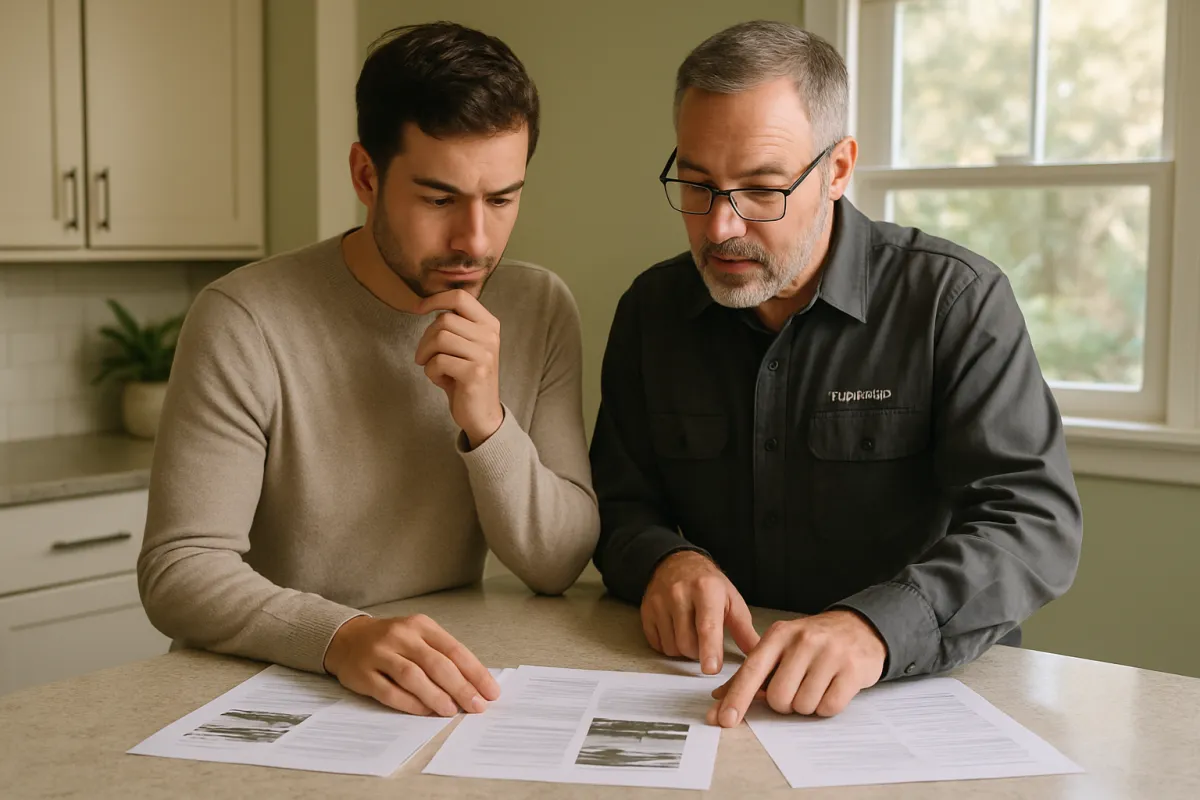
This is the step where remote buyers most often economise and most often regret it. Hire your own inspector. Ask your agent for names if you like, then find one or two independently, and choose on credentials and on whether they will spend twenty minutes on the phone with you afterwards.
Then do the thing almost nobody does: read the report with the inspector on the phone rather than skimming the PDF alone. A written report is a list of observations with photographs and a severity flag. A conversation with the person who was standing in the crawlspace tells you which two items actually matter, which fifteen are ordinary for a house of that age, and what they would look at again if it were their own money. That call is free and it is the highest value thirty minutes in the whole process.
Budget for specialists. On the illustrative purchase, the general inspection ran about $550, which a local buyer pays too, plus about $650 for additional work: a sewer scope, a closer look at the roof, and a follow up on one flagged item. That $650 is remote premium, because a local buyer can often satisfy the same curiosity with a second visit.
Our inspection walkthrough covers what a general inspection does and does not include. Watch out for scheduling: an inspection ordered late in a short contingency window leaves you no time to negotiate, and a remote buyer has no slack to spare.
Step 8: Close remotely and take possession
There are generally three routes to signing a closing package you cannot attend, and which ones are open to you is decided by your closing agent and your lender rather than by preference.
Remote online notarisation lets you appear by live video before a commissioned notary and sign electronically. Availability varies by state, by document type, and by the individual lender and title underwriter, and the rules have been changing, so treat it as something to confirm rather than assume. A mail away closing is the workhorse: the package is couriered to you, you sign the notarised pages in front of a local notary, and everything is couriered back. It works almost everywhere and it costs calendar days. A power of attorney is the fallback, where someone you name signs on your behalf, and it requires advance approval from the lender and title company plus specific wording, so it cannot be arranged in the final week.
Ask one question early: which of these will you and my lender accept, and what do you need from me to set it up. Ask it in week one.
On the illustrative purchase, closing logistics ran about $400 in couriers, notary appointments, and platform or drafting fees. Our read on what happens at a closing covers the sequence itself. Watch out for the funds transfer, which is the single highest risk moment in any purchase and more so remotely: confirm wire instructions by phone using a number you sourced independently, never a number from an email.

What a remote purchase actually adds to your costs
The extras in a remote purchase are travel and logistics rather than a fee schedule, which is why they are absent from every closing cost estimate and present in every relocating buyer’s bank statement. Four lines carry almost all of it on the illustrative purchase.
Remote specific extras on an illustrative $380,000 out of state purchase
Four lines a local buyer would not pay, totalling about $5,650. Bars scaled to the largest figure. Illustrative, not typical.
Bars are scaled to the largest figure, the $2,400 of temporary housing, so the $2,200 of trips fills 91.7 percent of the track, the $650 of specialist inspections fills 27.1 percent, and the $400 of closing logistics fills 16.7 percent. The two lines buyers actually budget for are the two smallest. These are illustrative figures for one purchase, not typical costs.
The ordering is the lesson. Buyers arrive at a remote purchase worrying about notary fees and courier charges, which together came to $400 here, while the two lines that carry roughly four fifths of the extra spending are the trips and the housing gap between move out and move in. Both of those are schedule problems rather than fee problems, and both are largely controllable if you plan them early. Put your own trip count and housing overlap into the companion beside this walkthrough and the four lines reprice to your purchase.
Where the remote premium goes
Seeing the same $5,650 as shares rather than amounts makes the planning implication clearer, because it shows which lines are worth negotiating and which are worth simply accepting.
The $5,650 remote premium, by share
Illustrative shares of the four remote specific lines on a $380,000 purchase, summing to 100 percent.
Shares of the illustrative $5,650 of remote specific spending: $2,400 of temporary housing is 42.5 percent, $2,200 of trips is 38.9 percent, $650 of specialist inspections is 11.5 percent, and $400 of closing logistics is 7.1 percent. The two largest slices are both schedule driven, which is why the calendar is the lever, not the invoice.
Read it as an instruction about where to spend attention. The housing overlap shrinks to zero if the closing date and the lease end line up, which is a planning outcome rather than a purchase outcome. The trips are the line you should be least eager to cut, since a second trip that stops you buying the wrong house pays for itself many times over. The inspections and the closing logistics together are 18.6 percent of the premium and about $1,050, which is not where the money is and never was.
What changes at the state line and must be checked, not assumed
The most expensive assumption a relocating buyer makes is that the purchase process they already know travels with them. Much of it does. Several important parts do not, and they differ enough that assuming is genuinely risky.
Four categories deserve a direct question to a local professional before you make an offer. Who runs the closing, since practice differs between places where an attorney is customary or required and places where a title or escrow company handles it. What the seller must disclose, since disclosure regimes vary widely in how much a seller is obliged to tell you about known defects and in what form. How property taxes behave after a sale, since a reassessment can move your bill away from what the current owner pays. Whether property insurance is readily available and affordable for that specific property.
None of these can be answered generally, which is exactly the point. This walkthrough will not tell you which states do what, because the answer would be stale by the time you read it and wrong for the exceptions. What it will tell you is the question to ask and who to ask it of: your buyer’s agent for local custom, the closing agent or attorney for procedure, the county or municipal assessor for tax treatment, and an insurance agent who writes policies in that market.
Write the four questions down before your first call. A remote buyer who asks them in week one has a normal transaction. One who discovers them in week seven has a problem.
Attorney states, escrow states, and who actually runs your closing
The practical version of the previous section is knowing who your closing is with, because that determines who you call when something goes wrong and how much lead time the signing arrangements need.
In some places a real estate attorney is customary or required, and that attorney conducts the closing, reviews the contract, and handles the title work. In others, a title company or an escrow company performs the same functions without an attorney routinely involved. Both models close houses reliably. What differs for a remote buyer is the point of contact, the typical timeline, and how flexible the signing arrangements are.
This matters more than it sounds because the remote signing question runs directly through this office. Whether you can use remote online notarisation, whether a mail away package is standard, and whether a power of attorney will be accepted are decided jointly by the closing agent, the title underwriter, and the lender. There is no general answer, and any source giving you one is describing one market.
The action is simple. As soon as you are under contract, ask your agent who will be conducting the closing, get that person’s contact details, and call them yourself. Introduce yourself as a remote buyer, ask which signing routes they support, and ask what they need from you and by when. That one call, made in week one instead of week six, removes most of what goes wrong at the end of a remote purchase.
Property tax reassessment and the payment you did not budget for
A listing often shows the current owner’s annual property tax, and a remote buyer with no local intuition tends to read that figure as their future cost. Sometimes it is. Sometimes it is substantially lower than what you will pay, because the assessed value on which that bill is based has not been updated in years and a sale is precisely the event that can trigger an update.
The mechanism varies by jurisdiction, and this is one to check rather than to assume in either direction. Some places reassess on transfer, some reassess on a cycle, some cap how fast an assessment can rise for a continuing owner in a way that resets for a new one, and exemptions attached to the seller frequently do not transfer to you.
The consequence is a monthly payment that lands higher than the one you modelled. On the illustrative $380,000 purchase, taxes at 1.2 percent of value are about $4,560 a year, or $380 a month, sitting alongside roughly $2,162 of principal and interest on a $342,000 loan at 6.5 percent, about $150 a month of insurance, and about $143 of mortgage insurance at 10 percent down, for a payment near $2,835. Move the tax assumption to 1.5 percent and the payment moves to roughly $2,930 without anything else changing.
Ask the assessor’s office directly how the property will be treated after a sale, and model the answer rather than the seller’s current bill.
Insurance availability as a purchase constraint
Insurance used to be a late administrative step. In markets exposed to wildfire, wind, hail, or flood it has become something closer to a purchase constraint, and a remote buyer is the least likely person to know that in advance.
The mechanism is straightforward even though the specifics vary constantly. Insurers set appetite by geography and by property characteristics such as roof age and construction type. Where losses have been heavy, carriers may write fewer new policies, raise deductibles for specific perils, or decline certain properties. Because your lender requires insurance in place at closing, a property that is difficult to insure can become a property you cannot finance on your intended timeline.
The remote specific risk is discovering this in week six. A local buyer often has an existing relationship with an agent who tells them immediately. A relocating buyer usually does not.
Do two things. Get an insurance quote on any property you are seriously considering before your inspection contingency expires, not after, and treat a slow or evasive quoting process as information rather than an inconvenience. Ask the same agent a general question early in your search: which parts of this market are difficult to insure right now, and what drives it. Availability, pricing, and carrier appetite change frequently, so confirm current conditions with a licensed insurance professional in that market rather than relying on anything written here or anywhere else.
What a video walkthrough can and cannot show you
The live video walkthrough is the remote buyer’s core tool and it is routinely used badly. Watching an agent’s edited tour is close to worthless. Directing a live camera for forty minutes is genuinely informative.
What it shows well: room proportions and how spaces connect, ceiling height, natural light at that hour, the actual condition of finishes rather than the staged version, visible mechanical equipment and its apparent age, water pressure if you ask them to run a tap, and whether doors and windows open properly if you ask them to try.
What it cannot show: smell, which is how damp announces itself. Sound, including road noise, aircraft, rail, and neighbours. Slope, because a camera flattens a floor that is visibly out of level in person. Drainage, unless it happens to be raining. Temperature and draught. The character of the street beyond the frame.
Build a request list before the call and work through it out loud: open the electrical panel, point the camera at the water heater and the furnace label, go into the crawlspace or basement corner, stand in the back yard and turn a full circle slowly, walk to the end of the driveway and pan up and down the street, then stand still and stay silent for thirty seconds so you can hear it.
Then treat the whole exercise as screening rather than deciding, and let the inspection contingency carry the weight of the actual decision.
Judging a neighbourhood you have never lived in
Buyers evaluate houses well remotely and neighbourhoods badly, because the house is a finite object and the neighbourhood is a pattern that reveals itself over time.
Three techniques get you most of the way. First, boundaries. Find the edges of the thing you liked, since almost every desirable pocket has a street where the character changes, and remote buyers frequently buy two blocks past it. Ask your agent to drive those boundaries on video. Second, time of day. Anything you assess only in weekday daylight is assessed at the neighbourhood’s best moment. Ask for footage at 8pm and on a weekend. Third, the routine test. Write down the five places you would go weekly, then check each one’s actual travel time from the specific address at the time you would go, rather than the neighbourhood’s general reputation for convenience.
The fourth technique is people. If you know anyone within an hour of the destination, ask them to drive the street and tell you what they notice. Someone with no financial interest in the transaction is a different kind of witness from everyone else in your process.
What none of this replaces is the rented six months in the first step, which remains the only method that gives you the pattern rather than a sample of it. Run the numbers on both sequences in the affordability calculator before deciding which you can afford.
A worked example from first search to closing day
Put the whole sequence on one purchase. A household relocating for work targets a $380,000 house and plans to buy before moving. They spend five weeks watching three shortlisted neighbourhoods, confirm in week one that their existing loan officer is not licensed in the destination state, and are introduced to a colleague who is. Preapproval comes through in week three at an illustrative 6.5 percent with 10 percent down.
They interview three agents, two found independently, and hire the one who has closed seven houses in their target neighbourhoods in the last year. Trip one, costing about $1,100, covers seven houses across two days and eliminates one neighbourhood entirely. Trip two, another $1,100, covers four houses and produces an offer.
The offer is $380,000 with $3,800 of earnest money, an inspection contingency with a slightly extended window, and a closing date set with courier transit in mind. The general inspection costs $550, a sewer scope and a roof follow up add $650, and the inspector’s phone call reframes two flagged items as ordinary for the age.
Closing runs through a mail away package for about $400 in courier and notary costs. Cash at closing is $38,000 down plus about $11,400 of closing costs, or $49,400. The remote extras add $5,650, including $2,400 for a month of temporary housing when the dates fail to line up, taking total cash to about $55,050. The payment lands near $2,835 a month including taxes, insurance, and mortgage insurance.
Common mistakes remote buyers make
- Applying with a lender who cannot originate in the destination state. The single most common week eating error, and it is prevented by one question asked before you upload anything.
- Taking the referred agent without interviewing anyone else. The referral is a lead. A remote buyer delegates more to their agent than a local buyer does, so the hire deserves three interviews, not one introduction.
- Waiving the inspection to win a competitive offer. A local buyer who waives has usually seen the house twice and knows the local building stock. A remote buyer who waives has removed the only mechanism that lets them exit on physical facts.
- Reading the inspection report alone. The PDF lists observations. The phone call tells you which two matter. Skipping the call is skipping most of the value you paid for.
- Budgeting the fees and not the trips. On the illustrative purchase, couriers and notary work were $400 while trips and temporary housing were $4,600. Buyers reliably worry about the smaller number.
- Assuming the home state's rules travel. Closing practice, disclosure obligations, tax reassessment, and insurance availability all vary, and all four are cheap to check and expensive to assume.
- Leaving the remote signing question until the final fortnight. Power of attorney in particular needs advance approval and specific wording, and it cannot be improvised.
Troubleshooting the situations that come up
What if the seller will not accept a longer inspection window. Ask for the standard window but schedule the inspector before you are under contract, so the clock starts with an appointment already booked rather than with a search for one. A named inspector and a confirmed date is often enough to make a shorter window workable.
What if you cannot make a second trip. Substitute three things: a longer live walkthrough you direct yourself, an independent inspector with a mandatory phone debrief, and someone local with no interest in the sale walking the street for you. Then keep every contingency you have, because you are relying entirely on proxies.
What if your job start date sits after closing. Raise it with the lender in week one. Treatment of future income varies by lender and by loan program, and the offer letter, the start date, and the gap between them all matter to underwriting. This is a question with a real answer, but only if it is asked early.
What if the appraisal comes in below the contract price. The problem is identical to a local purchase and the response is the same set of options, covered in our contingency read. What is different is that you cannot walk the comparable sales yourself, which makes your agent’s ability to compile a considered rebuttal more important.
What if the closing date slips. Assume it might, and never schedule movers or end a lease against a date that has not funded.

The remote buying checklist
- Decide the sequence deliberately: buy before the move, or rent six to twelve months first.
- Ask any loan officer whether they are licensed to originate in the destination state, before sending documents.
- Get a full preapproval with documents reviewed and credit pulled, not a prequalification.
- Interview three buyer's agents, at least two found independently, and choose on recent closings in your target neighbourhoods.
- Shortlist three or four neighbourhoods and watch them for four to six weeks before flying.
- Plan the trip as fieldwork: clustered showings, both commutes driven at real times, finalists revisited at 8pm and 7:30am.
- Keep the inspection contingency and ask for a window long enough to schedule and read the report.
- Hire your own inspector and book a phone debrief as a condition of hiring.
- Get an insurance quote before the inspection contingency expires.
- Call the closing agent in week one and ask which remote signing routes they and your lender accept.
- Confirm wire instructions by phone using a number you sourced independently.
- Never end a lease or book movers against a closing date that has not funded.
The bottom line
Buying a house out of state is the ordinary purchase process with the safety margins removed, which is why the steps that protect you are the ones worth defending hardest. The two structural surprises are lender licensing, which is state by state and blocks people who never thought to ask, and remote signing, which runs through your closing agent and needs to be arranged in week one rather than week eight. Everything else is the familiar sequence executed with less information and less slack.
On the illustrative $380,000 purchase carried through this walkthrough, the remote specific extras came to about $5,650, roughly 1.5 percent of the price and about a tenth of the $55,050 of total cash the deal required. Four fifths of that sat in trips and temporary housing, both of them calendar problems, while the fees buyers actually worry about came to $400. Spend on the trip. Manage the calendar. Do not economise on the inspection.
And take the first step seriously. Renting for six to twelve months at the destination is usually the lower risk sequence, and a buyer who is not confident about the job, the area, and staying five years is buying an irreversible answer to a question they have not finished asking. If you do buy remotely, keep every protection, hire your own people, and make one focused trip do the work that living there would have done.
Treat this walkthrough as a planning document for a relocation purchase, not as real estate, lending, insurance, tax, or legal advice. The $380,000 purchase price, the $342,000 loan, the 6.5 percent rate, the trip costs, the inspection figures, the $5,650 of remote specific extras, and the resulting payment were built so one example could be followed from search to closing, and none of them is a forecast of what your own move will cost. Lender licensing, closing procedure, seller disclosure obligations, notarisation rules, property tax assessment practice, and property insurance availability all differ by state and by jurisdiction and change over time, so nothing here should be read as a statement of what is permitted or required where you are buying. Confirm every one of those points with a licensed mortgage professional, a real estate attorney or closing agent, an insurance agent, and the relevant local office before you make an offer or send funds.
Frequently asked questions
Can you buy a house in another state without ever visiting it?
Legally yes, and people do it every week, but the risk profile is different from a purchase you walked through yourself. A video walkthrough shows layout, light, and finish quality reasonably well, and it shows almost nothing about smell, noise, slope, drainage, or how the street behaves at 7pm on a Friday. If you cannot travel, the substitutes are an independent inspector you hired yourself rather than one your agent nominated, a longer inspection period, and someone you trust with no financial interest in the sale walking the property and the block for you. Treat a fully sight unseen purchase as a decision that needs more contingency protection, not less, and be honest about whether you would still buy the same house after a bad surprise.
Do I need a mortgage lender licensed in the state where I am buying?
Yes, and this surprises more relocating buyers than almost anything else in the process. Mortgage lending is licensed state by state, so the loan officer who handled your last purchase may be unable to originate a loan on a property in your destination state even if the institution itself operates nationally. The fix is simple once you know to ask: before you fill in a single application, ask the loan officer directly whether they are licensed to originate in the state where the property sits, and whether the institution lends there. Getting this wrong costs you a week or two at exactly the point in the timeline where a week matters, so make it the first question rather than a later discovery.
Should I rent first or buy straight away when I relocate?
Renting first is usually the lower risk sequence, and it is worth saying plainly because most relocation content skips past it. Renting for six to twelve months lets you learn commute times in real traffic, discover which neighbourhoods you actually like, and find out whether the job and the move suit you before you commit six figures of equity and a transaction cost you cannot recover quickly. The arguments for buying immediately are real too: you avoid moving twice, you avoid a lease that boxes in your timing, and in a market where prices are climbing you are buying earlier. The honest test is how confident you are about the job, the area, and staying put for at least five years.
How do I close on a house if I cannot be there in person?
There are generally three routes and the right one is decided by the closing agent and the lender, not by you. The first is remote online notarisation, where you appear by video before a commissioned notary and sign electronically, which is available in some places and for some documents but not universally, and the rules change. The second is a mail away closing, where the package is couriered to you, you sign in front of a local notary, and the documents are couriered back. The third is a power of attorney, where someone you name signs on your behalf, which lenders and title companies accept only with advance approval and specific wording. Ask your closing agent which routes they and your lender will accept, and ask early rather than in the final week.
How much more does buying out of state cost than buying locally?
There is no standard figure, because the extra spending is travel and logistics rather than a fee schedule, and it scales with distance and how many trips you take. On the illustrative $380,000 purchase carried through this walkthrough, the remote specific extras came to about $5,650: roughly $2,200 for two scouting trips, $650 for specialist inspections beyond the general one, $400 for closing logistics such as couriers and notary appointments, and $2,400 for a month of temporary housing while the two ends of the move failed to line up. That is about 1.5 percent of the purchase price and roughly a tenth of the total cash the purchase required. Your own figure depends on airfare, how many trips you make, and whether the dates line up.
Can my current real estate agent help me buy in another state?
They can refer you, and that referral usually carries a fee paid out of the receiving agent's commission, which is worth understanding rather than being alarmed by. The problem is not the fee, it is that a referral chain optimises for who knows whom, not for who knows the specific submarket you are buying in. Ask for the referral if you want, then interview that agent alongside two others you found independently, and choose on evidence of recent closings in your price range and target neighbourhoods. A buyer's agent who works your destination submarket weekly is worth far more to a remote buyer than to a local one, because they are your eyes on the ground for the entire transaction.
Is a video walkthrough enough to make an offer on a house?
It is enough to form an opinion and not enough to skip protections. A live video walkthrough with your agent, where you direct the camera rather than watch an edited tour, shows you room proportions, ceiling height, natural light at that time of day, finish condition, and the state of visible mechanical equipment. It cannot show damp smell, traffic noise, how the yard drains in rain, whether the floor slopes, or how the neighbourhood sounds at night. Use the walkthrough to decide whether the house is worth an offer, then use an inspection contingency you fully intend to exercise as the mechanism that lets you walk away when the physical reality does not match the video.
What should I check about a destination state before I make an offer?
Four things that vary by state and are commonly assumed rather than checked. First, who runs the closing, since some places use attorneys and others use escrow or title companies, and that changes the timeline and who you call. Second, the seller disclosure regime, because how much a seller must tell you about known defects differs substantially from place to place. Third, how property taxes are assessed after a sale, since the current owner's tax bill is sometimes a poor guide to yours once the property is reassessed. Fourth, whether property insurance is readily available and at what cost, which in disaster exposed markets has become a genuine constraint on what you can buy. Confirm each with local professionals rather than assuming your home state's rules travel with you.

Hamza Hai is the editor of AbodeWave. She holds an MBA and reviews the site's articles against our editorial standards, checking that every figure is labelled for what it is, that nothing is presented as verified fact without a source the reader can check, and that the writing stays useful to a non-specialist.