
What's in this market read
- What a title search actually is
- Who orders the search and who performs it
- Where the search sits between contract and closing
- The chain of title and how far back an examiner goes
- The records a title examiner actually pulls
- Deeds: the instruments that move ownership
- Mortgages, deeds of trust, and the release that should follow
- Judgments, liens, and the name index problem
- Property taxes, assessments, and municipal charges
- Probate, divorce, and the question of who could legally sign
- Easements, plats, and recorded restrictions
- UCC filings and the fixtures question
- Name variations and identity mix-ups
- The defects a search most often turns up
- Illustrative days to clear a common finding
- The preliminary report or title commitment
- How to read Schedule A
- How to read Schedule B
- Where the contract-to-closing window actually goes
- Curing a defect and who pays for it
- Why a survey answers what a search cannot
- What a title search cannot find at all
- Search customs vary by state and by county
- A worked example: one search, one problem, one closing
- Common mistakes buyers make about the title search
- A short title search checklist
- The bottom line
A title search is the part of a home purchase that happens where you cannot see it. While you are scheduling movers and arguing about the inspection report, someone is sitting with a county index and a stack of recorded documents, reading backward through the property’s ownership to answer one narrow question: can the seller actually deliver what the contract promises? Almost every purchase clears this step without the buyer ever hearing about it. When it does not clear, the search is the reason you find out before closing rather than five years after.
This market read follows the search from the moment the contract is signed to the moment the deed is recorded. It covers who orders it and who performs it, what a chain of title is and how far back an examiner typically reaches, which records get pulled and why each one matters, the defects that surface most often, how to read the preliminary report or commitment and its two schedules, what curing a defect involves and who customarily pays, why a survey answers questions the records cannot, and the problems no search can find at all. That last category is the argument for the policy, which our title insurance market read handles in full. The affordability calculator sizes the payment sitting underneath all of it.
Key takeaways
- A title search reads public records to build the chain of ownership and list every recorded claim attached to the property, so the parties can clear problems before closing rather than after.
- Who orders it, who performs it, how far back it reaches, and who customarily pays all vary by state and often by county, and none of those customs is a national rule.
- The most common findings are administrative: unreleased mortgages, unpaid taxes, contractor liens, easements, and judgments recorded against a similar name.
- The commitment or preliminary report carries two schedules, and the second one is where the requirements to close and the exceptions the policy will not cover are written down.
- A search cannot find unrecorded interests, forgeries, or an heir nobody knew about, and it does not measure the land, which is exactly why a survey and a policy sit alongside it.
What a title search actually is
Title is not a document. It is the bundle of legal rights that makes someone the owner of a piece of land, and those rights are established in most of the United States by a public recording system: deeds, mortgages, liens, releases, and court orders are filed with a county office, indexed, and made available for anyone to examine. A title search is the act of examining that record for one specific parcel and reporting what it shows. Nothing about it is mysterious. It is careful reading, done in order, by someone who knows what a defective instrument looks like.
The search answers three questions at once. Who currently holds title, and by what document. What claims, debts, or rights held by other people are currently attached to the property. And whether each transfer in the ownership history was valid enough that the current owner really has what they think they have. A clean answer to all three is what lets a lender fund and a buyer close. A messy answer to any of them becomes a task list that has to be worked through before the closing date, or a written exception that follows the property into your ownership.
Who orders the search and who performs it
The order usually goes in shortly after the purchase contract is signed, and it comes from whoever is running the closing. That role is filled differently in different places. In much of the country a title company or escrow company handles it. In several states a real estate attorney runs the closing and the search is performed under that attorney’s supervision. In some regions the work is split, with an abstract company producing a written abstract of the record and an attorney reading it and issuing an opinion of title. None of these arrangements is more correct than the others; they are local practice, shaped by state law and by long habit.
The person doing the reading is typically called a title examiner, an abstractor, or a searcher. Some work in the county office itself, pulling from the original indexes. Many work from a title plant, a privately maintained copy of the local records organized by parcel rather than by name, which is faster to search but only as complete as the plant’s own history. The lender is a third interested party here, because its funding is conditioned on an acceptable title commitment, and the same closing agent typically handles both the search and the escrow of funds described in our escrow market read.
Where the search sits between contract and closing
The search is one of several parallel workstreams running between contract and closing, alongside the appraisal, the loan underwriting, and the inspection. It is easy to overlook because it produces no showings and no site visits, but it has the least forgiving timeline of the three. An appraisal that comes in low creates a negotiation. A title problem that is not cleared creates a closing that legally cannot happen.
The practical rhythm looks like this. The contract is signed and the file is opened. The examiner searches and examines the records. A commitment or preliminary report is issued and circulated to the buyer, the seller, the agents, and the lender. Anything the commitment flags as a requirement gets worked on. Shortly before closing the searcher runs the record forward one last time to catch anything filed since the original search, and after closing the new deed and mortgage are recorded. Our home closing market read walks the closing day itself; this article is about everything that has to be true before that day can be scheduled.
The chain of title and how far back an examiner goes
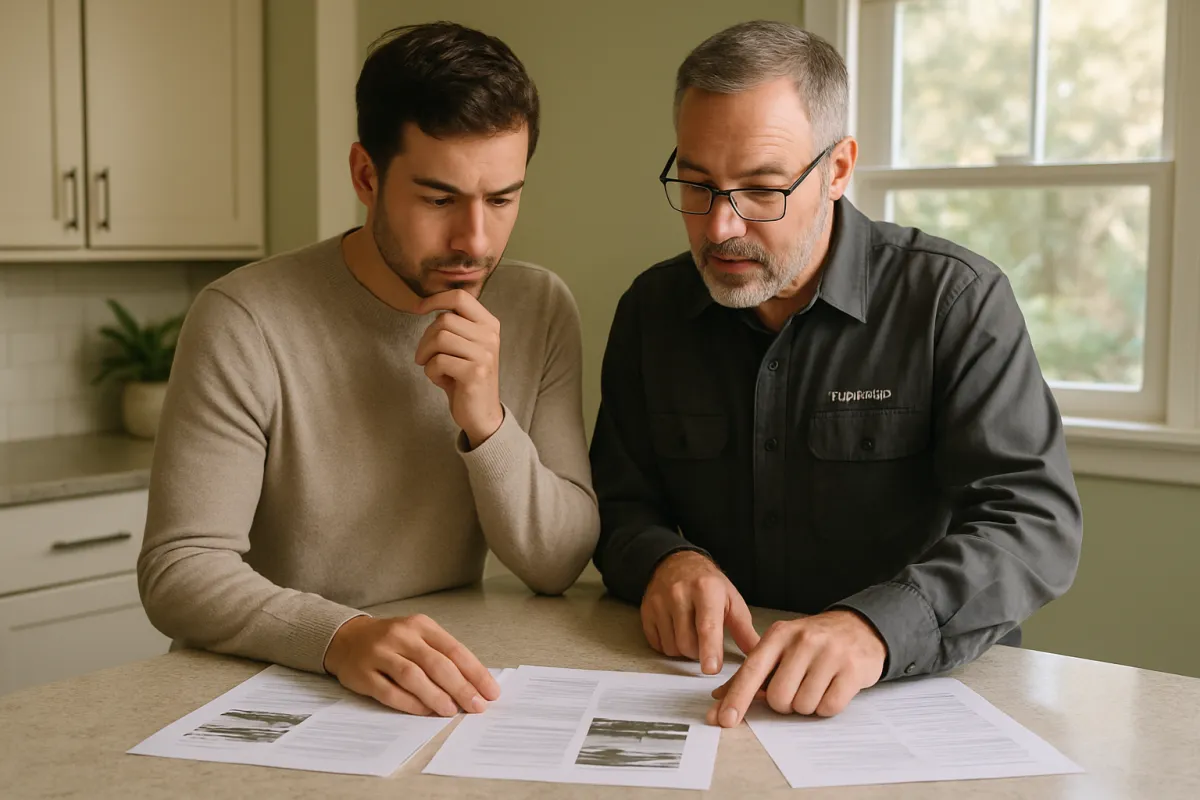
The chain of title is the sequence of transfers that connects today’s owner to an earlier one, and then to an earlier one still. Each link is a recorded instrument: a deed from a seller to a buyer, a deed from an estate to an heir, a sheriff’s deed, a trustee’s deed after a foreclosure. The examiner’s job is to confirm that each link connects properly to the next, that the person conveying the property in each document actually held it at the time, and that nothing in between broke the sequence.
Breaks are what the examiner is hunting. A gap appears when a document that should exist was never recorded, or was recorded under a name the index will not match, or was recorded out of order. A defective link appears when a deed was signed by only one of two owners, was never notarized where the state requires it, describes the wrong parcel, or was signed by someone acting under a power of attorney that had already expired. Individually these are paperwork problems. Cumulatively they are the difference between a property that can be conveyed and one that cannot.
How far back the examiner reaches is not a single national number. Some searches run the full chain to the earliest recorded transfer of the parcel. Some run a fixed period that local custom or a state marketable title statute treats as sufficient. Limited searches covering only the most recent owners are used in lower-risk situations such as refinances. A longer reach finds more but proves less than people assume, because a defect can originate outside any window and still be real. Ask what period is standard where you are buying, and treat the answer as local practice rather than as law everywhere.
The records a title examiner actually pulls
A search is not one lookup. It is a set of separate searches run against different record systems, some organized by parcel and some organized by the names of people, and the examiner has to run all of them because a claim against the owner can attach to the property without ever naming the property in an index. The categories below are the usual ones, though the names of the offices and the way they are organized differ from county to county.
- Deed records, tracing the transfers of ownership themselves.
- Mortgages and deeds of trust, plus the releases and satisfactions that should follow them.
- Judgment and lien records, including court judgments, mechanic’s liens, and government liens.
- Tax records, covering property taxes, special assessments, and municipal charges.
- Probate and estate files, where ownership passed through a death.
- Divorce and family court records, where a decree divided or awarded an interest.
- UCC filings, which can attach to fixtures rather than to land.
- Plats, easements, and recorded restrictions that define and limit the parcel.
Each of these is a different question about the same house, and each has its own way of going wrong. The rest of this market read takes them one at a time.
Deeds: the instruments that move ownership
Deeds are the backbone of the chain, and the examiner reads them for more than names. The legal description has to match the parcel being sold, which sounds trivial until you meet a deed that describes a lot by reference to a plat that was later amended, or a metes and bounds description that no longer closes because a road was widened. The grantor has to match the person who held title going in. The form of the deed matters too, because a warranty deed, a special warranty deed, and a quitclaim deed carry very different promises from the person signing.
Execution is the other half. Depending on the jurisdiction, a valid deed may need witnesses, a notarial acknowledgment, a spousal signature to release a marital or homestead interest, or specific language to be effective. A deed that skips a locally required element can be recorded and still be attackable, which is why examiners read the signature block as carefully as the description. Where a deed was signed by an entity rather than a person, the examiner also looks for evidence that the signer had authority to bind the entity, which is a common source of curative work when a small partnership or a family trust appears in the chain.
Mortgages, deeds of trust, and the release that should follow
Every mortgage or deed of trust recorded against the property should eventually be met by a recorded release, satisfaction, or reconveyance showing the debt was paid and the lien discharged. When that closing document never gets filed, the lien stays visible in the record even though the loan itself is long gone. This is one of the most common findings in the entire search, and it is almost always administrative rather than sinister: a lender was acquired, a servicing transfer dropped a file, a paper release was mailed and never recorded.
Clearing it means producing evidence of payoff and getting a release recorded, which can be quick if the lender still exists and slow if it does not. Where the original lender has been merged out of existence several times over, the examiner may have to trace the corporate succession to find who has authority to sign the release today. Some states provide statutory procedures for discharging an ancient satisfied lien, which is exactly the kind of local mechanism to ask your closing agent about rather than to assume. In the meantime, the item sits on the commitment as a requirement, and the closing cannot proceed as if it were not there.
Judgments, liens, and the name index problem
Judgments are searched by name, not by parcel, and that single fact causes more friction than any other part of the process. A money judgment entered against a person can attach automatically to real property that person owns in the county, so the examiner has to search the seller’s name, and often prior owners’ names, across the judgment and lien records for the relevant period. The search has to account for the way the person’s name actually appears in those records, which may not match the way it appears on the deed.
Mechanic’s liens deserve their own mention because they are tied to work rather than to lending. A contractor, subcontractor, or supplier who was not paid for improvements can generally record a claim against the property within a period set by state law, and in many states a properly perfected lien relates back to when the work began rather than to when it was filed. That is why a search on a recently renovated house draws extra attention, and why closing agents often ask a seller for lien waivers or an affidavit about recent work. Federal and state tax liens, child support liens, and code enforcement liens follow their own rules, and the details differ enough by jurisdiction that no general statement about priority or duration should be treated as universal.
Property taxes, assessments, and municipal charges
Property taxes are a lien on the property itself in most places, which means an unpaid balance follows the land rather than the person who ran it up. The examiner confirms the status of current and prior years, checks for any sale of a tax certificate or tax deed, and looks for special assessments levied for improvements such as sidewalks, sewer connections, or street work. These can be substantial and can be payable in installments that continue after your purchase, so knowing whether one is attached and how much of it remains is a real budgeting question, not a formality.
Municipal charges are the underrated category here. Depending on the locality, unpaid water and sewer bills, refuse collection charges, code violation fines, and demolition or nuisance abatement costs can become liens or can otherwise have to be cleared before a clean transfer. Some of these live in offices that are not part of the county recorder’s system at all, so the examiner or closing agent may have to request a payoff or a certificate directly from the municipality. Our property tax bill market read unpacks the tax side of that bill in detail, including the assessment lines that often surprise new owners.
Probate, divorce, and the question of who could legally sign
When a property passed through an estate, the examiner has to satisfy themselves that it passed properly. That means looking at the probate file: whether an estate was opened, whether a personal representative was appointed and had authority to convey real property, whether heirs were identified and given notice, and whether any required court approval was obtained. Where a property transferred by a small estate affidavit, a transfer on death deed, or a survivorship provision, the examiner checks that the instrument used was effective under local law for that situation.
Divorce records raise a parallel question. A decree can award one spouse the property, order a sale, or divide the proceeds, and the deed that follows should line up with what the decree required. Where it does not, or where a spouse with a marital or homestead interest never signed a deed out, an interest can survive quietly in the record. Trusts create their own version: the examiner wants to see that the trustee who signed had the power to sell and that the trust was in a position to hold the property at the time. In each of these cases the underlying question is identical and simple. Did the person who signed have the legal authority to sign.
Easements, plats, and recorded restrictions
Not everything the search finds is a defect. Many recorded items are permanent features of the parcel that will still be there after you own it, and the search exists partly to make sure you know about them. Easements give someone else a right to use part of your land: a utility company’s right to run and maintain lines, a neighbor’s recorded right to cross a driveway, a municipality’s drainage easement along a rear lot line. They are usually recorded, they usually run with the land, and they usually cannot be removed simply because you would prefer they were not there.
Plats and subdivision maps define the lot itself, including its dimensions, its access, and any setbacks or building lines drawn on the map. Recorded covenants and restrictions, common in subdivisions and in association-governed communities, can control everything from the materials on a roof to whether a fence is permitted. Where a homeowners association is involved, the search will also look at the recorded declaration that creates it and at whether the association has any recorded claim for unpaid dues, a topic our homeowners association market read develops further. Read this category as information rather than as an alarm, but read it, because it describes what you are actually buying.

UCC filings and the fixtures question
Uniform Commercial Code filings cover personal property rather than land, but they enter a title search through the door marked fixtures. When equipment is financed and then attached to a building, a lender can record a fixture filing to preserve a claim against that item even though it is now physically part of the property. Solar equipment, HVAC systems, commercial kitchen equipment, and similar installations are the usual candidates, and the filing may sit in a different index than the one used for mortgages.
For a typical single family purchase this is often a non-issue, but when it does apply it matters, because the buyer can end up owning a house with someone else’s security interest attached to a piece of it. The related trap is leased equipment, particularly leased solar arrays, where the agreement may need to be assumed by the buyer or terminated by the seller before closing. Ask specifically whether any equipment on the property is leased or separately financed, and let the closing agent tell you how that shows up in the record where you are buying.
Name variations and identity mix-ups
Because the judgment and lien searches run against names, spelling is not a clerical detail; it is the search itself. A person may appear in records as Robert, Bob, or R. James. A married name may differ from the name on a deed signed years earlier. A junior and a senior may share a name in the same county. A name may be transliterated differently by two clerks. Each of these can cause a real claim to be missed or an unrelated claim to be attached to the wrong person.
The second failure is the more common one at closing, and it has a standard remedy. When a judgment surfaces against someone with the same or a similar name, the seller signs an affidavit of identity, sometimes called a not the same person affidavit, stating under oath that they are not the individual named in that judgment and supplying identifying details. The title company evaluates it and, if satisfied, removes the item. It is a quick fix once identified, but it does require someone to notice the mismatch in the first place, which is why examiners search name variants rather than a single exact string.
The defects a search most often turns up
Grouping the findings makes the pattern clear. The overwhelming majority are ordinary and fixable, and only a small minority reach the level of a genuine ownership dispute.
- Unreleased mortgages and satisfied liens still on the record. Paid long ago, never discharged, still visible.
- Unpaid property taxes, special assessments, and municipal charges. Usually settled from the seller’s proceeds at closing.
- Mechanic’s liens from recent work. Common on renovated properties, cleared by payment and a recorded release or a waiver.
- Judgments against a same or similar name. Frequently resolved by an affidavit of identity.
- Easements, plat lines, and recorded restrictions. Not usually removable, disclosed as exceptions.
- Boundary and legal description problems. A description that does not match the parcel, or a plat that was amended.
- Missing or unknown heirs, and unfinished probate steps. Slower, sometimes requiring a court proceeding.
- Improperly executed or forged documents. Rare, and the category where the policy matters most.
The practical takeaway is that most title work is administrative cleanup done quietly by the closing agent. The reason it still deserves attention is that the rare items in the last two lines are the ones that can cost an owner their equity.
Illustrative days to clear a common finding
The chart below is an illustrative sketch of how long different curative tasks tend to run once a finding is identified. These are not measured figures and they are not promises. They are a rough sense of relative effort, drawn to make one planning point visible: the difference between the fastest and the slowest curative item is far larger than most buyers assume when they agree to a closing date.
Illustrative days to clear a title finding
Relative curative effort by finding type. Illustrative only, and highly dependent on the parties involved and local practice.
Bars are scaled from the illustrative day counts shown, against a 45 day maximum. A tax payoff is a same week task; a probate step can outlast an entire contract period.
Read the bottom bar as the warning it is. A thirty day contract-to-closing window has room for a tax payoff, an identity affidavit, and usually a mortgage release. It does not comfortably contain a probate step, and it certainly does not contain two slow items running at once. This is why an early search order is worth more than an aggressive closing date, and why the companion on this page prices your own window against the same illustrative curative clock.
The preliminary report or title commitment
The written output of the search goes by different names in different places. In much of the country it is a title commitment, a document in which the title company commits to issue a policy on stated terms once stated conditions are met. In other regions, particularly on the West Coast, the same function is served by a preliminary report or prelim. The names differ and so do some of the legal implications, but for a buyer reading it the practical content is similar: here is what we found, here is what we will insure, here is what we will not, and here is what has to happen first.
The single most useful habit a buyer can build is to actually read this document when it arrives rather than filing it. It is the only place the record’s findings are collected in one list, and it is written in enough plain language that a careful non-lawyer can follow it with an occasional question to the closing agent. It typically arrives with copies of the underlying documents attached, so an easement referenced on the schedule can be read in full. Treat the arrival of the commitment the way you treat the arrival of the inspection report, as something to work through with your agent and, where the stakes justify it, an attorney.
How to read Schedule A
Schedule A is the factual summary, and it is short. It states the effective date of the search, which matters because anything recorded after that moment is outside what was examined. It names the proposed insured parties, typically you as the buyer and your lender. It states the policy amounts, usually the purchase price for an owner’s policy and the loan amount for a lender’s policy. It identifies the current record owner and the estate or interest being insured, most often fee simple. And it carries the legal description of the property.
Check four things here, and check them the day it arrives. Is your name spelled exactly as it will appear on the deed. Is the legal description the property you actually walked through, including any additional lot or strip you believe is part of the deal. Is the policy amount right. And is the record owner the person who signed your purchase contract, because a mismatch there is worth resolving immediately rather than in the closing week. Errors on Schedule A are usually easy to correct early and awkward to correct late, which our closing disclosure market read makes the same point about on the money side.
How to read Schedule B
Schedule B is where the search results live, and it usually comes in two parts. The first part, often labeled Schedule B-I or Requirements, is a task list: the specific things that must be done before the policy will issue. Pay and release this mortgage. Record this corrective deed. Obtain this affidavit. Produce evidence of the trustee’s authority. Every line in this section is a piece of work assigned to somebody, and a closing date is only realistic if every one of them can be finished in time.
The second part, often labeled Schedule B-II or Exceptions, is the opposite: items the policy will not cover. Some are standard exceptions that appear on nearly every commitment, such as matters a survey would disclose, rights of parties in possession, or unrecorded mechanic’s liens. Others are specific to your parcel: a named utility easement, recorded covenants, a mineral reservation from decades ago. Read the specific exceptions closely, because each one describes a risk you are keeping. Some standard exceptions can be removed by providing a survey or an affidavit, and some specific risks can be covered by an endorsement for an added premium, both of which are conversations to have before closing rather than after.
Where the contract-to-closing window actually goes
The second chart splits an illustrative contract-to-closing period into the four phases of the title workstream. It assumes a clean-enough file with one real curative item, which is the ordinary case rather than the worst one. The proportions matter more than the days: search and examination is the visible part, but curative work is the phase that most often decides whether the closing date holds.
An illustrative split of the title workstream
Shares of a contract-to-closing window on a file with one real curative item. Illustrative only.
Shares sum to 100 percent of the window. On a thirty day contract that is roughly nine days of searching, six of review, twelve of curative work, and three at the end. Your file will differ.
The shape of this bar explains most title-driven closing delays. Buyers assume the search is the long pole, so they relax once the commitment arrives, but the commitment is the beginning of the work rather than the end of it. The safest thing a buyer can do is push for an early search order and read the commitment the day it lands, because every day saved in the first two segments is a day added to the segment that actually runs out. Sizing your own window against your own numbers is what the companion on this page is for, alongside the affordability calculator for the payment underneath.
Curing a defect and who pays for it
Curative work is the practical heart of the process, and it is more mundane than the word suggests. Paying off a debt from the seller’s proceeds at closing. Chasing a lender for a release of a mortgage that was satisfied years ago. Getting a contractor to sign and record a lien waiver. Recording a corrective deed to fix a legal description or a missing notarization. Obtaining an affidavit of identity. Completing a probate step or, in a harder case, filing a quiet title action to have a court settle a disputed claim.
Who pays follows from who is responsible, and that is a contract and custom question rather than a national rule. Purchase contracts commonly obligate the seller to deliver marketable or insurable title, which in practice places the cost of clearing pre-existing defects on the seller, often by deducting the payoff from the sale proceeds at closing. Buyers commonly pay for items tied to their own loan and, in some markets, for the search and settlement work itself. Where a cure cannot be completed before closing, the closing agent may hold funds in escrow, frequently at more than the face amount of the claim, until a release is recorded. Read your own contract, and where a defect is serious enough to affect value or use, get advice from a real estate attorney before you agree to close around it.

Why a survey answers what a search cannot
A title search reads documents. It does not go to the property, it does not measure anything, and it cannot tell you whether the physical world matches the paper. That is the survey’s job, and the two are complementary rather than redundant. A survey locates the boundaries on the ground, plots the improvements, and shows how the structures, fences, driveways, and utilities sit relative to the lot lines and to any recorded easements.
The problems a survey finds are the ones a search structurally cannot. A neighbor’s fence built two feet inside your line. A garage that crosses a setback. A shed sitting on a utility easement. A driveway that has been shared by custom for thirty years with nothing recorded about it. An addition built without a permit that now sits over a building line. None of these appear in a deed index, because none of them are documents. This is also why commitments carry a standard exception for matters a survey would disclose, and why providing an acceptable survey is frequently what allows that exception to be removed or replaced with specific ones. If the parcel is irregular, rural, unfenced, or recently improved, a survey is worth its cost for exactly the reasons the search cannot cover.
What a title search cannot find at all
Beyond the survey gap, there is a category of risk that no amount of careful reading can reach, because the problem was never in the record or was in the record incorrectly. This list is short and it is the reason the insurance product exists.
- Forged, fraudulent, or coerced documents. A forged deed can look entirely regular on its face and can be recorded without anyone questioning it.
- Undisclosed or unknown heirs. A person with a legitimate claim through an estate may simply not appear anywhere in the file.
- Unrecorded interests. An unrecorded lease, an unrecorded easement by long use, an option, or a side agreement that was never filed.
- Clerical and indexing errors. A document filed under a misspelled name or indexed to the wrong parcel can be effectively invisible to a name search.
- Capacity problems. A signer who lacked legal capacity, or who signed under a power of attorney that had been revoked.
- Post-search filings. Anything recorded between the search date and the recording of your deed, which the final rundown is designed to catch but cannot guarantee.
Every one of these is a defect that exists on the day you close, whether or not anybody knows it. That is the precise definition of what a title policy is built to cover, which is why the search and the policy are sold together and why declining the owner’s policy means keeping this list yourself. The trade-off is laid out in our title insurance market read.
Search customs vary by state and by county
It is worth stating plainly, because a national article about a county-level process can otherwise mislead. Recording systems, search customs, curative procedures, who performs the work, what the output document is called, how far back the examination reaches, and who customarily pays are all local. Two counties in the same state can differ in how their indexes are organized and how quickly a document becomes searchable after it is filed. Some states regulate title charges and some do not.
The consequence for a buyer is simple. Any specific number, period, or custom you read anywhere, including here, is a starting point for a question rather than an answer. The right question to ask your closing agent is not whether something is standard, but whether it is standard here. If you are buying in a state you have not bought in before, that question is worth asking early, and our out of state purchase market read covers the wider version of the same problem. Buyers purchasing together should also ask how title will be held, since the form of co-ownership is decided at closing and is covered in our co-purchase market read.
A worked example: one search, one problem, one closing
Take an illustrative purchase at $400,000 with ten percent down, so a $40,000 down payment and a $360,000 loan, and a contract that allows thirty days to closing. The file opens the day after the contract is signed. Search and examination take roughly nine days, tracing the chain back through an illustrative forty year period. At an illustrative average ownership tenure of about twelve years, that period spans roughly three and a third transfers and pulls somewhere near thirteen recorded documents, which is a normal-sized file rather than a difficult one.
The commitment arrives on about day nine. Schedule A checks out. Schedule B-I carries three requirements. First, a mortgage from two owners ago that was paid off but never released. Second, a judgment recorded against someone sharing the seller’s name. Third, an unpaid municipal charge. The buyer and agents read it over the next six days and the curative work runs in the following twelve. The lender release takes about fourteen days from request, which is tight but lands. The judgment is cleared with an affidavit of identity in about a week. The municipal charge, an illustrative $6,800 across the outstanding items, is paid from the seller’s proceeds at closing. Search and examination plus settlement work runs an illustrative $480 in total on this file.
Now change one fact. Suppose the second requirement had instead been an unfinished probate step on an estate in the chain, at an illustrative forty five days. Twelve days of curative room does not hold it, and the closing date moves. Same house, same price, same search, entirely different outcome, decided by which item the record happened to contain. Every figure here is illustrative; the companion recomputes the whole sequence from your own price, window, and findings.

Common mistakes buyers make about the title search
The errors cluster in a few predictable places, and each one is avoidable with a single question asked early.
- Treating the commitment as paperwork. It is the only consolidated list of what the record says about the property you are buying. Read it the day it arrives.
- Skipping Schedule B-II. The exceptions are the risks you are keeping. A buyer who reads only the requirements has read half the document.
- Assuming the search covers the boundaries. It does not measure anything. Fences, encroachments, and setback problems are survey findings.
- Agreeing to a short closing window before the file is opened. Curative work is the phase that runs out of time, and you cannot compress a lender’s release process by wanting it faster.
- Assuming the seller automatically pays for everything. Responsibility for the search, the settlement work, and curative costs follows the contract and local custom, and it is negotiable in many deals.
- Ignoring an easement because it looks harmless. An easement that runs where you intended to build a garage is not harmless, and it will still be there under the next owner.
- Believing a clean search means no risk. A clean search means nothing adverse was found in the records examined, which is genuinely good news and is not the same as a guarantee.
Each of these comes from treating the search as an administrative step performed on your behalf rather than as a report written for you to read.
A short title search checklist
A compact sequence keeps the title workstream from becoming the reason a closing slips.
- Ask when the search was ordered. Early in the contract period is the answer you want, and it is a fair question for your agent or closing agent.
- Ask who performs it locally. Title company, escrow company, abstractor, or attorney, because that shapes who you talk to when a question comes up.
- Read Schedule A the day it arrives. Names, legal description, policy amounts, record owner. Correct any mismatch immediately.
- Work Schedule B-I as a task list. For each requirement, confirm who owns it and when it will be done.
- Read every specific exception in Schedule B-II. Request copies of the underlying documents for anything that affects how you plan to use the property.
- Ask about a survey. Particularly on irregular, rural, unfenced, or recently improved parcels, and ask what removing the standard survey exception would require.
- Confirm who pays what in your contract. Search, settlement, and curative costs are assigned by agreement and custom, not by a national rule.
- Keep the final documents. The policy, the commitment, and any survey are worth storing for as long as you own the property.
A buyer who works this list turns an invisible process into a short set of answered questions, which is all it needs to be. The related sequencing of inspections and deadlines sits in our contingencies market read, and the total cash side of the closing is laid out in our cash to buy market read.
The bottom line
A title search is a reading of the public record that answers whether the seller can legally deliver the property and what claims come attached to it. It builds the chain of ownership from one recorded transfer to the next, checks deeds and mortgages and releases and judgments and taxes and probate files and plats, and reports the result in a commitment or preliminary report whose two schedules tell you what has to be fixed and what will never be covered. Most of what it finds is administrative and gets cleared quietly before closing.
What deserves your attention is the small part that does not clear quietly, and the smaller part the search cannot see at all. Curative work is the phase that decides whether a closing date holds, so an early order and a same-day read of the commitment are worth more than any other habit. A survey answers what the records cannot, because the records do not measure land. And forgery, unknown heirs, unrecorded interests, and indexing errors sit permanently outside the reach of any search, which is exactly the case for the policy described in our title insurance market read. Every custom, period, and figure in this article varies by state and often by county, so confirm the local version with your own closing agent, and use the affordability calculator to keep the payment underneath all of this sized honestly.
Treat this market read as background on a process, not as legal advice about your property. Recording systems, search practices, curative procedures, lien rules, marketable title periods, and the customs governing who orders and who pays are set at the state and often the county level, and they change; nothing here describes the rule in any particular place. Every day count, percentage, and dollar amount above is illustrative and chosen to show relative scale rather than to report measured practice. Your own commitment, its exceptions, and your purchase contract govern your transaction, and any question touching ownership, a recorded claim, a boundary, or an inherited interest belongs with a licensed real estate attorney, a title professional, or a surveyor in the jurisdiction where the property sits.
Frequently asked questions
What is a title search in simple terms?
A title search is an examination of public records to work out who legally owns a property and what claims are attached to it. Someone at a title company, an abstract company, or a real estate attorney's office pulls the recorded documents tied to the property and to the people who have owned it, then reads them in order to build a chain of ownership from one transfer to the next. Along the way the examiner looks for anything that would interfere with a clean transfer to you: an unreleased mortgage, an unpaid tax, a recorded lien, an easement, a restriction, or a signature that should not have been there. The result is written up as a preliminary report or a title commitment that says what the company is willing to insure and what it will not. Which records are searched, how far back, and who performs the work all vary by state and often by county, so ask your closing agent how it is done where you are buying.
Who orders the title search and who pays for it?
In most transactions the search is ordered by whoever is running the closing, which may be a title company, an escrow company, a settlement agent, or a closing attorney depending on local practice, and the order usually goes in shortly after the purchase contract is signed. Who pays is a matter of state and even county custom rather than a national rule. In some markets the buyer customarily pays for the search and the related settlement work, in others the seller pays because the seller is the party promising marketable title, and in many deals it is simply negotiated in the contract. The charge often appears on the closing statement bundled with settlement or closing fees rather than as a standalone line. Read your purchase contract and your Closing Disclosure to see who is assigned the cost in your own deal.
How long does a title search take?
There is no fixed answer, because the time depends on how the records are kept and what the search turns up. Where deed and lien records are fully digitized and indexed, an examiner may assemble a clean chain in a matter of days. Where older documents sit only on paper or on microfilm in a county office, or where the property has changed hands many times, the same work can stretch considerably longer. The bigger variable is not the search itself but the curative work that follows a finding: paying and releasing an old mortgage may take a couple of weeks, while an unfinished probate can outlast a normal contract period entirely. Build the search into your contract timeline early rather than assuming it will fit whatever days are left.
How far back does a title search go?
It depends on where the property sits and on the custom the examiner follows. Some searches trace ownership back to the earliest recorded transfer of the land, others run a fixed number of years that local practice or a state marketable title statute treats as sufficient, and a limited search used for a refinance or a low-risk file may cover only the most recent owners. A longer look back finds more, but no search period is a guarantee, because a defect can originate outside the examined window and still matter. What actually protects you against a defect outside the search period is the policy, not the search. Ask your title professional what period is standard where you are buying and why.
What kinds of problems does a title search usually find?
The most common findings are ordinary administrative loose ends rather than dramatic ownership disputes. Examiners frequently turn up mortgages that were paid off but never formally released, unpaid property taxes or municipal charges, contractor or mechanic's liens from recent work, judgments recorded against someone with a similar name, easements and recorded restrictions that will stay with the land, and gaps or errors in how a prior deed was signed, witnessed, or notarized. Less often but more seriously, a search can raise questions about heirs, about a signature on an old deed, or about whether a party who signed had the legal authority to do so. Most of these are cleared before closing. The ones that cannot be cleared are usually written into the commitment as exceptions, which is the title company's way of saying it will not insure that item.
What is the difference between a title search and title insurance?
The search is the investigation and the policy is the protection, and they do different jobs. The search reads the public records and reports what is there, which lets the parties clear problems before money changes hands. Title insurance is issued afterward and covers the risk that something was missed or was never in the records at all, such as a forged signature, an unrecorded interest, or an heir nobody knew about. One reduces risk up front; the other absorbs what slips through. Our market read on title insurance covers the policy side in detail, including the difference between the lender's policy and the owner's policy.
Can a title search miss something?
Yes, and that limitation is the whole reason the insurance product exists. A search can only report what is recorded and correctly indexed, so an unrecorded lease, an undisclosed heir, a forged or fraudulently obtained deed, a document filed under a misspelled name, or a clerical error in the index can all sit outside its reach. A search also does not measure the land, so an encroaching fence or a structure over a setback is a survey question rather than a records question. Examiners are careful, and most files are clean, but no reading of public records can prove a negative. Treat the search as the best available read of the record, not as a guarantee of fact.
What happens if the title search finds a problem?
Most findings are resolved through curative work before closing rather than by cancelling the deal. Depending on the item, that can mean paying off a debt from the seller's proceeds at closing, obtaining a written release or satisfaction from a lender or contractor, recording a corrective deed, having a party sign an affidavit of identity to separate them from a same-name judgment, or completing a probate step. Sometimes the closing agent holds funds in escrow until a release is recorded. If an item cannot be cleared, it is usually listed as an exception in the commitment, and you and your attorney decide whether the property is still acceptable with that item attached. Who pays for curative work is generally a matter of contract and custom, so check what your purchase agreement says.

Hamza Hai is the editor of AbodeWave. She holds an MBA and reviews the site's articles against our editorial standards, checking that every figure is labelled for what it is, that nothing is presented as verified fact without a source the reader can check, and that the writing stays useful to a non-specialist.