
What's in this market read
- Before you start
- Why there are two documents, not one
- What a loan estimate actually is and when you get it
- The loan estimate’s three pages, mapped
- Reading the loan terms and projected payments on the loan estimate
- Reading the costs on the loan estimate
- The loan estimate’s comparison tools: APR, total interest percentage, and the ten year calculation
- What a closing disclosure is, briefly, and where to read it in full
- Shopping with multiple loan estimates before you choose a lender
- When a revised loan estimate is issued
- Line by line: comparing loan estimate to closing disclosure
- Which numbers must not increase, which can shift, and which move freely
- Why some numbers change for good reasons
- What to do when a figure does not match
- Illustrative side-by-side: loan estimate vs closing disclosure totals
- What changed and why, in one chart
- The worked example: one buyer compares three loan estimates, then the closing disclosure
- How your agent and settlement team fit into the comparison
- Common mistakes comparing the two documents
- Troubleshooting situations that complicate the comparison
- Your loan estimate vs closing disclosure checklist
- The bottom line
Short answer: The loan estimate is the standardized quote you receive early, and the closing disclosure is the standardized final version of the same deal, received just before you sign. Compare them using the comparison section printed on the closing disclosure itself: charges the lender controls generally cannot increase, charges you shopped for can rise within a limited tolerance, and prepaid items tied to the closing date can change freely. A modest total increase is common; an unexplained one is worth a written question before you sign.
Every mortgage borrower receives two standardized federal disclosure forms built to look alike on purpose, and the similarity is the entire point: a loan estimate issued early and a closing disclosure issued late are designed to be placed side by side so you can see exactly what moved between a quote and a final deal. Most buyers read whichever one lands in their inbox that week and never actually set the two forms next to each other, which is where the real value of having both disappears.
This market note treats the comparison as its own skill. It covers what a loan estimate actually contains and when it arrives, how to use multiple loan estimates to shop lenders honestly, what a revised loan estimate means, and exactly how to read the closing disclosure’s comparison section line by line against it. For a full line-by-line walkthrough of the closing disclosure itself, our closing disclosure note covers that document in depth; this note focuses on the loan estimate and the comparison between the two. It also sits alongside our pre-approval walkthrough and our buyer closing-cost breakdown. The companion beside this note reprices your own estimate-to-final gap as you read.
Key takeaways
- The loan estimate is an early standardized quote, typically received within a few business days of applying. The closing disclosure is the standardized final version, received shortly before you sign.
- Both forms are free to receive, which makes requesting loan estimates from multiple lenders one of the few genuinely costless ways to compare mortgage offers.
- Closing costs are grouped into categories that behave differently between the two forms: some cannot increase, some may rise within a limited tolerance, and some change freely with the closing date.
- A revised loan estimate can be issued when a genuine changed circumstance affects the deal, and it resets the comparison going forward from that point rather than excusing an unrelated fee increase.
- The closing disclosure's own comparison section restates your loan estimate beside the final figures, which is the single most useful page for catching an error before you sign.
Before you start
Comparing these two documents properly is roughly an hour of work the first time, done in two sittings weeks apart: once when loan estimates arrive and once when the closing disclosure does. The difficulty is low, since nothing here is harder than reading two forms side by side, but it depends on actually keeping the first one.
- Every loan estimate you receive, even from lenders you ultimately do not choose, since comparing several is the only way to know whether your chosen lender’s numbers were competitive.
- The loan estimate from the lender you actually selected, kept specifically for comparison against the closing disclosure later, since comparing against a different lender’s quote produces meaningless differences.
- Any written fee agreements, such as a lender credit or a rate lock confirmation, since these are the promises the comparison section is meant to verify were honored.
- A calculator for the cash-to-close math. Our affordability calculator is useful alongside this note for checking that a final payment still fits the budget you set when you first compared lenders.
One framing note before anything else. Every dollar figure in this walkthrough, the price, the rate, and every cost, is illustrative and built around one consistent example so the arithmetic is followable. Disclosure timing rules, tolerance categories, and what counts as a valid changed circumstance are set by federal regulation, apply with some variation by loan type, and can change over time. Confirm the current specifics with your lender or a HUD-approved housing counselor before relying on anything here.
Why there are two documents, not one
A single document issued once, at application, could never serve both purposes a mortgage closing actually needs. Early in the process, a lender has not yet ordered an appraisal, finished underwriting, or confirmed the exact closing date, so any number quoted at that stage is necessarily an estimate. By the time those pieces are settled, weeks have often passed, and the original numbers may no longer be accurate even when nothing went wrong.
The loan estimate exists to give you an early, standardized, comparable quote while there is still time to shop and negotiate. The closing disclosure exists to state the final, binding numbers once everything is actually known, with a mandatory review period attached so you have time to check it before signing. Two documents, issued at two different moments, each doing a job the other cannot.
The shared structure between them, a loan terms box, a projected payments table, and similarly organized cost sections, is what makes the two-document system work at all. Without that shared format, comparing an early estimate to a final disclosure would require decoding two different layouts instead of simply reading the same layout twice.
What a loan estimate actually is and when you get it
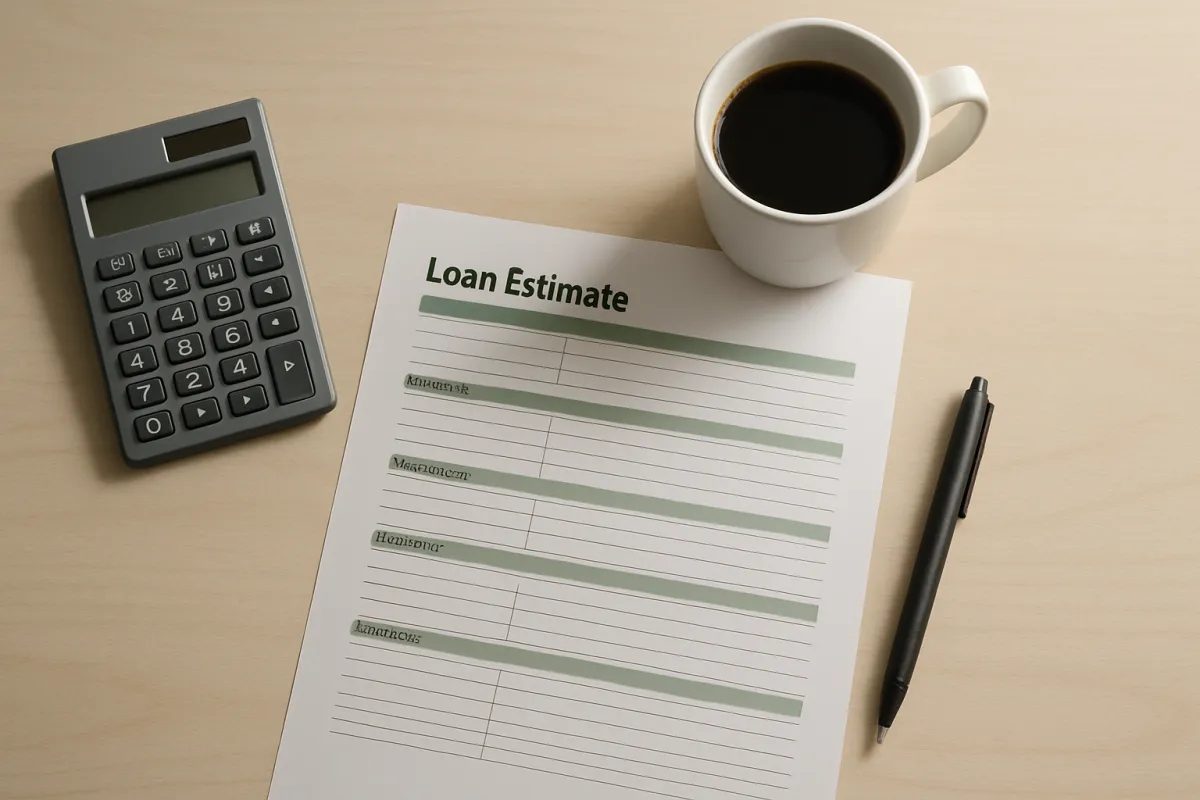
A loan estimate is a standardized three-page form a lender is required to provide within a few business days after receiving your completed application, built to the same federal template regardless of which lender issues it. It states the proposed loan amount, interest rate, projected monthly payment, an estimate of closing costs, and a handful of comparison figures meant to help you evaluate the offer against others.
It is explicitly an estimate rather than a commitment. Nothing on it obligates the lender to actually make the loan on exactly those terms, and nothing on it obligates you to proceed with that lender. Its purpose is comparison and planning, which is why the form uses the word estimate throughout rather than final.
Receiving a loan estimate is also, in most cases, free. Applying for a mortgage and receiving this form does not commit you financially, which is the basis for the shopping strategy covered later in this note: there is little reason to evaluate only one lender’s quote when several more are available at no cost.
The loan estimate’s three pages, mapped
Knowing the shape of the form before you read it closely saves time, since the three pages carry distinctly different information. Page one carries the loan terms, the projected payments table, and a summary of your estimated closing costs and estimated cash to close, the same categories of information the closing disclosure’s own first page carries.
Page two carries the closing cost details in two tables, loan costs and other costs, broken into lettered sections much like the closing disclosure, though the loan estimate groups a few sections slightly differently since it is working from projections rather than final figures. This page is where the bulk of the dollar detail lives.
Page three carries the comparison figures: the annual percentage rate, the total interest percentage over the loan’s full term, and a statement of whether the loan can be assumed by a future buyer. It also typically includes contact information and, on some versions of the form, a brief confirmation section for your signature acknowledging receipt, which is not the same as agreeing to the loan.
Reading the loan terms and projected payments on the loan estimate
The loan terms box on page one states the proposed loan amount, interest rate, and monthly principal and interest payment, each with a yes-or-no indicator for whether that figure can change before closing. Read these indicators as carefully here as you would on the closing disclosure, since an estimate that already signals a variable rate or an adjustable payment is telling you something important about the loan product itself, not just the price.
The projected payments table below it adds mortgage insurance and an estimated escrow for taxes and insurance, producing an estimated total monthly payment. Because taxes and insurance are themselves estimates this early in the process, this total is the figure most likely to shift by the time the closing disclosure arrives, generally for reasons unrelated to anything the lender did wrong.
Compare the loan terms box across multiple lenders’ loan estimates if you are shopping, since this is where a materially different rate or a different loan structure becomes visible immediately, before you get anywhere near the closing cost detail on page two.
Reading the costs on the loan estimate
Page two’s closing cost tables work much like the closing disclosure’s do, separating origination charges and services the lender selected from services you were allowed to shop for yourself, then adding taxes, government fees, prepaid items, and the initial escrow deposit in a second table. The dollar figures here are projections, built from the lender’s typical experience and any quotes already available, rather than final invoiced amounts.
Pay particular attention to which services are marked as ones you can shop for versus ones the lender selected, since this distinction follows you all the way to the closing disclosure’s comparison section and determines which tolerance category a given charge falls into later. If you intend to shop for your own title company or survey provider, the loan estimate is where that choice should already be reflected or at least anticipated.
Total estimated closing costs and estimated cash to close appear on page one as a summary of everything detailed on page two. These are the two headline figures worth comparing most carefully across multiple lenders’ estimates, since a lower rate from one lender can sometimes be offset by meaningfully higher fees from another.
The loan estimate’s comparison tools: APR, total interest percentage, and the ten year calculation
Page three carries three figures specifically designed to help you compare loans that might otherwise look similar on the surface. The annual percentage rate folds certain loan costs into a single rate figure, so it is generally higher than the plain interest rate on any loan carrying meaningful fees, and a wide gap between the two numbers signals a loan with substantial upfront charges.
The total interest percentage states the total interest you would pay over the full loan term as a percentage of the loan amount, which is a blunt but useful way to compare the long-run cost of different loan terms, particularly when comparing a fifteen year loan against a thirty year one. It is not the same measure as the annual percentage rate, and the two should not be read as interchangeable.
A separate calculation on this page, sometimes labeled in terms of the first five years of payments, shows how much of your payments go to principal versus interest and the total you would have paid over that early stretch, which is useful context if you expect to sell or refinance before the loan matures rather than holding it for the full term.
What a closing disclosure is, briefly, and where to read it in full
The closing disclosure is the standardized final version of the same deal, provided before you sign, restating the loan terms and costs with actual final figures rather than estimates, and adding material the loan estimate never carried: the seller’s side of the transaction, a calculating cash to close table, and the loan calculations page with the total of payments and finance charge.
This note does not re-walk the closing disclosure line by line, since our closing disclosure note already covers that document section by section in full detail, including how to verify the projected payments, walk both cost tables, and rebuild your cash to close figure from scratch. What matters here is narrower and, for most buyers, more immediately useful: how the closing disclosure’s own built-in comparison section measures your final numbers against the loan estimate you already have in hand.
That comparison section is the bridge between the two documents, and it is the single page most buyers skip even though it does the comparison work for you, restating your original loan estimate figures directly beside the closing disclosure’s final ones.

Shopping with multiple loan estimates before you choose a lender
Because a loan estimate costs nothing to receive and follows an identical format across every lender, requesting one from two or three lenders is one of the few genuinely free ways to compare mortgage offers before committing to one. Request them within a similar window, since rates move daily and a wider gap in request dates can produce a misleading comparison that has more to do with timing than with which lender is actually cheaper.
Compare the interest rate and the loan terms box first, then compare total estimated closing costs, paying particular attention to section A origination charges, which reflects what each specific lender charges for making the loan rather than third party costs that would be similar regardless of lender. A lender quoting a slightly higher rate but meaningfully lower fees can be the better overall deal depending on how long you expect to keep the loan.
Once you choose a lender, keep every other estimate you received, not just the winning one, since they document what the market was actually offering at the time and are useful if you later want to question why your chosen lender’s costs ended up different from what was initially competitive.
When a revised loan estimate is issued
A lender may issue a revised loan estimate when a genuine changed circumstance affects the deal: a change in the loan amount or program, new information about your credit profile, a change in the property itself such as a different appraised value, or a request you make to add or remove a loan feature. A revised estimate resets the baseline for comparison going forward from the date it is issued, which matters because the closing disclosure’s comparison section will measure against the most recent valid estimate, not the very first one, if a revision legitimately occurred.
What a revision cannot generally do is retroactively excuse an increase in a charge that was never allowed to change in the first place. If a lender attempts to justify a higher origination fee by issuing a revised estimate without a genuine changed circumstance behind it, that is worth questioning directly rather than accepting as routine paperwork.
Keep every version of the loan estimate you receive, dated, so you can see exactly when and why a revision occurred, and use the most recent legitimate one as your comparison baseline when the closing disclosure finally arrives.
Line by line: comparing loan estimate to closing disclosure
With your final loan estimate and the closing disclosure both in hand, start with the loan terms box on each and confirm the loan amount, rate, and monthly principal and interest match, or that any difference is one you already expected and agreed to. Then move to the total estimated versus total final closing costs, which is the headline comparison most buyers care about first.
From there, work section by section using the closing disclosure’s own comparison page, which restates the loan estimate figures beside the final ones for exactly this purpose. Note the dollar difference in each major category, and before concluding anything is wrong, identify which tolerance category that specific charge falls into, since the answer to whether a change is a problem depends entirely on that category, covered in the next section.
Resist comparing total dollar figures alone without checking which specific line items moved. A total that looks unchanged can still hide one charge that rose and another that fell by a similar amount, and only the line-by-line comparison reveals that kind of offsetting movement.
Which numbers must not increase, which can shift, and which move freely
Closing costs sort into three behaviors, and understanding them is what turns the comparison from an exercise in suspicion into an informed check. Charges the lender itself sets and controls, generally its own origination fees and charges for services it required where you had no choice of provider, are generally not allowed to increase from the loan estimate to the closing disclosure at all.
A second group may rise, but only within a limited overall tolerance applied across the group as a whole rather than line by line, typically covering recording fees and services you were allowed to shop for but chose a provider from the lender’s own list. One line in this group can rise if another falls, as long as the group’s total increase stays within the allowed tolerance.
A third group can change freely because the figures depend on facts not fixed until the closing date itself, most commonly prepaid interest, which depends on exactly how many days fall between closing and your first full mortgage payment, and the initial escrow deposit, which depends on the specific month taxes and insurance are due. A change in this group is the least likely to signal a problem and the most likely to simply reflect the calendar.
Why some numbers change for good reasons
The most common source of an increase between the two documents is not an error at all, it is a closing date that moved. A closing pushed back by even a few days adds days of prepaid interest and can shift how much initial escrow cushion the servicer needs to collect, both of which are facts that genuinely cannot be fixed until the date is actually set.
A second common, legitimate source is a choice you made yourself after the loan estimate was issued, such as selecting an owner’s title insurance policy you were not required to buy, or choosing a different, more expensive provider for a service you were allowed to shop for. Neither of these is a lender error; both reflect decisions or timing facts that simply were not known when the earlier estimate was prepared.
Recognizing these legitimate sources matters because treating every increase as suspicious burns the attention and credibility you need for the line that actually is a problem. The discipline is to check every change against its tolerance category first, and reserve genuine concern for a charge in a category that was never supposed to move.
What to do when a figure does not match
If a charge in a category that should not have increased did increase, raise it in writing immediately, addressed to your loan officer and your settlement agent together, citing the specific section, the loan estimate figure, the closing disclosure figure, and the difference. Ask for a corrected disclosure showing the right number, not a verbal assurance that it will be handled at the table.
If the charge falls in the limited tolerance group and the group as a whole appears to exceed what is allowed, the same written approach applies, since the lender is generally expected to cure an improper increase, often through a credit, though the specific mechanism and amounts depend on rules that can change, so ask your lender directly how a cure would be applied in your case.
Keep the exchange in writing and keep your original loan estimate attached to every message, since a corrected disclosure is far easier to obtain when the request is specific, documented, and sent well before the signing date rather than raised verbally at the closing table itself.
Illustrative side-by-side: loan estimate vs closing disclosure totals
Numbers make the comparison concrete. The chart below follows one illustrative purchase where the total closing costs moved by $250 between the loan estimate and the closing disclosure, and ranks the three sources of that increase.
Where an illustrative $250 increase came from
One illustrative $320,000 purchase with a $288,000 loan. Bars scaled to the largest source of the increase. Your own gap, if any, will trace to different lines.
Each bar is scaled to the largest source, $150 of additional prepaid interest from a later closing date. All three sources here fall into categories allowed to move, which is why a $250 total increase on this illustrative purchase is a calendar story rather than an error to dispute.
The pattern worth remembering is that an increase concentrated in prepaid interest and escrow almost always traces back to one thing: the closing date moved. Before assuming any charge was mishandled, check the closing date on both documents, since a shift of even a week explains a meaningful share of the most common differences buyers find.
What changed and why, in one chart
The same illustrative numbers, viewed as a composition of the final total rather than a ranking of what changed, show how the categories that behave differently actually sit next to each other on the finished bill.
What the illustrative $9,450 closing disclosure total is made of
Loan costs that cannot increase, prepaids and escrow that move with the calendar, and government fees and title charges with limited tolerance, summing to 100 percent.
Illustrative shares of a $9,450 total on a $320,000 purchase. Nearly a third of the total sits in the slice most likely to shift between the two documents for entirely legitimate reasons, which is why a modest total increase is common rather than alarming.
Seeing the composition this way reframes the comparison. Less than half of this illustrative total is even capable of increasing from an error, since the largest slice is fixed by the lender’s own quote. The slice most prone to movement is also the one tied most directly to a fact, the closing date, that simply was not settled when the earlier estimate was written.
The worked example: one buyer compares three loan estimates, then the closing disclosure
Follow one illustrative buyer, call her Sana, from application through signing. She applies with three lenders in the same week and receives three loan estimates within days of each other. All three quote a $288,000 loan on a $320,000 purchase with 10 percent down, but the rates differ slightly: 6.75, 6.875, and 6.625 percent, and the total estimated closing costs differ more than the rates do, ranging from $8,900 to $9,600.
She chooses the lender quoting 6.75 percent with $9,200 in estimated closing costs, since it offers the best combination of rate and fees for her plan to keep the loan for many years rather than refinance quickly. She keeps all three loan estimates, dated, in a folder.
Five weeks later her closing disclosure arrives, showing total closing costs of $9,450, a $250 increase from her chosen lender’s loan estimate. Using the comparison section, she traces the increase to $150 of additional prepaid interest from a closing date that moved a week later than originally planned, $70 of additional initial escrow cushion from the same date shift, and a $30 rise in recording fees within the limited tolerance group. None of it traces to section A origination charges, which matches exactly what she expected to see unchanged. She signs with confidence rather than simply hoping the numbers were right. Run your own purchase price, down payment, and estimated-to-final gap through the companion to see your version of Sana’s comparison.
How your agent and settlement team fit into the comparison
Comparing the two documents is mostly a lender conversation, since the loan terms box, the origination charges, and the annual percentage rate all trace back to the loan itself, but a settlement agent or title company is usually the right contact for anything on the government fees and title side of the cost tables. Knowing which party to ask first saves a round trip when a question actually comes up.
Your real estate agent is the right first call for anything tracing back to the purchase contract itself, most commonly a negotiated seller credit that should appear on the closing disclosure but does not, since they hold the contract language that proves what was promised. A clean comparison often involves all three parties briefly, each confirming the piece of the form that belongs to them, rather than one person trying to explain the whole document alone.
Common mistakes comparing the two documents
- Not keeping the original loan estimate. Without it, the closing disclosure’s comparison section is a set of final numbers with nothing to check them against, and the single most useful page becomes decorative.
- Comparing against the wrong lender’s estimate. If you received multiple quotes, compare only against the one from the lender you actually chose, not the cheapest one you were quoted elsewhere.
- Treating every increase as an error. Prepaid interest and escrow moving with the closing date is common and expected, not automatically a sign something went wrong.
- Not checking which tolerance category a charge belongs to. Whether a change is a problem depends entirely on that category, not on the dollar amount alone.
- Accepting a verbal explanation instead of a corrected disclosure. A promise to fix it later is not the same as a document showing the right number.
- Ignoring a revised loan estimate’s date. Comparing a closing disclosure against an outdated original estimate, when a legitimate revision was issued later, produces a misleading picture of what actually changed.
- Shopping only one lender. Receiving a single loan estimate removes the one genuinely free way to check whether your quote was competitive.
Troubleshooting situations that complicate the comparison
You lost your original loan estimate. Ask your lender for a copy, since they are required to retain records, and request it as soon as possible rather than waiting until days before closing.
You received a revised loan estimate and are unsure which one to compare against. Use the most recent one issued for a genuine changed circumstance, and ask your loan officer to confirm which revision is the correct baseline if more than one exists.
The closing date moved more than once. Each move can add prepaid interest and shift escrow figures again, so re-run the comparison against the most current closing disclosure rather than an earlier draft.
You are refinancing rather than purchasing. The same two documents and the same comparison principles apply, though the cash-to-close line may represent money you receive rather than pay, and a right-of-rescission period generally follows signing on a primary residence refinance.
A fee appears on the closing disclosure that was not on the loan estimate at all. Ask specifically why it is new rather than assuming it falls into an allowed-to-change category, since a genuinely new charge not contemplated by the original estimate deserves its own explanation.
Your loan estimate vs closing disclosure checklist
- Request loan estimates from more than one lender, within a similar window, before committing to one.
- Keep every loan estimate you receive, dated, including any revisions, in one folder.
- Compare the loan terms box first across competing estimates, then total estimated closing costs.
- Identify which tolerance category each major charge belongs to before deciding whether a later change is a concern.
- Use the closing disclosure’s own comparison section to check every line against your final loan estimate, not just the headline total.
- Check the closing date on both documents before questioning a change in prepaid interest or escrow.
- Raise any increase in a charge that should not have moved in writing, immediately, to your loan officer and settlement agent together.
- Rebuild your own cash to close using our closing disclosure note rather than trusting the printed total alone.
- Confirm current disclosure timing and tolerance rules with your lender or a HUD-approved housing counselor, since they are set by regulation and can change.
- Never sign without comparing, even when the total looks close enough to assume it is fine.
The bottom line
The loan estimate and the closing disclosure are built to be read together, not separately, and the comparison between them, not either document in isolation, is where a buyer actually catches an error or confirms a deal held together as quoted. The loan estimate’s job is an early, comparable quote; the closing disclosure’s job is the final binding statement; and the tolerance categories in between explain almost every dollar of difference you are likely to see.
On the illustrative purchase in this note, a $250 increase traced entirely to a shifted closing date and a modest, allowed rise in recording fees, with the lender’s own origination charges unchanged exactly as expected. Whatever your own numbers, keep your original estimate, use the comparison section the closing disclosure already provides, and sort every difference into its category before deciding whether it deserves a phone call.
This market note is educational reporting on how loan estimate and closing disclosure forms generally compare, not legal, lending, tax, or financial advice. The $320,000 purchase, the $288,000 loan, the rates, and every closing cost figure used throughout are invented to make one example reproduce cleanly, and none of it describes a real loan or a real lender’s pricing. Disclosure timing requirements, tolerance categories, cure procedures, and the rules governing a revised loan estimate are set by federal regulation, apply with variation by loan type, and change over time. Confirm the current rules and your own documents’ specifics with your lender, your settlement agent, or a HUD-approved housing counselor before signing anything or wiring any funds.
Frequently asked questions
What is the difference between a loan estimate and a closing disclosure?
A loan estimate is the standardized quote a lender provides early in the process, within a few business days of your application, outlining the proposed loan terms, projected payments, and an estimate of closing costs. A closing disclosure is the standardized final version of the same deal, provided before you sign, showing the actual final terms and costs rather than an estimate. They share a similar structure so you can compare line by line, but the closing disclosure is longer because it adds the seller's side of the transaction and a page of loan calculations the loan estimate does not include.
When do you receive a loan estimate versus a closing disclosure?
The loan estimate arrives early, generally within a few business days after a lender receives your completed application, well before most of the transaction details are finalized. The closing disclosure arrives late, generally a set number of business days before you actually sign, commonly described as three business days, once the loan has been underwritten and the numbers are final rather than estimated. The gap between the two documents, often weeks, is exactly the period during which the numbers on your deal firm up from an estimate into a final figure.
Can I get loan estimates from more than one lender?
Yes, and doing so is one of the few genuinely free ways to compare mortgage offers, since a loan estimate itself typically costs nothing to receive. Because every lender's loan estimate follows the same standardized format, you can place several side by side and compare the interest rate, the lender's own fees, and the annual percentage rate directly, without needing to decode different formats from different companies. Rate locks and the exact fees quoted can depend on timing, so request estimates within a similar window if you want the closest comparison.
Why did my closing disclosure total differ from my loan estimate?
Closing costs are grouped into categories that behave differently between the two documents. Some charges, generally the lender's own origination fees, are not allowed to increase at all. Others may rise, but only within a limited overall tolerance across a group of related charges. A third group, commonly prepaid interest and the initial escrow deposit, can change freely because they depend on facts not fixed until the closing date itself is set, such as how many days of interest accrue before your first payment. A modest increase in this third group is common and not automatically a sign of an error.
What triggers a revised loan estimate?
A lender may issue a revised loan estimate when a changed circumstance affects the deal, such as a change in the loan amount, the property's appraised value, your credit profile, or the loan product itself, or when you request a change, such as adding or removing a feature. A revised estimate resets portions of the comparison going forward from that point. It generally cannot be used to justify an increase in a charge that was not allowed to change in the first place, so a revision tied to a genuine changed circumstance is different from a lender simply raising a fee after the fact.
What is the ten-year total interest percentage on a loan estimate used for?
It is a comparison tool required on the loan estimate's third page, stating the total interest you would pay over the loan's life as a percentage of the loan amount, intended to let you compare the long-run cost of competing offers beyond the monthly payment alone. It is not the same figure as the annual percentage rate, which folds certain costs into a single rate measure, and it is not a prediction of what you will actually pay if you refinance, sell, or pay the loan off early. Use it as one more comparison point among several, not as a standalone decision rule.
Which closing costs are not allowed to increase between the loan estimate and the closing disclosure?
Charges the lender itself controls and sets, most commonly its own origination charges and fees for services it required where it did not let you choose the provider, are generally not allowed to increase from the loan estimate to the closing disclosure. If one of these does increase, that is a direct question for your loan officer rather than something to assume is routine. Charges you were allowed to shop for and chose a provider from the lender's list typically fall into a group with a limited overall tolerance rather than a flat prohibition on increasing.
What should I do if a number increased that should not have?
Raise it in writing immediately, addressed to your loan officer and your settlement agent together, citing the specific line, the loan estimate figure, and the closing disclosure figure. Ask for a corrected disclosure rather than a verbal assurance that it will be handled, and if the charge belongs to a category that is not allowed to increase, ask directly how the difference will be cured. Keep your original loan estimate and any written fee agreements attached to the email so the full record sits in one place, and do not sign until you have a clear, written answer.

Hamza Hai is the editor of AbodeWave. She holds an MBA and reviews the site's articles against our editorial standards, checking that every figure is labelled for what it is, that nothing is presented as verified fact without a source the reader can check, and that the writing stays useful to a non-specialist.