What's in this market read
- What the two paths actually differ on
- The builder’s purchase agreement is not the standard form
- What to read first inside a builder contract
- The builder’s preferred lender and the incentive attached to it
- How to test whether a builder incentive is real
- The design center and the arithmetic of upgrades
- What financing an upgrade costs over thirty years
- Where an illustrative new construction spend goes
- What the builder contract does not include
- Timeline risk and what a delay clause does
- What a new home warranty actually covers
- Why a new build still needs an inspection
- Inspecting at more than one stage
- The unfinished neighborhood you buy into
- The HOA transition from builder control
- What an existing home gives you that a new build cannot
- Negotiating room on an existing home
- Deferred maintenance and the replacement horizon
- Illustrative near term capital costs on an existing home
- The renovation costs that close the gap
- The total cost comparison, side by side
- A worked example: two houses over eight years
- How each path changes the closing
- Which buyer each path suits
- The bottom line
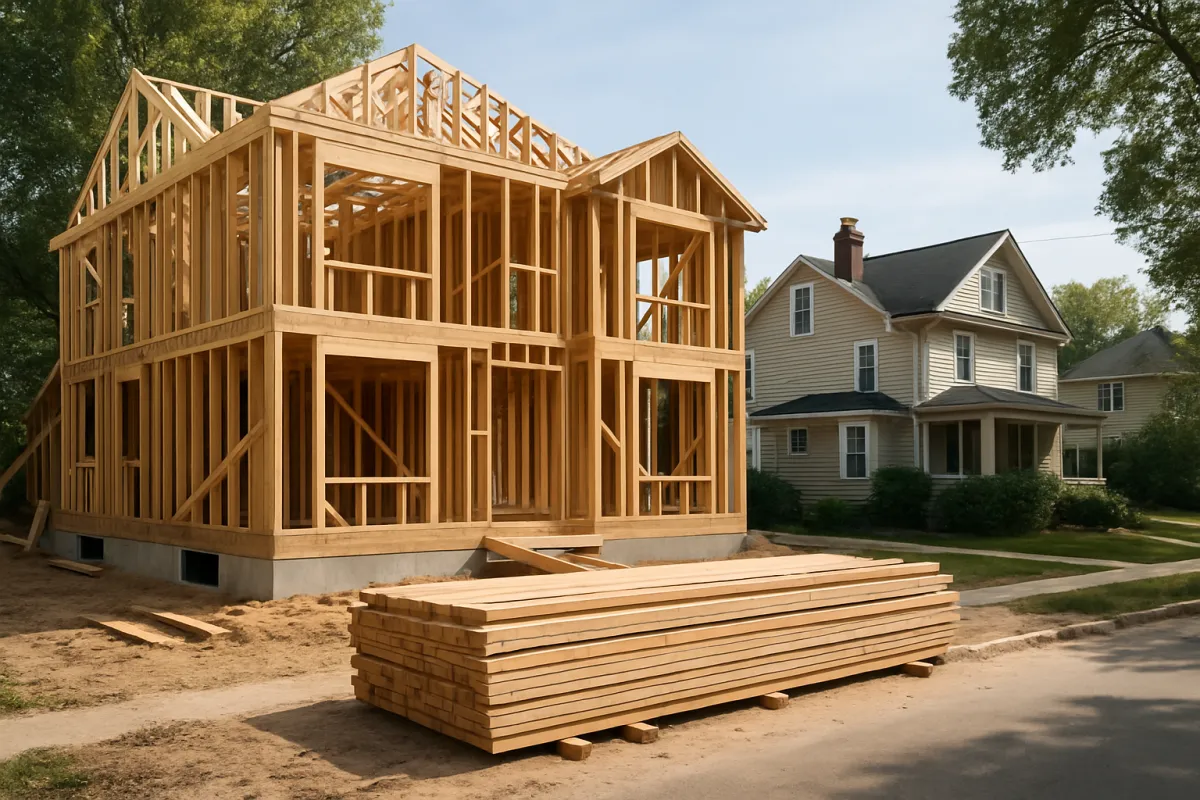
Almost every buyer reaches the same fork early and passes through it without really deciding: a model home in a new community on one side, a twenty five year old house on an established street on the other. The two look like the same purchase wearing different finishes. They are not. They run on different contracts, different negotiating logic, different inspection timing, different risk calendars, and different cost curves after the keys change hands. A buyer who compares them on price and square footage alone is comparing the two things that matter least.
This market read works the trade honestly in both directions rather than arguing for either. It covers the builder purchase agreement and why it is not the standard form your state uses, the preferred lender incentive and how to test whether it is real, the arithmetic of design center options, the timeline and warranty structures, why a new build still deserves an inspection, and what an unfinished community actually feels like to live in. Then it turns the same attention on existing homes: the negotiating room, the mature street, and the deferred maintenance that can consume a lower sticker price entirely. Every dollar figure here is illustrative rather than a quoted average.
Key takeaways
- The builder's purchase agreement is drafted by the builder and is usually not the standard state form your agent uses, which makes independent review the highest value hour in the entire transaction.
- A builder incentive tied to the preferred lender can be genuinely worth taking, but only arithmetic against an independent quote on the same loan amount settles it, not the sales office's framing.
- Design center options carry a builder margin and, financed into the mortgage, spread that cost over decades: an illustrative $28,000 of options adds about $177 a month and roughly $63,700 of total payments at a 6.5 percent rate over 30 years.
- A new build still deserves an inspection, and it can be run at several stages, including pre drywall while the framing and rough ins are visible and again late in the first warranty year.
- Total cost, not sticker, is the fair comparison: an illustrative $45,000 sticker gap between a $440,000 build contract and a $395,000 existing home narrows to about $13,000 once $8,000 of post closing items and $40,000 of near term roof, window, and mechanical work are counted.
What the two paths actually differ on
Strip away the finishes and the differences sort into five buckets. The first is the contract, because a builder sells under its own document while an existing home sells under the form your market has standardized. The second is price behavior, because a builder defends a published base price and an individual seller defends a net proceeds figure, which changes what each will concede. The third is timing, because one purchase closes on a house that exists and the other closes on a house that has to be finished first.
The fourth is the condition curve. A new house starts with everything at year zero and a warranty period behind it; an existing house starts partway through the life of every major component, with the replacement dates already set by the calendar rather than by you. The fifth is the setting, because a finished street and a street that is still a construction site are different products regardless of what the houses cost. Those five buckets decide the trade. Square footage and countertop material do not.
The builder’s purchase agreement is not the standard form
This is the single most important and least known fact in the whole comparison. When you buy an existing home, your agent typically writes on a standardized purchase agreement produced by a state association or a state agency, refined over decades, with allocations of risk that both sides recognize. When you buy from a builder, you sign the builder’s own document, drafted by the builder’s counsel to protect the builder. Both are legal, both are normal, and only one of them was written with your interests in mind.
The practical difference shows up in the terms buyers assume are universal. Deposit handling, what happens if you cannot obtain financing, who controls the closing date, what remedies exist if completion runs late, how change orders are priced, what the warranty replaces, how disputes are resolved, and what happens if you walk away are all set by that document rather than by custom. None of it is necessarily unfair. All of it is unfamiliar. Treat the contract as the product you are actually evaluating and have it reviewed by a real estate attorney before you sign, in every market where attorney review is customary or permitted.

What to read first inside a builder contract
Reviewing a builder contract cold is daunting, so work it in order of consequence. Start with the completion and delivery terms: what date is promised, what qualifies as a permitted delay, and what your remedy is if the date passes. Then read the deposit terms, since builder deposits are often larger than the earnest money in a resale and are not always held on the same terms. Our explainer on real estate contingencies describes the protections a standard resale contract usually carries, which gives you a checklist for what may be absent here.
Next, read the financing terms, including whether the contract makes your obligation conditional on obtaining a loan and on what schedule. Then the change order and option pricing terms, which govern what happens when you change your mind about an option or the builder substitutes a material. Then the warranty and dispute resolution sections. Then the specification list, which is the document that actually defines what you are buying. A specification list that says “builder’s standard” without describing it is telling you something worth asking about.
The builder’s preferred lender and the incentive attached to it
Most large builders either own a mortgage affiliate or maintain a preferred lender relationship, and most attach an incentive to using it: a closing cost contribution, an option credit, a rate buydown, or some combination. Sales offices present this as a benefit, and it frequently is one. It is also a marketing spend that has to be evaluated like any other, because the incentive is only worth what it leaves in your pocket after the rate and fees on that loan are compared with an independent offer.
Two things are worth knowing before that conversation. First, you are generally entitled to choose your own lender, and an incentive conditioned on the preferred lender is a discount, not a requirement to finance there. Second, the comparison has to be run on the same loan amount, the same day, and the same product, because rate quotes move and a stale comparison proves nothing. Our note on choosing between a mortgage broker and a bank sets out how to line two offers up honestly, and the same method works here with the builder’s affiliate as one of the two.
How to test whether a builder incentive is real
Run the arithmetic on your own numbers rather than accepting or rejecting the offer on principle. Take an illustrative $440,000 contract with 20 percent down, so a $352,000 loan. Suppose the builder offers $12,000 toward closing costs through its affiliate at 6.75 percent, while an independent lender quotes 6.5 percent with no such credit. At 6.5 percent that loan costs about $2,225 a month in principal and interest; at 6.75 percent it costs about $2,283. The rate difference is roughly $58 a month.
Now divide. The $12,000 credit covers about 205 months of that $58 difference, which is somewhere near seventeen years. Over a realistic seven year hold, the extra rate costs about $4,900 and the credit is worth $12,000, so the incentive is ahead by roughly $7,100. On those inputs, taking it is defensible. Change the inputs and the answer changes: a half point rate gap instead of a quarter point roughly doubles the monthly cost and cuts the breakeven in half, and a smaller credit does the same. The test is the division, not the instinct.
The design center and the arithmetic of upgrades
The design center is where a new build purchase quietly grows. You arrive having agreed a base price and leave having agreed a larger one, item by item, in an environment designed to make each individual decision feel small. The honest description is that options at a design center generally carry a builder margin above what the same work costs arranged separately, sometimes a substantial one, and that the margin is not visible on any line of the selection sheet. That is not a scandal. It is how the model works, and it is why the base price could be as low as it was.
The useful discipline is to sort options by whether they are hard to add later. Structural changes, additional rough ins, electrical runs, window placement, insulation upgrades, and anything that will end up behind drywall belong on the buy now side, because retrofitting them later means opening finished surfaces. Flooring, fixtures, cabinet hardware, backsplash, lighting, mirrors, and paint are far easier to change after closing, at a price you control, on a schedule you set. Sorting by that test rather than by desire usually reduces the option total sharply.
What financing an upgrade costs over thirty years
Options folded into the purchase price are financed like the house, and that changes what they cost. Take an illustrative $28,000 of design center selections at a 6.5 percent rate over 30 years. That adds about $177 a month to the payment. Over the full term it adds roughly $63,700 of total payments, of which about $35,700 is interest. The selection sheet showed $28,000; the mortgage shows something over twice that if you carry the loan to term.
Widen it to include a lot premium. If the base is $404,000 and the contract adds $28,000 of options and an $8,000 lot premium, the contract price is $440,000 and the amount above base is $36,000. Financed on the same terms, that $36,000 costs about $228 a month, about $81,900 over 30 years, and about $45,900 in interest. None of that means the options are a mistake. It means the price of an option is its number multiplied by the way you are paying for it, and the same $36,000 paid from savings after closing costs $36,000. Run both versions through the affordability calculator before the selection appointment, not after.

Where an illustrative new construction spend goes
The base price is the number in the advertisement and the smallest of the numbers that matter. The chart below breaks down the money that sits above an illustrative $404,000 base on the way to a first year total of $448,000.
Where the money above the base price goes on an illustrative new build
An illustrative $44,000 above a $404,000 base price. Segments sum to 100 percent. Your builder, community, and selections will produce different shares.
Shares sum to 100 percent of the $44,000 above base and are illustrative rather than surveyed. The first two segments total $36,000 and sit inside the $440,000 contract; the third lands after closing and is usually paid in cash rather than financed.
Read the chart as a warning about which number you are comparing. A buyer weighing a $404,000 base against a $395,000 existing home is looking at a $9,000 gap that does not exist. The comparable figure is $448,000, because the lot premium was chosen at the sales office, the options were chosen at the design center, and the post closing items were chosen by the fact that the house arrives without window coverings, a fence, or rear landscaping. Only the third segment is genuinely optional in the short run, and even that one tends to get spent within the first year of ownership.
What the builder contract does not include
The exclusions are consistent enough across the industry to plan for, even though the specific list varies by builder and market. Window coverings are the classic one, because a house with no blinds anywhere is both a privacy problem and a several thousand dollar problem on the first weekend. Fencing is another, often complicated further by community rules on style and height. Rear landscaping is frequently a builder allowance covering less than the finished yard costs. Gutters are included in some markets and excluded in others.
Appliances vary widely, with the base specification sometimes covering a range and dishwasher while leaving the refrigerator, washer, and dryer to the buyer. Garage door openers, closet systems, ceiling fans, and mailbox or address hardware appear on exclusion lists more often than buyers expect. The way to handle all of it is to ask for the exclusion list in writing and price it before you sign, then treat that total as part of the purchase rather than as a series of surprises. In the illustrative figures used here it comes to about $8,000.
Timeline risk and what a delay clause does
An existing home closes when the parties agree. A new build closes when the house is finished, which is a different kind of promise. Weather, inspections, trade availability, material lead times, and municipal scheduling all sit between a projected completion date and an actual one, and none of them are within your control or, in many cases, fully within the builder’s. This is normal. What matters is what the contract says happens when the date moves.
Most builder agreements contain a delay provision that excuses the builder for defined categories of delay and extends the completion window accordingly. Read what those categories cover, how long the extension can run, whether there is an outside date beyond which you may cancel, and whether cancellation returns your deposit. Then price the delay yourself. A closing that slips from month seven to month ten can mean rate lock extension costs and temporary housing: at an illustrative $2,200 a month, three additional months of rent is about $6,600 that no line of the contract mentions. Ask about the current build cycle in that community and about the last few homes delivered.
What a new home warranty actually covers
New home warranties are typically layered, and the layers narrow as time passes. The common structure is a short initial period covering workmanship and finish items, an intermediate period covering distribution systems such as plumbing, electrical, heating, and cooling, and a longer period covering major structural elements only. That last layer is the one buyers remember, and it is also the narrowest, because structural coverage generally means load bearing failure rather than any problem that appears in a later year.
Three details are worth confirming in the warranty document itself rather than assuming. First, appliances and several components usually carry manufacturer warranties instead of builder coverage, with their own registration and claim requirements. Second, the claim process typically requires written notice within defined windows, and missing them can waive a claim that would otherwise have been covered. Third, many warranty documents specify how disputes are resolved, which is a term worth reading before you need it. Terms vary substantially by builder and by state law, so read the booklet for the specific home and ask your attorney about anything that reads as a waiver.
Why a new build still needs an inspection
Buyers skip inspections on new construction more often than on any other purchase, usually reasoning that the house is new and the municipality already inspected it. Both halves of that reasoning are weaker than they sound. Municipal inspection tests compliance with a code minimum on a sampling basis; it is not a room by room review performed on your behalf. And a house being new means its components have not worn out, not that they were all installed correctly. The defects found in new builds are typically installation and completion issues rather than age issues, which is exactly what an inspector is looking for.
The economics are not close. At an illustrative $500 to $550 a visit, an inspection is a rounding error against a purchase in the high hundreds of thousands, and a single missed flashing detail or an incorrectly vented appliance costs more than the fee many times over. Our step by step on how to get a home inspection covers hiring and scheduling, and the home inspection checklist covers what a thorough report should address. Ask early whether the builder permits an independent inspector and at which stages, since the answer varies and belongs in your decision.
Inspecting at more than one stage
The advantage a new build offers is that you can inspect while the house is still open. A pre drywall inspection, scheduled after framing, rough electrical, rough plumbing, and mechanical work are complete but before insulation and drywall close the walls, is the only chance anyone gets to look at those systems directly. It is the highest value inspection in a new build purchase for exactly that reason, and it is the one most commonly skipped because it happens months before closing when the purchase still feels abstract.
The second is the final or pre closing inspection, run alongside or shortly before the builder’s own walkthrough, which produces the punch list of items to be corrected. The third is an inspection late in the first warranty year, commonly around the eleventh month, while workmanship coverage is still open. That visit exists because a house reveals settling, finish, and system issues over its first seasons that no inspection at closing could have seen. Three visits at illustrative fees near $500 to $550 each is roughly $1,550 total, spread over a year, against a purchase of $448,000.
The unfinished neighborhood you buy into
The model home sits on a finished street with mature planting. The house you buy may not. Early phase buyers in an active community live with construction traffic, weekday noise starting early, dust, mud tracked onto roads, temporary utility arrangements, and streets that are still being cut and patched. That is not a defect; it is the normal condition of a community being built, and it typically resolves. The question is how long, and the honest answer requires asking how many phases remain and how many homes are still to be delivered.
Amenities deserve the same question. Pools, trails, playgrounds, and clubhouses are frequently shown on a community plan and built in later phases, and the plan is generally a representation of intent rather than a guarantee of delivery date. Ask what is built, what is under construction, what is planned, and what the association budget assumes for each. Ask the same about schools and commercial development shown on the plan, which are decided by parties other than the builder. None of this argues against buying early, since early phase pricing is often the reason to. It argues for buying with the timeline understood.

The HOA transition from builder control
Nearly every new community is governed by an association, and nearly every one of those associations begins under builder control. During that period the builder appoints the board, sets the budget, and often subsidizes operations or defers reserve funding while homes are still selling. Dues during that phase can therefore be lower than the community’s steady state cost, which is a fact worth knowing before you treat the quoted dues figure as permanent.
Control transitions to owner elected directors on a trigger written into the governing documents, commonly tied to the percentage of homes sold or to a date. That transition is the moment the community’s real budget becomes visible, and it is when dues increases and reserve funding decisions typically arrive. For a buyer, the questions are what the transition trigger is, how much of it has been reached, whether a reserve study exists, and what the budget assumes for amenities not yet built. Our explainer on what an HOA is covers dues, reserves, and assessments in depth. An illustrative $85 a month of dues displaces roughly $13,400 of loan at a 6.5 percent rate over 30 years, which is why the figure belongs in your affordability math rather than in a footnote.
What an existing home gives you that a new build cannot
Turn the comparison around, because the existing home side has real advantages that get flattened into “it is older” too easily. The first is evidence. An established street has a sales history, a known traffic pattern, known schools with actual outcomes, visible neighbors, and a shape that is already settled. Nothing has to be projected from a site plan. What you tour on a Saturday is what the street is.
The second is the physical setting. Mature trees, established landscaping, and grown in planting are worth real money and cannot be bought at any price, only waited for. The third is location, since established neighborhoods are frequently closer to employment centers, transit, and commercial services simply because they were built first, while new communities are often built where land is available, which tends to mean farther out. The fourth is layout variety. An existing market offers whatever was built over decades; a new community offers the floor plans currently on offer. For a buyer with an unusual requirement, that difference matters.
Negotiating room on an existing home
The negotiation is structurally different, and the difference favors the buyer in a way many first time purchasers miss. An individual seller is optimizing a net proceeds figure against a personal timeline, and personal timelines create leverage: a job that started in another city, a house already under contract elsewhere, a listing that has sat past the local average days on market. A builder has none of those pressures and, crucially, cannot cut a base price without setting a comparable that affects every unsold home behind it.
So the existing home path offers price concessions, repair credits, and closing cost contributions that respond to evidence such as comparable sales and inspection findings, while the new build path offers option credits and financing incentives that respond to the builder’s current sales targets. Our walkthrough on how to make an offer on a house covers building the resale offer from comparable sales rather than from the list price. On the illustrative numbers used here, negotiating $10,000 off a $395,000 existing home narrows the total cost gap against the new build from about $13,000 to about $3,000.
Deferred maintenance and the replacement horizon
Here is the cost the existing home side actually carries. Every major component of a house has a service life, and buying a house partway through those lives means inheriting the replacement dates. A twenty five year old home is typically at or past the horizon on its original roof, near it on original windows, and past it on an original furnace or air conditioner. None of that is a defect and none of it appears as a line item at closing. It appears as a series of five figure bills over the following decade.
The distinction worth holding is between deferred maintenance and normal aging. Deferred maintenance is work that should already have been done and was not, which is negotiable because it is a defect the inspection can document. Normal aging is a component quietly approaching the end of its life, which is not negotiable but is entirely predictable if you ask the age of every major system and write the answers down. Ask for the age of the roof, the furnace, the air conditioner, the water heater, the windows, and the electrical panel, and treat any answer of “original” as a date.

Illustrative near term capital costs on an existing home
Put numbers on the replacement horizon. The chart below shows an illustrative eight year capital budget for a twenty five year old house whose major components are largely original, scaled to the largest item.
Illustrative eight year capital work on a twenty five year old home
Illustrative planning figures in dollars, scaled to the roof at 100 percent. Actual costs vary enormously by market, size, material, and access.
Bars scale to the $14,000 roof illustration at 100 percent and total about $40,000 across eight years. These are planning bands for comparison, not quotes. Get local estimates for the specific house before relying on any of them.
Two readings matter. The first is the total: about $40,000 across eight years, or roughly $420 a month set aside. The second is the concentration. Roof, windows, and heating and cooling alone account for $35,000 of the $40,000, and all three are lumpy, unavoidable, and difficult to defer indefinitely once they fail. The smaller items are annoying rather than decisive. This is the honest counterweight to the new build option sheet: one path prices its extras at a design center in advance, the other prices them at a contractor’s discretion over the following decade.
The renovation costs that close the gap
Beyond replacement, there is renovation, and it is where the gap between the two paths often closes entirely. An existing home that suits you structurally but dates badly in a kitchen or bathroom presents a choice: live with it, or spend. Kitchen and bathroom work is the most common renovation and among the most expensive per square foot in the house, because it combines cabinetry, counters, plumbing, electrical, ventilation, and finish work in a small area. Flooring across a whole house is another meaningful number.
The trap is treating renovation as free upside because it “adds value.” Some of it does, unevenly and rarely dollar for dollar, and the value it adds is realized only when you sell. Meanwhile the cost is paid now, in cash or on a loan at a rate typically higher than a mortgage. The honest way to compare against a new build is to decide before you buy which renovations are conditions of living in the house rather than someday projects, then price those and add them to the purchase price. That total is the number that belongs in the comparison and in the affordability calculator.
The total cost comparison, side by side
Now put both columns together on the illustrative figures used throughout. The new build column: a $404,000 base, $28,000 of design center options, an $8,000 lot premium for a $440,000 contract, plus about $8,000 of post closing items, for a first year total near $448,000. Near term capital work is minimal, since everything is new and a warranty period is running.
The existing home column: a $395,000 purchase price plus about $40,000 of capital work across eight years, for a total near $435,000. The sticker gap between the two contracts was $45,000. The total cost gap is about $13,000, which means roughly 71 percent of the apparent gap was never real. That is the whole point of the exercise, and it cuts both ways: the existing home is still cheaper on these inputs, but by an amount small enough that the decision should turn on the street, the layout, the timeline, and the risk you prefer to carry rather than on price. Change the inputs and the ranking can flip.
A worked example: two houses over eight years
Follow one buyer through both columns. Buyer A signs the builder contract at $440,000, spends about $8,000 in the first six months on blinds, a fence, and rear landscaping, and pays illustrative association dues of $85 a month in a community still under builder control. Over eight years the major repair budget is small, though warranty coverage narrows year by year and the association’s dues rise once control transitions to owners. The purchase cost $448,000 in the first year and the maintenance calendar stayed quiet.
Buyer B buys the twenty five year old house at $395,000, negotiates $10,000 off after an inspection documents a failing water heater and aging roof, and closes at $385,000. Over the following eight years the roof, the windows, the furnace and air conditioner, the panel, and the water heater are all replaced, for about $40,000. The total is about $425,000, roughly $23,000 below Buyer A. Buyer B also lived through three separate renovation projects; Buyer A lived beside an active construction site for two years. Neither made the wrong choice. They bought different risks, and both should have run their own numbers through the affordability calculator before signing.
How each path changes the closing
The mechanics of closing differ enough to plan for. On a resale, the closing date is negotiated and the sequence is familiar, as described in our walkthrough of what happens at a home closing. On a new build, closing waits on the certificate of occupancy, which means the date can move late in the process, sometimes within days. Rate locks are the usual casualty. Longer locks and extended lock products exist for exactly this reason and typically cost more, so ask about lock strategy at application rather than at week thirty.
Two other differences are worth noting. First, appraisal timing works differently when the house is not finished, and the contract may address what happens if the appraisal comes in below the contract price. Second, closing cost structure can differ, particularly where the builder contributes toward costs as part of an incentive and where title work is handled by an affiliate. Compare the closing disclosure against your loan estimate carefully in either path, and give yourself time to ask questions before the day itself.
Which buyer each path suits
Patterns are not rules, but they help. New construction tends to suit a buyer who values predictability of maintenance over predictability of setting, who can wait for completion, who wants current construction methods and a warranty period, who is comfortable reading and negotiating a contract written by the other side, and who will hold long enough to see the community finish. It suits less well a buyer on a hard deadline, a buyer who needs to know exactly what the street will be, or a buyer who will spend heavily at the design center on items they could add later for less.
An existing home tends to suit a buyer who wants an established location, who can absorb lumpy capital costs, who values negotiating leverage and a documented sales history, and who is willing to manage contractors. It suits less well a buyer with no cash reserve behind the down payment, since the replacement horizon does not wait for convenience. The test is not which house is better. It is which risk you would rather be holding in year five.
The bottom line
New construction versus existing home is a trade, not a ranking, and the trade is obscured by the two numbers buyers compare first. On the new build side, the contract is written by the builder rather than by your state’s standard form, which makes independent review the highest value hour in the purchase; the preferred lender incentive is worth arithmetic rather than reflex; the design center prices options at a margin and financing them spreads that cost across decades; the timeline carries real risk written into a delay clause; the warranty narrows sharply by layer; an inspection is still worth running, ideally at several stages; and the community arrives unfinished, with an association still under builder control. On the existing home side, you get negotiating room, a settled street, mature planting, and a lower price that a roof, a heating and cooling system, and a set of windows can consume in eight years. On the illustrative figures here, a $45,000 sticker gap becomes a $13,000 total cost gap. Run your own two candidates the same way, all in, over the years you actually plan to own, and the fork stops being a matter of taste.
This market read is published for general education about how new construction and resale purchases are structured, and it is not legal, tax, lending, construction, or real estate advice for any particular transaction. Builder contract terms, warranty structures, association transition rules, inspection access, disclosure obligations, and attorney review customs differ by builder, by community, and by state, and they are revised over time, so nothing above should be read as a statement of what your own contract or your own state provides. Every price, option cost, repair estimate, dues amount, rate, and payment figure used here is an illustrative planning number chosen to demonstrate a method, not a quote, a surveyed average, or a prediction of what any home will cost. Before acting on any of it, read the actual purchase agreement, specification list, warranty booklet, and association documents for the specific home, obtain written estimates for any repair or renovation you are pricing, and consult a licensed real estate attorney where attorney review is customary, together with your own lender, inspector, and agent.
Frequently asked questions
Is new construction more expensive than an existing home?
On the sticker, usually yes, but the sticker is the wrong comparison. A new build carries a base price plus design center options, a lot premium, and a set of post closing items the contract never included, while an existing home carries a lower price plus whatever capital work its systems are due for. In the illustrative comparison used throughout this market read, a $440,000 builder contract plus $8,000 of post closing items runs $448,000, while a $395,000 existing home plus $40,000 of near term roof, window, and mechanical work runs $435,000. The $45,000 sticker gap narrows to about $13,000, which is a very different decision from the one the listing prices suggested. Every figure there is illustrative and your own two candidates will produce their own answer.
Can you negotiate the price of a new construction home?
Price itself is usually the least negotiable term, because a builder who cuts a base price sets a recorded comparable that affects every remaining home in the community. What builders do negotiate is value delivered another way: option credits, closing cost contributions, a rate buydown, appliance packages, fencing, or landscaping. That is why comparing a new build against an existing home on price alone misreads the negotiation entirely, since one seller is defending a number and the other is defending a net. Ask what the builder is currently offering rather than what it will take off the price, and get every concession written into the contract or an addendum rather than promised at the sales office. Availability and terms vary by builder, community, and phase of construction.
Do I need a home inspection on a new construction home?
A new build is inspected by the municipality for code compliance, which is a different exercise from an inspection performed for you. Code inspection asks whether the work meets a minimum standard; your inspector asks whether the work was done correctly and completely on the specific house you are buying. Buyers commonly arrange a pre drywall inspection while framing, wiring, and plumbing are still visible, a final inspection before closing, and a further visit late in the first warranty year while builder obligations are still open. At an illustrative $500 to $550 a visit, that is roughly $1,550 spread across three appointments on a purchase measured in hundreds of thousands, and our walkthrough on how to get a home inspection covers the mechanics. Fees, availability, and the access a builder permits vary.
Should I use the builder's preferred lender?
Sometimes, and the way to find out is arithmetic rather than instinct. Builders often attach a meaningful incentive to their affiliated or preferred lender, and that incentive can be genuinely worth taking, but it has to be weighed against the rate and fees that lender quotes compared with an independent offer on the same loan amount and the same day. In the illustrative example used here, a $12,000 closing cost incentive against a rate a quarter point higher on a $352,000 loan costs roughly $58 a month, so the incentive stays ahead for something like seventeen years and is clearly ahead over a realistic seven year hold. Reverse those inputs and the answer reverses too. Our comparison of a mortgage broker against a bank explains how to put two offers side by side, and you are entitled to shop regardless of what the sales office implies.
What does a new home warranty actually cover?
New home warranties are typically layered rather than single. A short initial period commonly covers workmanship and finish items, an intermediate period commonly covers distribution systems such as plumbing, electrical, heating, and cooling, and a longer period commonly covers major structural elements only. The practical consequences are that the coverage narrows sharply as time passes, that appliances and some components usually carry their own manufacturer warranties instead, and that the claim process, notice requirements, and dispute resolution terms are written into the warranty document rather than assumed. Read the actual warranty booklet for the home you are buying before closing, note the dates each layer expires, and confirm what the builder requires you to do to keep coverage valid. Terms differ substantially by builder and by state law.
Are upgrades worth it in a new build?
Some are, most are a financing decision disguised as a decorating decision. Options priced at a design center generally carry a builder margin, and financing them into the mortgage spreads that cost across thirty years rather than paying it once. On an illustrative $28,000 of design center options at a 6.5 percent rate over 30 years, the added payment is about $177 a month and the total paid is roughly $63,700, of which about $35,700 is interest. The honest test is which options are genuinely hard to add later, such as structural changes, rough ins, and anything behind a wall, and which are simply convenient to add now, such as flooring, fixtures, and cabinet hardware. Prices, margins, and rates are illustrative and vary widely.
What are the hidden costs of buying new construction?
They are less hidden than unlisted. The common ones are a lot premium for a preferred position, design center options above the base specification, window coverings, fencing, rear landscaping, gutters in some markets, appliances the base plan excludes, and a community association whose dues begin at closing and often rise as amenities come online. In the illustrative figures used in this market read, those post closing items total about $8,000 on top of a $440,000 contract. Add the possibility of a delayed completion, which can mean rate lock extension costs and temporary housing. None of this makes a new build a bad purchase; it means the base price is a starting point rather than a total, and the total is what belongs in your affordability math.
Is an older home a better investment than a new build?
Neither path is inherently the better investment, and any confident claim in either direction is usually selling something. An established neighborhood offers a visible sales history, mature landscaping, known schools and traffic patterns, and a seller who can be negotiated with, while carrying dated systems that will need replacing on a schedule you inherit. A new build offers current construction methods, a warranty period, and lower near term repair exposure, while carrying option pricing, an unfinished community, and an association still under builder control. What actually drives the outcome is location, price paid relative to comparable sales, how long you hold, and how much capital work each home demands. Treat both as purchases first and investments second, and confirm local conditions with a qualified real estate professional.

Hamza Hai is the editor of AbodeWave. She holds an MBA and reviews the site's articles against our editorial standards, checking that every figure is labelled for what it is, that nothing is presented as verified fact without a source the reader can check, and that the writing stays useful to a non-specialist.